Leptogorgia hebes
A soft coral with a horny skeleton and variable coloration.

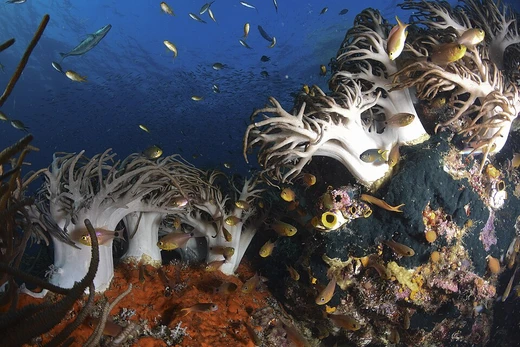
Leptogorgia hebes, called the regal sea fan or false sea fan, is a soft coral from the Gorgoniidae family. It was once placed in the genus Lophogorgia, but that group has since been dissolved. This colonial animal forms a fan-like structure that usually grows in a single plane, with dense branching. Its color varies, typically appearing in shades of red, orange, or deep yellow, though purple colonies are sometimes found.
The colony reaches about 6 inches (15 cm) tall. Its core is a flexible, horny skeleton made of a protein called gorgonin, covered by a thin living layer called coenenchyme. Tiny, calcified sclerites shaped like capstans and rods are embedded in this tissue, strengthening it and making the coral unappealing to most predators. The polyps, which are white, extend from slit-like openings in small, hemispherical calyces along the branches. Each polyp has eight feathery tentacles and eight internal partitions, and can retract into its calyx. A single siphonoglyph—a channel for water intake—serves the whole colony. Because the skeleton is not rigid, the entire fan sways with water movement.
This species lives in the western Atlantic Ocean, from Chesapeake Bay, Georgia, and Florida through the Gulf of Mexico, and down to the coasts of Venezuela and Brazil. It inhabits shallow reefs at depths between 25 and 130 feet (7.6 to 39.6 m). It tolerates low salinity levels (26 to 36 parts per thousand) and moderate wave action, usually growing on limestone or rock ledges.
To feed, the polyps extend their tentacles to capture plankton and small organisms from the water. Individual colonies are either male or female. Females begin breeding at two years old, while males do not start until age six. In a study from the Gulf of Mexico, where this coral is a dominant species on shallow reefs, female gonads started developing in January and male gonads in April. Both matured by August, when eggs and sperm were released into the water in a synchronized spawning event. The trigger for spawning was unclear, but may have been linked to the full moon.
The regal sea fan is part of a diverse reef community. Amphipods like *Ericthonius brasiliensis* climb on its branches to feed from an elevated position. The skeleton shrimp *Caprella equilibra* grips the fan with its rear limbs, resembling a piece of attached seaweed.
Quick Facts
- Taxon
- Leptogorgia hebes
Facts from the source article.
Lore & Background
The regal sea fan has a horny axial skeleton made of gorgonin, covered with coenenchyme from which polyps protrude. Embedded in the coenenchyme are minute capstan-shaped and rod-shaped calcified sclerites that strengthen the tissue and deter predators. The skeleton is not rigid, allowing the fan-like structure to sway with water movement. Polyps are white, project from slit-shaped openings in hemispherical calyces, and each has eight pinnate tentacles and eight mesenteries; the whole colony has a single siphonoglyph.
It is found in the western Atlantic from Chesapeake Bay, Georgia, and Florida to the Gulf of Mexico and off Venezuela and Brazil, on shallow reefs at depths of 25 to 130 feet. It grows on limestone or rock ledges and tolerates low salinity and moderate wave action.
Individual colonies are either male or female. Females start breeding at age two, males at age six. In a Gulf of Mexico study, female gonads developed in January, male gonads in April, and both became ripe in August for a synchronized spawning event possibly linked to the full moon.
Reader's Guide
The regal sea fan is a dominant member of shallow reef communities in the Gulf of Mexico, contributing to biodiversity. Its dense branching provides habitat for amphipods such as Ericthonius brasiliensis, which climb the branches for an elevated feeding position. The skeleton shrimp Caprella equilibra grasps the fan with its posterior appendages, resembling attached seaweed. Predators include the sea whip slug Tritonia wellsi, which feeds on soft tissues and is disguised by cerata that resemble the fan's polyps, and the sea whip shrimp Neopontonides beaufortensis. The coral's sclerites make it distasteful to most predators. Its tolerance of low salinity and moderate wave action allows it to occupy specific reef niches. The species' reproductive strategy—with females maturing earlier than males and synchronized spawning in August—reflects adaptation to its environment, though the exact trigger for spawning remains uncertain.
Did You Know?
- The regal sea fan was formerly placed in the genus Lophogorgia, which has since been dismantled.
- Its skeleton is made of a fibrous protein called gorgonin, not calcium carbonate.
- Female colonies begin breeding at age two, while males do not until age six.
- The sea whip slug Tritonia wellsi is disguised by cerata that resemble the sea fan's polyps.
More in Soft Corals and Leathers, Part 2 1-24
Spotted an error? Know more?
Reader corrections go straight into our review queue. Suggest an edit · How this site is sourced