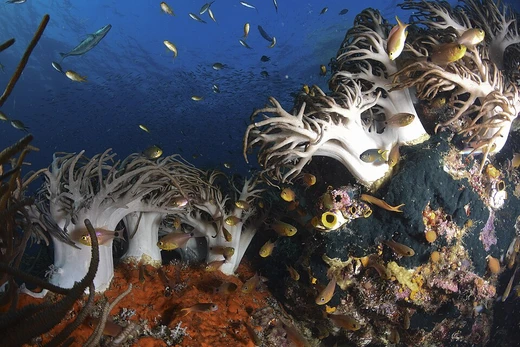
Iciligorgia schrammi
Largest sea fan, found in tropical Atlantic waters.

Iciligorgia schrammi, also called the deepwater sea fan or black sea fan, belongs to the gorgonian family Melithaeidae. It holds the title of the largest sea fan, with fully grown individuals far exceeding the size of other gorgonians. Its branches split in two repeatedly, all within a single flat plane, and are spaced much more widely than those of other sea fans, giving larger specimens a scraggly, uneven look—though smaller ones don’t appear this way. The main branches are somewhat flattened, measuring 3 to 5 millimeters wide. The polyps stick out from the edges of the branches, each housed in a dome-shaped calyx with eight separate lobes. These polyps are reinforced by sclerites—curved spindles and rods arranged in a collar with pointed projections. The fan’s color ranges from light brown to bright red. In its habitat, several brittle stars have been found living alongside it.
This sea fan lives in tropical parts of the Atlantic Ocean, from south Florida down to Brazil, including the Caribbean Sea and the Gulf of Mexico. A single specimen turned up in 2007 off Georgia in the South Atlantic Bight, marking a northward range extension. It typically grows at depths between 3 and 368 meters, often on vertical walls where it stands out perpendicularly, and also in clear, deep water with strong currents on slope breaks. The species was first described in 1870 by French naturalist Édouard Placide Duchassaing de Fontbressin.
Quick Facts
- Taxon
- Iciligorgia schrammi
Facts from the source article.
Lore & Background
Iciligorgia schrammi was first described in 1870 by the French naturalist Édouard Placide Duchassaing de Fontbressin. It is found in tropical parts of the Atlantic Ocean, from south Florida southwards to Brazil, and in the Caribbean Sea and the Gulf of Mexico. A single specimen was found in the South Atlantic Bight in Georgia in 2007, representing a northward extension to its range.
This species is dichotomously branched in a single plane, with branches much further apart than other sea fans, giving large specimens a ragged appearance; small specimens do not give this impression. The main branches are somewhat flattened, 3 to 5 millimetres in width. The polyps protrude from the edges of the branches, with dome-shaped calyces having eight separate lobes. The polyps are stiffened with sclerites, which are curved spindles and rods arranged as a collar with pointed projections. The colour is usually light brown to bright red. Several brittle stars were associated with it in its habitat.
Iciligorgia schrammi normally grows at depths from 3 to 368 metres. It lives on vertical walls, standing out perpendicularly, and can also grow in deep water where the water is clear and the current high on slope breaks.
Reader's Guide
Iciligorgia schrammi holds significance as the largest of the sea fans, with large specimens much bigger than other gorgonians. Its distinctive ragged appearance, due to widely spaced branches in a single plane, sets it apart from other sea fans. The species was first described in 1870 by French naturalist Édouard Placide Duchassaing de Fontbressin, and its distribution spans the tropical Atlantic from south Florida to Brazil, including the Caribbean Sea and Gulf of Mexico. A notable northward range extension was recorded with a single specimen found in the South Atlantic Bight in Georgia in 2007. Its habitat includes vertical walls and deep, clear water with high current on slope breaks, at depths from 3 to 368 metres. The polyps, stiffened with sclerites arranged as a collar with pointed projections, and the association of several brittle stars in its habitat, contribute to its ecological context. The species is also known by the common names deepwater sea fan and black sea fan.
More in Soft Corals and Leathers, Part 2 1-24
Spotted an error? Know more?
Reader corrections go straight into our review queue. Suggest an edit · How this site is sourced