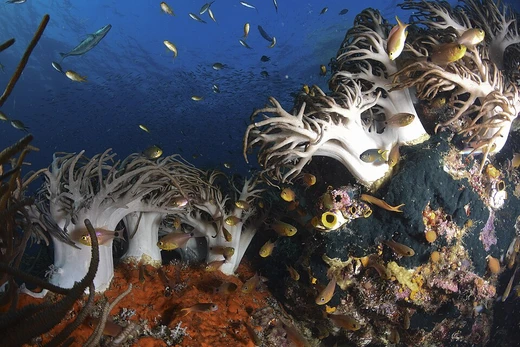
Gorgonia ventalina
A fan-shaped octocoral found in western Atlantic and Caribbean waters.

Gorgonia ventalina, also called the common sea fan or purple sea fan, belongs to the octocoral family Gorgoniidae. It grows as a fan-shaped colony with several main branches and a lattice of smaller connecting branches. Its skeleton is made of calcite and gorgonin, a collagen-like material. The polyps sit in calyces arranged in two rows along the branches. Many of the smaller branches are flattened within the fan’s plane, a feature that sets it apart from the Venus sea fan (Gorgonia flabellum). Small accessory fans often sprout sideways from the main fan. It can reach 1.5 meters (5 feet) tall and varies in color, appearing whitish, yellow, or pale purple. The main branches are often purple, and the fan aligns perpendicular to the current.
This sea fan lives in the western Atlantic Ocean and the Caribbean Sea, from Bermuda, Florida, and the Gulf of Mexico down to Curaçao. It grows near shore in shallow water where wave action is strong, and on deeper outer reefs with strong currents, down to about 15 meters (49 feet).
G. ventalina is a filter feeder. Each polyp extends eight tentacles to catch drifting plankton. Its tissues host symbiotic dinoflagellates of the genus Symbiodinium, which photosynthesize and provide organic carbon compounds to the coral. The skeleton contains hard sclerites that predators find unpalatable, and the tissues also hold distasteful secondary metabolites. The nudibranch Tritonia hamnerorum is not deterred by these defenses and is often found on the coral. While feeding, it concentrates the compound julieannfuran from G. ventalina in its own tissues, making itself unpleasant to predators.
The coral is sometimes attacked by the fungus Aspergillus sydowii, causing aspergillosis that leads to damaged patches, galls, purple discoloration, and death. Several outbreaks have occurred in the Caribbean, especially on corals under stress, such as those in low-salinity estuarine waters. A parasite from the class Labyrinthulomycetes, family Thraustochytriidae, causes similar purple spots called multifocal purple spots. A study in the U.S. Virgin Islands found that G. ventalina has high ecological resilience, with populations maintaining their density after two hurricanes in 2017.
Quick Facts
- Taxon
- Gorgonia ventalina
Facts from the source article.
Lore & Background
Gorgonia ventalina forms a fan-shaped colonial coral with several main branches and a latticework of linking smaller branches. Its skeleton is composed of calcite and gorgonin, a collagen-like compound. The calyces containing the polyps are arranged in two rows along the branches, and many smaller branches are compressed in the plane of the fan, distinguishing it from the Venus sea fan (Gorgonia flabellum). It often has small accessory fans growing sideways from the main fan. The fan is orientated at right angles to the current, and its color varies from whitish, yellow, or pale purple, with main branches often purple.
This species is a filter feeder; each polyp extends eight tentacles to catch plankton drifting on the current. Its tissues contain symbiotic dinoflagellates of the genus Symbiodinium, which are photosynthetic and provide organic carbon compounds to the host. The skeleton contains hard sclerites that are unpalatable to predators, and its tissues also contain distasteful secondary metabolites. The nudibranch Tritonia hamnerorum is often found associated with the coral, feeding on it and sequestering the chemical compound julieannfuran from G. ventalina to use as a chemical deterrent against predators.
The coral is sometimes attacked by the fungus Aspergillus sydowii, causing aspergillosis with damaged patches, galls, purpling of tissues, and even death. Epizootics have occurred in the Caribbean on corals in stressful conditions such as low-salinity water in estuaries. A parasite of the class Labyrinthulomycetes in the family Thraustochytriidae has been found to cause similar damaged purple patches called multifocal purple spots. A study in the U.S. Virgin Islands showed that G. ventalina has high ecological resilience, maintaining its densities after two hurricanes in 2017.
Reader's Guide
Gorgonia ventalina is a significant component of western Atlantic and Caribbean reef communities, serving as a filter feeder that captures plankton from passing currents. Its symbiotic relationship with photosynthetic dinoflagellates (Symbiodinium spp.) links it to primary production in shallow waters. The species exhibits chemical and structural defenses against predation, including unpalatable sclerites and secondary metabolites, which are exploited by the nudibranch Tritonia hamnerorum that sequesters the compound julieannfuran for its own protection. The coral is vulnerable to disease, notably aspergillosis caused by the fungus Aspergillus sydowii, which has led to epizootics in stressful environments such as low-salinity estuaries. Additionally, a Labyrinthulomycetes parasite produces similar purple lesions. Despite these threats, a study in the U.S. Virgin Islands demonstrated high ecological resilience, with populations maintaining densities after two hurricanes. The species' fan-shaped morphology, orientation perpendicular to currents, and variable coloration (whitish, yellow, or pale purple) are key identifying features, with the compressed smaller branches distinguishing it from Gorgonia flabellum. Its distribution spans from Bermuda and Florida through the Gulf of Mexico to Curaçao, in shallow waters with strong wave action or deeper outer reefs with strong currents down to about 15 meters.
Did You Know?
- Gorgonia ventalina grows to 1.5 m (5 ft) tall and is variable in color, being whitish, yellow, or pale purple.
- The nudibranch Tritonia hamnerorum sequesters the chemical compound julieannfuran from G. ventalina to deter predators.
More in Soft Corals and Leathers, Part 2 1-24
Spotted an error? Know more?
Reader corrections go straight into our review queue. Suggest an edit · How this site is sourced