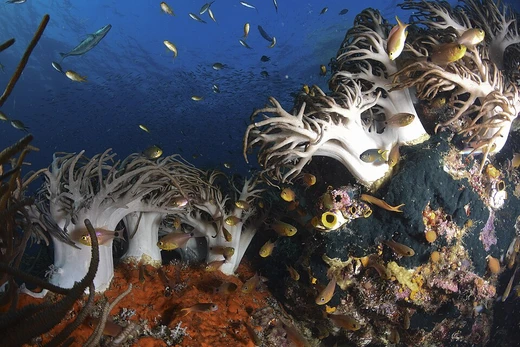
Gorgonia mariae
Smallest sea fan in the Caribbean, with a net-like branching structure.

Gorgonia mariae, known as the wide-mesh sea fan, is a soft coral that lives attached to the seafloor. It is a colonial, sessile species belonging to the family Gorgoniidae. Found in the tropical western Atlantic Ocean and the Caribbean Sea, it inhabits depths down to roughly 50 meters (160 feet).
This sea fan is the smallest in the Caribbean, reaching about 30 centimeters (12 inches) tall. Its branching structure is mostly flat, and as it grows, the branches fuse together to form a net. The branches are only slightly flattened, with side branches arranged like feathers. Color varies: most specimens are whitish, some are yellow, and a violet tint often appears near the base. Two other growth forms exist in the region. One has many short, free branches on one or both sides of the net. The other, usually bright yellow, has a net-like lower section while the upper and outer parts have free branches. The main stem and branches are supported by a flexible, nearly unbreakable rod made of gorgonin, which is partly calcified. This allows the fan to brace itself and sway with currents, letting its polyps expand to feed.
The species anchors to the seabed in moderately deep water, from about 5 to 47 meters (20 to 150 feet) deep.
In reproduction, gametes are released into each polyp’s body cavity and then expelled through the mouth into open water, where fertilization occurs. The fertilized egg becomes a planktonic planula larva. Before settling, the larva develops tentacles, septa, and a pharynx. It then attaches by its aboral (non-mouth) end and transforms into a juvenile sea fan.
In 1995, a disease struck Caribbean gorgonians, particularly affecting *Gorgonia flabellum* and *Gorgonia ventalina*. The cause was a terrestrial fungus, *Aspergillus*, which also infected *G. mariae*. Symptoms included tissue dieback, abnormal tufts of growth, and purpling of affected areas. The disease ranged from mild to severe, sometimes leading to full recovery and other times causing mass deaths. *Aspergillus sydowii*, a common soil fungus, had not previously been known to affect marine invertebrates.
Quick Facts
- Taxon
- Gorgonia mariae
Facts from the source article.
Lore & Background
Gorgonia mariae is the smallest sea fan in the Caribbean, reaching a height of about 30 cm. Its much-branched structure is mostly two-dimensional, and as it enlarges, the branches become cross-connected to form a net. The branches are only slightly compressed and the side branches are pinnately divided. Color varies; most specimens are whitish, others are yellow, and often some violet color is seen near the base. Two other growth forms exist in the Caribbean: one has many short, free branches on one or both faces of the net; the other, usually bright yellow, has the lower part of the colony anastomising and net-like, while the upper and outer parts have free branches. The supporting axial rod in the main stem and branches is formed of gorgonin, calcified to some extent, a flexible and almost unbreakable material, enabling the gorgonian to brace itself and sway with the current so that the polyps can expand to feed.
Reader's Guide
Gorgonia mariae is significant as the smallest sea fan in the Caribbean, with a distinctive net-like growth form. Its flexible axial rod of gorgonin allows it to withstand currents while feeding. The species is native to the tropical western Atlantic Ocean and Caribbean Sea, anchored to the seabed at depths from about 5 to 47 m. In 1995, a disease caused by the terrestrial fungus Aspergillus sydowii affected gorgonians in the Caribbean, including G. mariae. Symptoms included tissue dieback, abnormal tufts of growth, and some purpling of affected areas. The disease varied in severity from mild to severe, with full recovery occurring on some occasions and mass deaths on others. This was notable because Aspergillus sydowii, a common soil species, had not previously been known to affect marine invertebrates. The species reproduces by shedding gametes into the coelenteron of each polyp, which pass through the mouth into the open sea for fertilization; the resulting planula larva is planktonic, with tentacles, septa, and pharynx developing before settlement.
Did You Know?
- Gorgonia mariae is the smallest sea fan in the Caribbean, growing to about 30 cm tall.
- Its axial rod is made of gorgonin, a flexible and almost unbreakable material.
- In 1995, it was affected by a disease caused by the terrestrial fungus Aspergillus sydowii.
- The species sheds gametes into the coelenteron, where they are released into the open sea for fertilization.
More in Soft Corals and Leathers, Part 2 1-24
Spotted an error? Know more?
Reader corrections go straight into our review queue. Suggest an edit · How this site is sourced