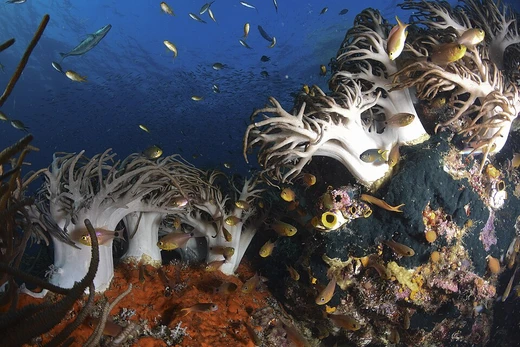
Gorgonia flabellum
A colonial soft coral forming a delicate, single-plane fan.

Gorgonia flabellum—known by several common names, including Venus fan, Venus sea fan, West Indian sea fan, purple gorgonian seafan, and common sea fan—is a type of sessile colonial soft coral. Its delicate, fan-like shape comes from a lattice of branches that all lie in a single plane, and the fan often positions itself perpendicular to oncoming waves. It can grow up to 1.5 meters tall.
In appearance, the Venus sea fan resembles *Gorgonia ventalina*, but it tends to look slightly messier, with short, stubby side growths that project out of the main plane. A key difference is in branch shape: in *G. flabellum*, the branches are flattened at right angles to the fan’s plane, whereas in *G. ventalina* they are either round or flattened parallel to it. Another similar species, the wide-mesh sea fan (*Gorgonia mariae*), is smaller—only about 30 centimeters—and many of its branchlets do not connect with one another. The Venus sea fan can be white, yellowish, or pale lavender.
This species is very common in the Bahamas, where it is easy to tell apart from *G. ventalina*. Elsewhere in its range—Florida and the Lesser Antilles—the two are more easily confused. It lives in shallow water, rarely deeper than 10 meters, and prefers spots with strong wave action.
The skeleton of the Venus sea fan is made of calcite mixed with a collagen-like substance. Embedded within this skeleton are the coral polyps, each of which is a filter feeder that extends eight tentacles to catch drifting plankton. The coral’s tissues also contain symbiotic dinoflagellate algae (*Symbiodinium* spp.), which photosynthesize and produce organic carbon compounds that the host coral uses.
Several pathogens threaten the Venus sea fan. Cyanobacteria—especially filamentous Oscillatoriales—can overgrow the coral, causing tissue necrosis and damaging its structure. Infections by the fungus *Aspergillus* have also been linked to large-scale tissue loss, particularly in larger colonies and deeper waters.
Quick Facts
- Taxon
- Gorgonia flabellum
Facts from the source article.
Lore & Background
The Venus sea fan is a colonial soft coral that grows from a small base into several main branches with side branches and a network of small branchlets, forming a fan composed of a lattice in a single plane. It is similar in appearance to Gorgonia ventalina but has a slightly more untidy shape and short, stubby side growths protruding from the main plane. In G. flabellum, the branches are flattened at right angles to the plane of the fan, whereas in G. ventalina, branches are either round or flattened parallel to the fan. The wide-mesh sea fan (Gorgonia mariae) is also similar but smaller, at only 30 centimeters, and many of its branchlets do not interconnect.
The Venus sea fan is very common in the Bahamas, where it is easily distinguishable from G. ventalina, but in Florida and the Lesser Antilles the two species are more easily confused. It is a shallow-water species seldom exceeding a depth of 10 meters and favors locations with strong wave action. The skeleton is composed of calcite and a collagen-like substance, with embedded coral polyps that are filter feeders, extending eight tentacles to catch plankton. Its tissues contain symbiotic dinoflagellate algae Symbiodinium spp., which photosynthesize and provide organic carbon compounds to the host.
Reader's Guide
Gorgonia flabellum is significant as a common and visually distinctive sea fan in shallow Caribbean waters, particularly in the Bahamas, where it is easily distinguished from the similar Gorgonia ventalina. Its fan-shaped growth, oriented perpendicular to wave action, reflects an adaptation to strong currents. The species is threatened by pathogens including cyanobacteria, especially filamentous Oscillatoriales, which cause tissue necrosis and disrupt its structure, and the fungal pathogen Aspergillus, linked to large-scale tissue loss in larger colonies and deeper waters. These threats highlight the vulnerability of this soft coral to microbial infections. The Venus sea fan's reliance on symbiotic algae for nutrition and its filter-feeding polyps underscore its ecological role in reef communities. Its legacy lies in its contribution to the biodiversity of Caribbean coral reefs and its use as an indicator of environmental health, given its sensitivity to disease outbreaks.
Did You Know?
- The Venus sea fan can grow to a height of 1.5 meters.
- It is threatened by cyanobacterial overgrowth and Aspergillus infections.
- The fan is often found oriented perpendicular to incoming waves.
Frequently Asked Questions
What is Gorgonia flabellum?
Gorgonia flabellum is a sessile colonial soft coral that builds a flat, fan-shaped colony from a lattice of branches all aligned in a single plane. It is widely known by names such as Venus fan, West Indian sea fan, and purple gorgonian seafan.
How does Gorgonia flabellum differ from the similar Gorgonia ventalina?
Although the two species can look nearly identical at a glance, G. flabellum tends to appear a bit more irregular, with short, stubby side branches that poke out of the main fan plane. Its overall branching architecture also distinguishes it from G. ventalina.
How large can a Gorgonia flabellum colony grow?
A mature fan can reach up to roughly 1.5 meters (about 4 feet 11 inches) in height. It is typically found in relatively shallow water, generally at depths no greater than around 10 meters.
What colors does Gorgonia flabellum come in?
Colonies are most often white, yellowish, or a soft pale lavender. The fan usually positions itself perpendicular to incoming currents so that water flows evenly across its polyps.
Why is Gorgonia flabellum called a "sea fan"?
The nickname comes from the colony's distinctive shape: a network of branches confined to one flat plane, making the whole structure resemble an open hand fan. This single-plane architecture is what sets it apart from more three-dimensional branching gorgonians.
More in Soft Corals and Leathers, Part 2 1-24
Spotted an error? Know more?
Reader corrections go straight into our review queue. Suggest an edit · How this site is sourced