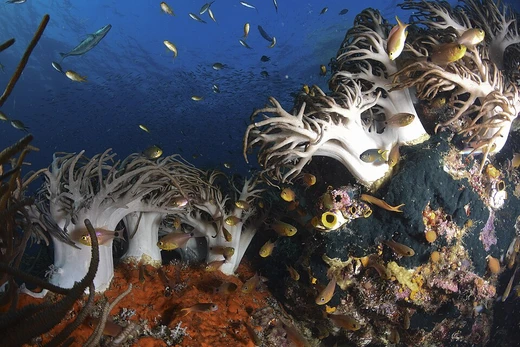
Clavularia viridis
Colonial soft coral with fluorescent green polyps and symbiotic zooxanthellae.

Clavularia viridis is a species of colonial soft coral in the family Clavulariidae, found in shallow waters of the tropical Indo-Pacific. It is notable for its large, fluorescent green polyps with feathery tentacles and a purple encrusting mat, as well as for hosting symbiotic zooxanthellae that contribute to its nutrition.
Quick Facts
- Taxon
- Clavularia viridis
Facts from the source article.
Lore & Background
Clavularia viridis grows from basal stolons that form a purple mat encrusting the substrate. Its polyps have eight tentacles with feathery margins, are retractable, and are fluorescent green, usually with a band of white or yellow around the margin of the oral disc. Compared with related species, the polyps are large and may reach 5 cm in diameter. This octocoral is native to the tropical Indo-Pacific, occurring at depths down to about 19 m, and usually colonises other species of coral. Its tissues contain symbiotic unicellular protists known as zooxanthellae, which use photosynthesis to synthesize carbohydrates; the octocoral derives much of its nutrition from this source. It also spreads its tentacles to catch zooplankton and can extract organic matter from seawater. Reproduction takes place in November, when all colonies in the area liberate gametes into the sea between 22 and 24 days after the full moon.
Reader's Guide
Clavularia viridis is significant as a colonial soft coral that illustrates the ecological role of symbiotic relationships in tropical reef environments. The article notes that its tissues contain zooxanthellae, which provide much of its nutrition through photosynthesis, while the coral also supplements its diet by capturing zooplankton and absorbing organic matter. This dual feeding strategy is typical of many octocorals and underscores their adaptability. The species is also notable for its secondary metabolites: a number have been isolated from the coral itself, and two norcarotenoids showing cell growth-inhibitory activity were isolated from its symbiotic zooxanthellae. These compounds highlight the potential biomedical relevance of such symbioses. The reproductive timing—November, 22 to 24 days after the full moon—indicates a synchronized spawning event, a common but ecologically important phenomenon among marine invertebrates. The species' large polyps (up to 5 cm) and distinctive fluorescent green coloration with white or yellow oral disc margins make it visually recognizable. Its habit of colonizing other coral species suggests a competitive or opportunistic life history strategy in shallow Indo-Pacific waters.
More in Soft Corals and Leathers, Part 2 1-24
Spotted an error? Know more?
Reader corrections go straight into our review queue. Suggest an edit · How this site is sourced