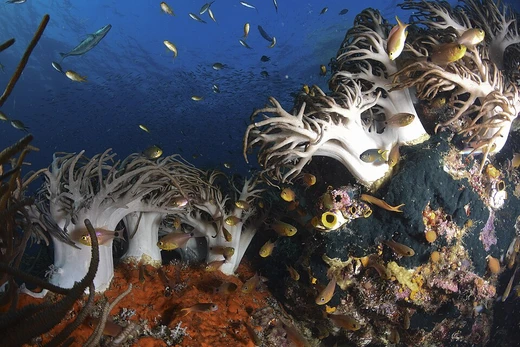
Clavularia crassa
A colonial soft coral with eight feathery tentacles, found in the Mediterranean.

Clavularia crassa belongs to the family Clavulariidae and is a colonial soft coral. Its range includes the eastern Atlantic Ocean and the Mediterranean Sea. The species was first recorded in 1848 by French zoologist Henri Milne-Edwards, based on a specimen taken off Algeria’s coast.
Colonies are small, made up of up to roughly fifty individual polyps that sprout from a stolon. This stolon, along with the polyp bases, is orangish-brown and grows along the surface of whatever it attaches to. Each polyp can reach 10 mm in length and 2 mm in width. The slender column is creamy-white, while the eight long, feathery tentacles are either transparent white or colorless with white flecks. Calcareous sclerites stiffen the oral surface.
Two similar soft corals are *Cornularia cornucopiae* and *Sarcodictyon catenatum*. *C. cornucopiae* has shorter polyps and narrower stolons, and its tissue lacks sclerites. *S. catenatum* has much smaller polyps and a thick, brick-red stolon that is easily seen.
In the Mediterranean and nearby eastern Atlantic—off Portugal and Algeria—this coral lives where water movement is moderate to strong. Its depth range spans from about 1 to 33 meters.
The polyps can partly retract. When extended, they feed by filtering zooplankton from the water with their tentacles. This octocoral often grows on the rhizomes of Neptune grass (*Posidonia oceanica*), as well as on algae and sponges. Starting in late June, eggs are pushed out through the polyp mouths and stick together in small orange clusters. These clusters are brooded on the outer surfaces of the polyps.
Quick Facts
- Taxon
- Clavularia crassa
Facts from the source article.
Lore & Background
Clavularia crassa forms small colonies of up to about fifty individual polyps growing from a stolon. The stolon and the bases of the polyps are orangish-brown, while each polyp is slender and creamy-white, up to 10 mm long and 2 mm wide. The eight long, feathery tentacles are either transparent white or colourless flecked with white, and the oral surface is stiffened by calcareous sclerites. This species may be confused with Cornularia cornucopiae, which has shorter polyps and narrower stolons and lacks sclerites, or with Sarcodictyon catenatum, which has much smaller polyps and a thick, brick-red stolon. Clavularia crassa occurs in positions with moderate to high water movement, at depths from about 1 to 33 metres. It is often found growing on the rhizomes of Neptune grass (Posidonia oceanica), as well as on algae and sponges. The polyps can partially retract and feed on zooplankton filtered from the water by the tentacles. From late June onwards, eggs are extruded through the mouths of the polyps and remain stuck together in small orange clusters, brooded on the outer surface of the polyps.
Reader's Guide
Clavularia crassa is notable as a colonial soft coral first described in 1848 by Henri Milne-Edwards, based on a specimen from off the coast of Algeria. Its distribution spans the eastern Atlantic Ocean and the Mediterranean Sea, where it occupies depths from 1 to 33 metres in areas with moderate to high water movement. The species forms small colonies of up to about fifty polyps, each with eight feathery tentacles and an oral surface stiffened by calcareous sclerites. It is often found growing on the rhizomes of Neptune grass, as well as on algae and sponges. Its reproductive strategy involves extruding eggs through the polyp mouths from late June onward, which remain in small orange clusters brooded on the outer surface of the polyps. The species can be confused with Cornularia cornucopiae and Sarcodictyon catenatum, but differs in polyp size, stolon characteristics, and the presence of sclerites. These details contribute to its identification and ecological role in its habitat.
Did You Know?
- Clavularia crassa was first described in 1848 by French zoologist Henri Milne-Edwards.
- The type specimen was collected off the coast of Algeria.
- Eggs are extruded through the polyp mouths from late June onward and brooded on the outer surface.
More in Soft Corals and Leathers, Part 2 1-24
Spotted an error? Know more?
Reader corrections go straight into our review queue. Suggest an edit · How this site is sourced