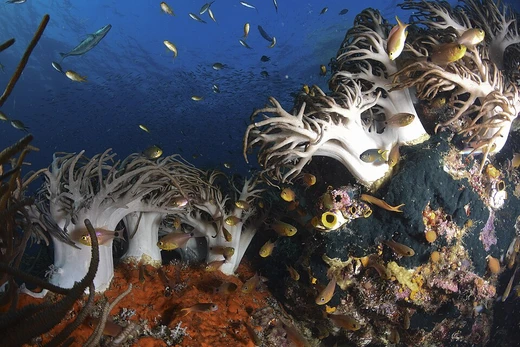
Carijoa riisei
A soft coral with disputed origins, invasive in many regions.

Carijoa riisei, commonly known as the snowflake coral or branched pipe coral, is a species of soft coral in the family Clavulariidae. It is notable for its disputed native range: originally thought to be native to the tropical western Atlantic Ocean, molecular evidence now suggests it is actually native to the Indo-Pacific and spread to the Atlantic as a hull fouling species prior to its original description in 1860. It is regarded as invasive throughout much of its range, including Hawaii and the greater tropical Pacific.
Quick Facts
- Taxon
- Carijoa riisei
Facts from the source article.
Lore & Background
Carijoa riisei is a colonial soft coral with a tangled, bushy growth form. Its hollow branches, up to 30 cm long, grow from a creeping stolon and bear eight longitudinal furrows with a prominent polyp at the tip. The polyps sit in tubular calyces that are widely separated on the branches, measuring 3 to 5 mm long and 1.5 mm wide, and are retractible into the branches. It is an azooxanthellate species, lacking symbiotic zooxanthellae, and must capture all its food by filter feeding on zooplankton and other particles, thriving in turbid waters with moderate to strong currents.
Originally thought native to the tropical western Atlantic, Caribbean Sea, and Gulf of Mexico, its range extends from South Carolina to Brazil. However, molecular evidence indicates it is more likely native to the Indo-Pacific and spread to the Atlantic as a hull fouling organism before its 1860 description. It was first detected in Hawaii in 1972 in Pearl Harbor and has since spread to other Hawaiian islands and many Indo-Pacific locations, including Australia and Asia. In Ecuador, it was first reported in 2010 in Machalilla National Park, with subsequent sightings along the coast through 2013; as of 2020, 22 known colonies exist there.
Carijoa riisei is a shade-loving species that grows on hard surfaces away from direct sunlight, such as caves, overhangs, ledges, and under piers. It is a common hull fouling organism, growing on metal, wood, concrete, plastic, and rope. It tends to smother other corals, except for another Indo-Pacific invasive, Tubastraea coccinea. Individual colonies are either male or female, and gametes are liberated into the sea at any time of year, a strategy unusual among corals. The eggs tend to sink, which may mean the larvae are benthic rather than planktonic.
Reader's Guide
Carijoa riisei is significant primarily as an invasive species with a complex biogeographic history. The article highlights that its presumed native range in the tropical western Atlantic was based solely on the type specimen collected from the US Virgin Islands, but molecular evidence now points to an Indo-Pacific origin, with human-mediated spread via hull fouling occurring before its scientific description. This challenges long-held assumptions about coral biogeography and underscores the role of shipping in species dispersal. In Hawaii, it overgrows and kills native black corals (Antipathes dichotoma and Antipathes grandis) below about 75 m depth, disrupting a managed fishery for jewelry. The ecological balance is disturbed because the faster-growing octocoral smothers the slow-growing black corals before they reach reproductive age (twelve years). Its spread in Hawaii may have been facilitated by the relative scarcity of native octocorals. The only known predators are the nudibranchs Phyllodesmium poindimiei and Tritoniopsis elegans, and the bearded fireworm Hermodice carunculata, but the nudibranch cannot be used as biocontrol because the coral can grow faster than the predator can destroy its tissues. The species' ability to thrive in turbid, high-current environments and on artificial substrates makes it a persistent fouling organism in ports worldwide.
Did You Know?
- Carijoa riisei was originally thought native to the tropical western Atlantic, but molecular evidence now suggests it is native to the Indo-Pacific.
- It is an azooxanthellate species, meaning it lacks symbiotic zooxanthellae and must filter feed on zooplankton.
- In Hawaii, it overgrows and kills native black corals below about 75 m depth.
More in Soft Corals and Leathers, Part 2 1-24
Spotted an error? Know more?
Reader corrections go straight into our review queue. Suggest an edit · How this site is sourced