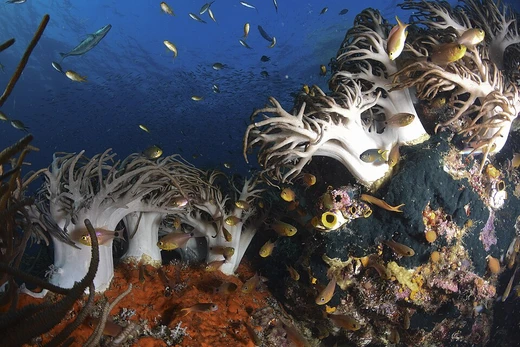
Briareum asbestinum
A soft coral with variable finger-like forms in Caribbean waters.

The corky sea finger, *Briareum asbestinum*, is a soft coral from the Briareidae family. It lives on coral reefs and rocky seafloors across the Caribbean, the Bahamas, and Florida, typically reaching 30 centimeters in height at depths between one and 40 meters.
This coral grows as large, unbranched, vertical tubes or "fingers" that can extend up to a meter long. Its appearance changes with depth: individuals in shallow water (around 5 meters) have shorter, stouter fingers and smaller sclerites than those found deeper (around 35 meters). Deeper colonies also show reduced polyp density and thinner tissue. This flexibility, known as phenotypic plasticity, likely stems from unknown environmental factors, possibly including predation, changes in light with depth, or increased fragility in shallow zones. The polyps, each over a centimeter in size, give the coral a hairy look, and its surface can be purple, gray, tan, brown, or greenish-brown underneath.
*Briareum asbestinum* thrives in shallow tropical waters of the western Atlantic and Caribbean Sea, down to 35 meters deep. It is common in back-reef areas, on coral rubble, and in seagrass beds.
The species reproduces both sexually, by releasing gametes into the water each year, and vegetatively, when broken fragments settle and grow in new spots.
Rising ocean temperatures threaten this coral by causing bleaching.
Quick Facts
- Taxon
- Briareum asbestinum
Facts from the source article.
Lore & Background
Briareum asbestinum grows large vertical cylindrical tubes or 'fingers,' usually unbranched, that may reach up to one metre in length. The morphology varies with depth: shallow-water (5 m) fingers are shorter and stouter, with shorter sclerites, while deep-water (35 m) fingers are longer and more slender, with longer sclerites. Polyp density and colony thickness are reduced at deeper depths. The polyps are over 1 cm in size, giving the surface a hairy appearance, and the surface may be purple, grey, tan, brown, or greenish-brown.
Reader's Guide
Briareum asbestinum is significant as a common soft coral in shallow tropical waters of the western Atlantic and Caribbean, found in back-reef areas, coral rubble, and seagrass beds. Its phenotypic plasticity—differences in finger shape, sclerite length, and colony thickness between shallow and deep sites—is attributed to unknown environmental factors, possibly predation, light reduction with depth, or increased fragility in shallow waters. The species reproduces both sexually, through annual gamete release, and vegetatively via broken fragments that settle and colonize new sites. It is threatened by rising ocean temperatures that cause coral bleaching, highlighting its vulnerability to climate change. The taxonomic note that encrusting and tall tube-shaped forms are considered conspecific despite genetic differences underscores ongoing complexity in coral systematics.
Did You Know?
- The fingers of Briareum asbestinum may reach up to one metre in length.
- Shallow-water morphs have shorter sclerites than deep-water morphs.
- It reproduces vegetatively by growth of broken fragments that settle on the ocean floor.
More in Soft Corals and Leathers, Part 2 1-24
Spotted an error? Know more?
Reader corrections go straight into our review queue. Suggest an edit · How this site is sourced