Astrogorgia
Fan-shaped soft corals with pharmacological potential.

Astrogorgia is a genus of fan-shaped soft corals within the family Plexauridae and the order Alcyonacea. These corals are ecologically significant in reef ecosystems and hold considerable promise for pharmacological study due to the bioactive compounds they produce.
The genus was first described by Addison Emery Verrill in 1868, with *Astrogorgia sinensis* designated as the type species. Its classification has undergone major revisions over time, largely because of variable physical forms and inconsistent historical records. Today, species are identified using both morphological analysis—particularly electron microscopy of sclerites—and molecular techniques, including sequencing of the COI, ND2, and MSH gene fragments.
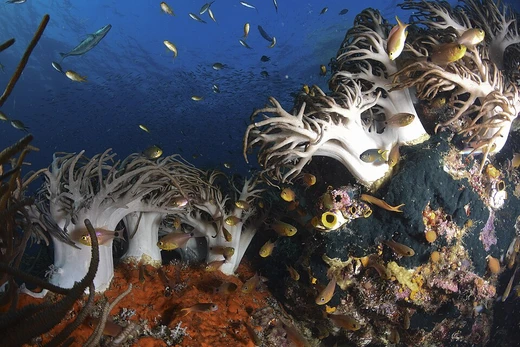
Astrogorgia colonies are fan-shaped with irregular side branches that do not fuse into a closed network. They display a range of vivid colors, including dark red, red, pink, orange, yellow, cream, or tan. The internal spicules, or sclerites, are spindle-shaped and often longer than the branch diameter; they may be colorless or tinted red, orange, or yellow. Key identification features include the arrangement of these sclerites and the distinct structures of the polyps, coenenchyme, and tentacles.
Species in this genus are found across Southeast Asia and the Indian Ocean. Recognized species include *Astrogorgia arborea*, *Astrogorgia balinensis*, and *Astrogorgia bayeri*.
Quick Facts
- Taxon
- Astrogorgia
Facts from the source article.
Lore & Background
Addison Emery Verrill established the genus Astrogorgia in 1868, with Astrogorgia sinensis as the type species. The genus's classification has experienced substantial changes throughout history due to phenotypic variability and inconsistent identification records. Modern identification relies on two main methods: molecular biology (COI, ND2, and MSH gene fragment sequencing) and morphological analysis (sclerite analysis using electronic microscopy).
Morphologically, Astrogorgia species display a fan-shaped (flabellate) colony form with irregular lateral branches that do not merge to form a closed network (non-anastomosing). Colonies exhibit vibrant hues such as dark red, red, pink, orange, yellow, cream, or tan. The internal structural components, called spicules or sclerites, have a spindle-like form and can be colorless or have red, orange, or yellow hues; they are frequently longer than the diameter of the branches. Spicule arrangement and the unique features of polyps, coenenchyme, and tentacles are often used for identification.
Species within the genus include Astrogorgia arborea (Thomson & Simpson, 1909), Astrogorgia balinensis Hermanlimianto & van Ofwegen, 2006, and Astrogorgia bayeri van Ofwegen & Hoeksema, 2001. The genus is found in Southeastern Asia and the Indian Ocean.
Reader's Guide
Astrogorgia is notable for its dual significance: ecologically, it plays an important role in coral reef ecosystems, and pharmacologically, it holds potential due to its bioactive natural substances. The genus was established by Addison Emery Verrill in 1868, with Astrogorgia sinensis as the type species. Its classification has undergone substantial changes because of phenotypic variability and inconsistent identification records, a challenge that modern science addresses through molecular biology (sequencing of COI, ND2, and MSH gene fragments) and morphological analysis (sclerite analysis via electronic microscopy). The fan-shaped, non-anastomosing colonies display a range of vibrant colors, and their spindle-like sclerites aid in identification. Species such as Astrogorgia arborea, Astrogorgia balinensis, and Astrogorgia bayeri are documented, all found in Southeastern Asia and the Indian Ocean. The genus's ecological role and pharmacological promise underscore its importance in both conservation and biomedical research.
Did You Know?
- The type species is Astrogorgia sinensis.
- Its colonies are fan-shaped with non-anastomosing branches.
More in Soft Corals and Leathers, Part 2 1-24
Spotted an error? Know more?
Reader corrections go straight into our review queue. Suggest an edit · How this site is sourced