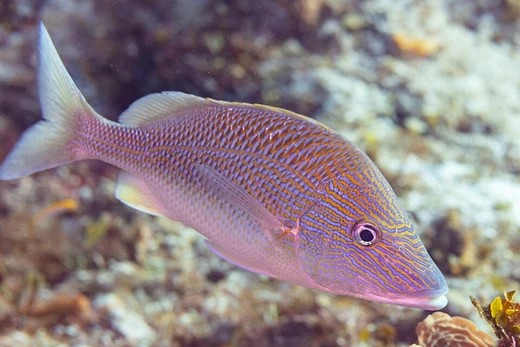
Yellowtail snapper
An abundant snapper with a distinct yellow lateral band.

The yellowtail snapper (Ocyurus chrysurus) is a plentiful snapper found in the western Atlantic, from the Gulf of Mexico and Caribbean Sea up to Massachusetts, though its usual range runs from Florida south through the West Indies to Brazil. It mostly lives around coral reefs but can turn up in other spots, at depths from the surface down to 180 meters (590 feet), typically between 10 and 70 meters (33–230 feet). This fish can grow to 86.3 cm (34 inches) long, but most stay under 40 cm (16 inches), and the heaviest recorded was 4.98 kg (11 pounds). It’s important commercially, farmed, popular with recreational anglers, and often seen in public aquariums. In places like the Florida Keys, divers and snorkelers frequently spot this brightly colored fish.
It was first described in 1791 as *Sparus chrysurus* by German naturalist Marcus Elieser Bloch, with the type location given as “Brazilian seas.” It’s the only species in the genus *Ocyurus*, a name from Greek *okys* (swift, like the bird) and *oura* (tail), referring to its forked tail. *Chrysurus* comes from Greek *chryso* (golden). Some studies suggest *Ocyurus* and *Rhomboplites* might belong inside the genus *Lutjanus*, and a possible hybrid between *Lutjanus synagris* and *Ocyurus chrysurus* (called *Lutjanus ambiguus*) supports this close relationship.
The fish has a bright yellow stripe starting at the snout and widening toward the forked tail, which is entirely yellow. The rest is olive to bluish black with yellow spots above the stripe. The dorsal fin is yellow; the anal and pelvic fins are whitish. It has one dorsal fin with ten spines and 12–14 soft rays, and one anal fin with three spines and eight or nine soft rays. Scales cover the bases of the soft parts of these fins. The long pectoral fin reaches the vent. Unlike other snappers, its head and mouth are small, and it lacks a dark spot below the dorsal fin. It has canine teeth in the upper jaw, but most teeth are villiform, and it uniquely has teeth on the ectopterygoid bones.
Yellowtails are native to the western Atlantic, ranging from Massachusetts to southeastern Brazil, but are most common in the Bahamas, off south Florida, and throughout the Caribbean. Adults are preyed on by large fish like barracuda, mackerel, grouper, sharks, and other snappers. They eat shrimp, crabs, worms, and smaller fish.
Quick Facts
- Taxon
- Ocyurus chrysurus
Facts from the source article.
Lore & Background
The yellowtail snapper was first formally described in 1791 by German physician and naturalist Marcus Elieser Bloch as Sparus chrysurus, with the type locality given as 'Brazilian seas'. It is the sole member of the monotypic genus Ocyurus, derived from Greek words meaning 'swift' and 'tail', referring to its forked tail. The species name chrysurus comes from the Greek word for 'golden'. A taxonomic study of snappers in the tropical western Atlantic indicated that the monotypic genera Ocyurus and Rhomboplites sit within the genus Lutjanus. Lutjanus ambiguus is considered by some authorities to most likely be a hybrid between Lutjanus synagris and Ocyurus chrysurus, supporting the close relation between the two genera.
Yellowtail snapper have a distinct yellow lateral band beginning at the snout that gets wider towards the forked tail, which is completely yellow. The rest of the fish is olive to bluish black with yellow spots above the lateral band. The dorsal fin is yellow while the anal and pelvic fins are whitish. In contrast to other snapper species, the head and mouth are small and the species does not have a dark lateral spot below its dorsal fin. Canine teeth are present in the upper jaw, but most teeth are villiform. A distinctive characteristic is the presence of teeth on the ectopterygoid bones.
Natural predators of adult yellowtail snapper include barracuda, mackerel, grouper, sharks, and even other snapper species. They feed on shrimp, crabs, worms, and smaller fish. They spawn in groups off the edges of reefs from spring to fall, heavily in midsummer.
Reader's Guide
The yellowtail snapper is a commercially important species and has been farmed. It is sought as a game fish by recreational anglers and is a popular species for display in public aquaria. In certain reefs, most notably in the Florida Keys, this beautifully colored fish is commonly spotted among divers and snorkelers. Yellowtail snapper are typically caught in 30–120 ft of water on and around reefs using hook and line with frozen chum to attract the fish. Light tackle is generally accepted, as the fish are wary of thicker line and larger hooks. Most fish caught by anglers range from eight to 14 inches, although catches to 16 inches are not uncommon. Larger fish are often called 'flags' in the United States. Yellowtail snapper is highly prized for its light, flaky meat and is considered by some to be one of the best of the snapper family. Normally, they are caught and sold to eat, especially in American cuisine. The species is not overfished and the stock is not currently experiencing overfishing in the United States, but stocks in Cuba and Brazil are overfished and the species is listed as highly vulnerable to overfishing in Mexico, where management is extremely limited.
Did You Know?
- The yellowtail snapper is the only known member of its genus, Ocyurus.
- Yellowtail snapper have teeth on the ectopterygoid bones, a distinctive characteristic.
More in Snappers and Grunts 1-24
Spotted an error? Know more?
Reader corrections go straight into our review queue. Suggest an edit · How this site is sourced