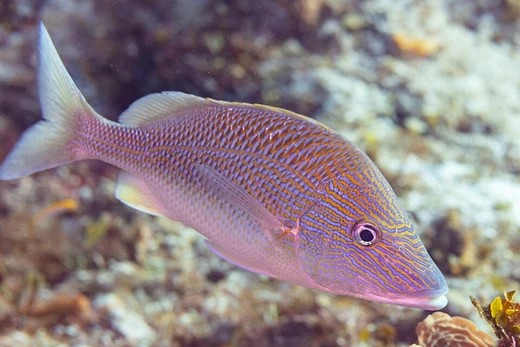
Rhonciscus pauco
A recently described grunt from deep waters off western Puerto Rico.

Rhonciscus pauco, commonly called the opalescent grunt, is a marine ray-finned fish in the Haemulidae family, which includes grunts and sweetlips. It was first scientifically described in 2022 based on specimens collected by fishermen off the western coast of Puerto Rico.
The species was formally named in 1922 by Jose Tavera, Michelle T. Schärer-Umpierre, and Arturo Acero Pizarro. Its type locality is Tres Cerros, Rincón, Puerto Rico, at coordinates 18.34433°N, 67.28343°W, taken from a depth of 280 meters (920 feet). It belongs to the genus *Rhonciscus* within the subfamily Haemulinae, part of the family Haemulidae. The Haemulidae also includes the sweetlips of the subfamily Plectorhinchinae, and the entire family is placed in the order Acanthuriformes.
The genus name *Rhonciscus* is a diminutive of *rhencus*, the Greek word for "snore." This refers to the grunting sounds haemulids produce by grinding their pharyngeal teeth, amplified by the swim bladder, especially when removed from water. The specific name *pauco* honors Pauco, the nickname of fisherman Edwin Font, who caught the type specimens and shared traditional knowledge about the fish’s ecology.
The dorsal fin has 12 spines and 12 soft rays, while the anal fin has 3 spines and 7 soft rays. The body is somewhat elongate, with a depth just over a third of its standard length. The dorsal profile before the dorsal fin is convex, the eyes are large, and the snout is shorter than the eye’s diameter. The body is silvery-white with some opalescence and golden spots. The maximum published standard length is 25 centimeters (9.8 inches).
*Rhonciscus pauco* is known only from a small area of the Caribbean Sea off western Puerto Rico, in deep water with fine sandy sediments between Rincón and Mayagüez, at depths greater than 250 meters (820 feet).
Quick Facts
- Taxon
- Rhonciscus pauco
Facts from the source article.
Lore & Background
Rhonciscus pauco was first formally described in 1922 by Jose Tavera, Michelle T. Schärer-Umpierre and Arturo Acero Pizarro, with its type locality given as Tres Cerros, Rincón, Puerto Rico, at a depth of 280 m. The species is classified within the genus Rhonciscus, subfamily Haemulinae, family Haemulidae, which is placed in the order Acanthuriformes. The genus name Rhonciscus is a diminutive of rhencus, the Greek word for 'snore,' referencing the grunting noises haemulids produce by grinding their pharyngeal teeth, amplified by the swim bladder, especially when removed from water. The specific name pauco honors Pauco, a nickname for the fisherman Edwin Font, who caught the type specimens and shared traditional knowledge of its ecology.
Reader's Guide
Rhonciscus pauco is significant as a recently described species that highlights the biodiversity of deep-water habitats in the Caribbean Sea. Its discovery relied on local fishermen's traditional knowledge, specifically that of Edwin Font, whose nickname Pauco is immortalized in the specific name. The species is known only from a small area off western Puerto Rico, between Rincón and Mayagüez, at depths greater than 250 m over fine sandy sediments. This restricted distribution underscores the potential vulnerability of deep-reef fish populations and the importance of continued exploration. The opalescent grunt's description adds to the understanding of the family Haemulidae, which includes both grunts and sweetlips, and its unique coloration—silvery-white with opalescence and golden spots—distinguishes it from related species. Its maximum standard length of 25 cm and fin ray counts (12 spines and 12 soft rays in the dorsal fin, 3 spines and 7 soft rays in the anal fin) provide key taxonomic data. The species' reliance on deep, sandy habitats and its limited range make it a subject of interest for conservation and biogeographic studies.
Did You Know?
- Rhonciscus pauco was first formally described in 2022 from type specimens caught by fishermen off western Puerto Rico.
- The specific name pauco honors the fisherman Edwin Font, nicknamed Pauco, who caught the type specimens.
- This species is known only from depths greater than 250 m between Rincón and Mayagüez, Puerto Rico.
- The genus name Rhonciscus refers to the grunting sound haemulids make by grinding their pharyngeal teeth.
Frequently Asked Questions
What is Rhonciscus pauco?
Rhonciscus pauco, popularly known as the opalescent grunt, is a deep-water marine ray-finned fish belonging to the Haemulidae family. It sits within the genus Rhonciscus and the subfamily Haemulinae, alongside other grunts and sweetlips.
Where and when was Rhonciscus pauco first described?
The species was formally described in 2022 by Tavera, Schärer-Umpierre, and Acero Pizarro, based on specimens hauled up by local fishermen off the western coast of Puerto Rico. Its type locality is Tres Cerros near Rincón, Puerto Rico, at a depth of roughly 280 metres (920 ft).
How large does Rhonciscus pauco grow?
The opalescent grunt reaches a maximum standard length of about 25 cm (roughly 9.8 inches), making it a modestly sized member of the grunt family.
What are Rhonciscus pauco's fin-ray counts?
It carries 12 spines and 12 soft rays in the dorsal fin, while the anal fin bears 3 spines and 7 soft rays. These counts are key diagnostic characters used to separate it from other Rhonciscus species.
At what depths is Rhonciscus pauco found?
The species is a deep-water inhabitant, with a recorded depth range of greater than 250 metres (820 ft). Its type specimen was collected at 280 metres, and no shallower records are currently known.
More in Snappers and Grunts 1-24
Spotted an error? Know more?
Reader corrections go straight into our review queue. Suggest an edit · How this site is sourced