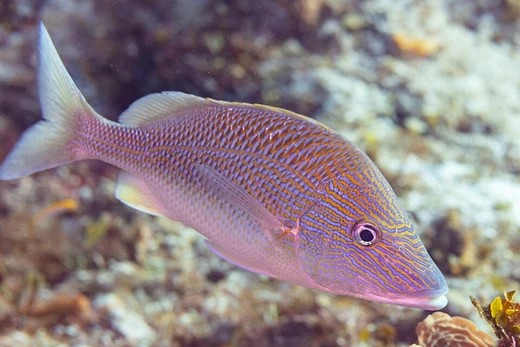
Haemulinae
New World-origin grunts with short dorsal fins of 13–16 soft rays.

Haemulinae is a subfamily of the family Haemulidae, comprising genera regarded as being of New World origin, though they are now widespread. It is distinguished from the other haemulid subfamily, Plectorhynchinae, by having a short dorsal fin containing 13–16 soft rays, whereas Plectorhynchinae has a long dorsal fin with 17–26 soft rays.
Quick Facts
- Taxon
- Haemulinae
Facts from the source article.
Lore & Background
The subfamily Haemulinae consists of genera that are regarded as being of New World origin, although they are now widespread. It is distinguished from the subfamily Plectorhynchinae by having a short dorsal fin containing 13–16 soft rays, as opposed to the long dorsal fin with 17–26 soft rays of Plectorhynchinae.
Genera included in Haemulinae by Eschmeyer's Catalog of Fishes include Anisotremus, Boridia, Brachydeuterus, Brachygenys, Conodon, Emmelichthyops, Haemulon, Haemulopsis, Isacia, Microlepidotus, Orthopristis, Parakuhlia, Paranisotremus, Pomadasys, Rhencus, Rhonciscus, and Xenichthys. The genus Brachygenys is recognized by some authorities because Haemulon was determined to be paraphyletic in molecular studies, which showed Haemulon chrysargyreum clustered with Xenistius californianus; Brachygenys also includes species from the former genera Xenistius and Xenocys.
Similarly, molecular studies resolved Pomadasys as paraphyletic, leading to the revival of the genera Rhencus and Rhonciscus to solve this paraphyly. The eastern Pacific species P. macracanthus and P. panamensis are placed in Rhencus, while Rhonciscus contains the eastern Pacific species P. bayanus and the western Atlantic species P. crocro. These changes are recognized by Catalog of Fishes but not yet by Fishbase. Additionally, Anisotremus moricandi makes Anisotremus paraphyletic if included and has been placed in the monotypic genus Paranisotremus.
Reader's Guide
The significance of Haemulinae lies in its distinction from the other haemulid subfamily Plectorhynchinae based on dorsal fin ray counts, a key morphological trait. The subfamily's composition has been refined by molecular studies that revealed paraphyly in several genera, leading to taxonomic revisions such as the recognition of Brachygenys, Rhencus, Rhonciscus, and Paranisotremus. These changes are acknowledged by Eschmeyer's Catalog of Fishes but not yet by Fishbase, indicating ongoing taxonomic debate. The inclusion of Pomadasys fossils from the Middle Eocene of Egypt provides a paleontological anchor for the group. Some authorities place the genus Genyatremus within Haemulinae, though both Fishbase and Catalog of Fishes place it in Plectorhinchinae, preserving uncertainty. The subfamily's legacy is one of dynamic classification driven by molecular evidence, with its New World origin and subsequent widespread distribution underscoring its evolutionary success.
Did You Know?
- Haemulinae is distinguished from Plectorhynchinae by having a short dorsal fin with 13–16 soft rays, versus 17–26 soft rays.
- Molecular studies showed Haemulon chrysargyreum clustered with Xenistius californianus, leading to the recognition of the genus Brachygenys.
- Anisotremus moricandi was placed in the monotypic genus Paranisotremus to resolve paraphyly in Anisotremus.
Frequently Asked Questions
What is Haemulinae?
Haemulinae is a subfamily of the fish family Haemulidae, grouping together what hobbyists commonly call 'grunts' and some smaller snappers. The subfamily includes genera that first appeared in the New World but are now found across tropical and subtropical oceans.
How can I distinguish Haemulinae from Plectorhynchinae?
Count the soft rays in the dorsal fin: Haemulinae species have a shorter fin with only 13 to 16 soft rays, whereas their Plectorhynchinae relatives carry a longer fin with 17 to 26 soft rays. This single morphological trait is the standard way to separate the two subfamilies.
Where did Haemulinae species originate?
The genera assigned to this subfamily are regarded as having New World roots, meaning they first evolved in the Western Atlantic or Caribbean. Over time their distributions broadened until representatives now occur in tropical and subtropical waters on every continent.
How many genera are in Haemulinae?
Seventeen genera are currently listed under the Haemulinae subfamily. Together they make up the bulk of what most reef divers and aquarists recognize as 'grunts.'
What is the relationship between Haemulinae and the family Haemulidae?
Haemulinae is one of two subfamilies recognized within Haemulidae, the other being Plectorhynchinae. In practical terms, every grunt or snapper you encounter in the wild belongs to one of these two groups.
More in Snappers and Grunts 1-24
Spotted an error? Know more?
Reader corrections go straight into our review queue. Suggest an edit · How this site is sourced