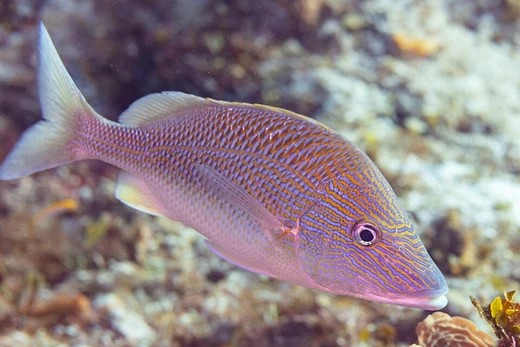
Haemulon parra
A grunt species with striped silver-grey adults and black-striped juveniles.

Haemulon parra, known as the sailor's grunt or sailor's choice, is a grunt species found in the Atlantic Ocean. Its genus name derives from the Greek *haimaleos*, meaning "bloody," and the species name is Latin for "sparrow." Anselme Gaëtan Desmarest first described it in 1823.
The fish has a dull head with a small to medium mouth, lacking fleshy lips. Scales cover part of the eye near the back, and the chin has two small openings with a single furrow down the middle. The eye's edges are typically yellow or bronze. Adults are silver and grey, with dotted black stripes running along their sides. Juveniles have four black stripes over a white body and a spot on the tail fin. The longest recorded individual measured 41.2 cm (16.2 in).
This species lives in the western Atlantic, from Florida to Brazil, and also enters the Gulf of Mexico. It prefers reefs and hard bottoms at depths from 0 to 80 m (0–262 ft). Juveniles are more drawn to seagrass beds, while adults school and can be seen in more open areas. It feeds at night on mollusks and fish.
Humans fish for it on a small commercial scale, and it sometimes appears in aquariums. In March 2011, the International Union for Conservation of Nature evaluated *Haemulon parra* and listed it as Least Concern.
Quick Facts
- Taxon
- Haemulon parra
Facts from the source article.
Lore & Background
Haemulon parra was described in 1823 by Anselme Gaëtan Desmarest. Its genus name comes from the Greek haimaleos, meaning 'bloody,' while the specific epithet is a Latin word for 'sparrow.' The species has a dull head with a medium-to-small-sized mouth, lacking fleshy lips, and a part of the eye near the back is covered by scales. Its chin has two small openings and one furrow in the middle, and the eye's edges are commonly either yellow or bronze.
Adults are a mixture of silver and grey covered with dotted black stripes running laterally, while juveniles have four black stripes over white and a spot on their tail fin. The maximum recorded length is 41.2 cm (16.2 in). The species is found in the Western Atlantic Ocean, from Florida to Brazil, also entering the Gulf of Mexico.
The sailor's grunt prefers reefs and hard bottoms, residing in depths from 0–80 m. Juveniles are more attracted to seagrass beds, while adults school and can be seen in more open areas. It feeds at night, eating mollusks and fish.
Reader's Guide
Haemulon parra holds significance as a species of grunt native to the Atlantic Ocean, described in 1823 by Anselme Gaëtan Desmarest. Its taxonomy reflects Greek and Latin roots, with the genus name meaning 'bloody' and the specific epithet meaning 'sparrow.' The species is characterized by its dull head, medium-to-small mouth, and eye edges that are yellow or bronze. Adults display a silver-grey coloration with dotted black lateral stripes, while juveniles have four black stripes over white and a tail spot. The maximum recorded length is 41.2 cm.
Its distribution spans the Western Atlantic from Florida to Brazil, including the Gulf of Mexico. Ecologically, it inhabits reefs and hard bottoms at depths up to 80 m, with juveniles favoring seagrass beds. Adults school in open areas and feed nocturnally on mollusks and fish. Human use is minor, with occasional commercial fishing and presence in aquariums. The International Union for Conservation of Nature evaluated it in March 2011, placing it as Least Concern on the IUCN Red List, indicating a stable population. Its legacy lies in its role as a common reef-associated grunt with distinct juvenile and adult color patterns.
Did You Know?
- The specific epithet 'parra' is a Latin word for 'sparrow.'
- It was evaluated by the IUCN in March 2011 and placed as Least Concern.
Taxonomic Standing & the Polyphyletic Question
Haemulon parra, commonly known as the sailor's grunt, was formally described by Desmarest in 1823 and occupies a place within the genus Haemulon, the scaled-fin grunts of the grunt family. This genus encompasses roughly twenty-three species, the vast majority of which inhabit the western Atlantic Ocean, with a small number extending into the eastern Pacific. The group as a whole is regarded as one of the most significant fish assemblages on Brazilian coral reefs, owing to both its commercial importance and its critical ecological function. However, the very boundaries of the genus have come under scrutiny. Molecular phylogenetic work has revealed that Haemulon sensu lato is polyphyletic: the species H. chrysargyreum clusters more closely with Xenistius californiensis than with other Haemulon members. In response, some authorities have revived the older genus name Brachygenys to house that lineage along with Xenistius peruanus and Xenocys jessiae. Haemulon parra itself remains within the core Haemulon group, sharing its taxonomic neighborhood with species described by Linnaeus in 1758 all the way through to the Atlantic latin grunt, named by Carvalho and colleagues in 2020.
Body Plan & the Juvenile-to-Adult Transformation
Members of the genus Haemulon, including H. parra, share a recognizable body architecture: an oblong silhouette paired with a notably large mouth. A defining morphological trait is the presence of scales draped over the rays of both the second dorsal fin and the anal fin, a feature that gives the group its scaled-fin common name. A consistently oversized second anal spine relative to the third provides a useful identification character. Inside the oral cavity, the lining is typically a vivid red, a striking contrast to the external coloration. One of the most ecologically interesting aspects of this genus is the dramatic shift in appearance between life stages. Juveniles of all Haemulon species look remarkably similar to one another, making it difficult to tell a young sailor's grunt from a young cottonwick or a young bluestriped grunt at a glance. As the fish mature, however, the variation in adult coloration and patterning becomes pronounced, and species like H. parra develop their own distinctive adult phenotype. This ontogenetic divergence likely reflects different ecological pressures as the fish transition from reef-sheltered juveniles to open-water foragers.
Nocturnal Foraging & the Rhythm of the Schools
The feeding ecology of Haemulon parra follows the broader pattern of the grunt family: these are nocturnal hunters. While a few species in the genus take plankton from the open water column, the majority, and H. parra among them, target small prey on the seabed. The daily cycle is tightly structured. As the sun drops below the horizon, schools of grunts leave the shelter of the reef and spread out into the surrounding waters. The cohesive group fractures as individuals break off to forage independently on the bottom. This dispersal phase lasts through the night. As dawn approaches, the scattered fish begin to reconvene, re-forming their school and heading back toward the reef to take up their daytime positions. Schools can be enormous, numbering in the hundreds or even thousands, and they include both adults and juveniles mixed together. The same gathering can also incorporate multiple Haemulon species simultaneously, creating a fluid, multi-species unit that moves as one through the reef landscape.
Social Fabric, Mimicry & the Grunt's Signature Sound
Haemulon parra is a common resident of shallow reef communities, and its social life extends well beyond its own species. Large schools of grunts regularly attract unrelated fish seeking the safety of numbers. Some species simply shelter within the mass, but others go further, engaging in what can only be called protective mimicry. The goatfish Mulloidichthys martinicus, for instance, closely resembles H. chrysargyreum in color, size, and shape; when it ventures into the open water column where it is visible to predators, it deliberately joins grunt schools, adopting their swimming style, movements, and postures to blend in seamlessly. The parrotfish Sparisoma axillare and the herring Harengula clupeola have been observed doing something similar. Despite this gregariousness, larger Haemulon individuals can turn territorial and aggressive, a behavior that peaks in the early morning hours. And then there is the sound: like all grunts, H. parra produces its characteristic grunting noise by grinding its pharyngeal teeth, the very behavior that gave the family its name. Spawning, by contrast, remains unobserved.
Frequently Asked Questions
What is Haemulon parra?
Haemulon parra is a grunt species native to the Atlantic Ocean, commonly called the sailor's grunt or sailor's choice. It was first formally described by Anselme Gaëtan Desmarest in 1823.
What does a Haemulon parra look like?
Adults show a silver-grey body with dotted black stripes running along the flanks, while juveniles carry more prominent black striping. The head is relatively plain, featuring a small-to-medium mouth without fleshy lips and eye margins that tend toward yellow or bronze.
How large can Haemulon parra grow?
The species reaches a maximum recorded length of about 41.2 cm, roughly 16.2 inches.
Where and how deep is Haemulon parra found?
This grunt inhabits the Atlantic Ocean, occurring from the surface down to depths of approximately 80 meters (262 feet).
What do the name parts of Haemulon parra mean?
The genus name derives from the Greek word haimaleos, meaning "bloody," while the species epithet is simply Latin for "sparrow."
More in Snappers and Grunts 1-24
Spotted an error? Know more?
Reader corrections go straight into our review queue. Suggest an edit · How this site is sourced