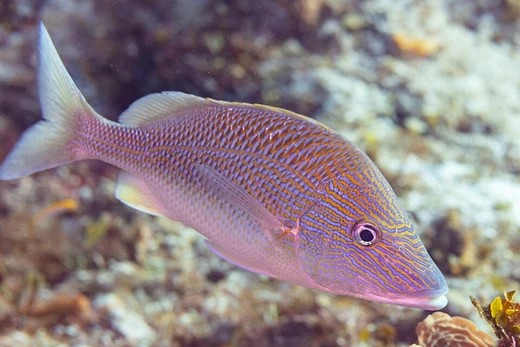
Lutjaninae
Subfamily of snappers including true snappers and fusiliers.

Lutjaninae is a subfamily of marine ray-finned fish, one of four subfamilies in the snapper family Lutjanidae. It includes the true snappers and the fusiliers, which were once placed in their own family, Caesionidae.
**Taxonomy** The fusiliers (genera *Caesio*, *Dipterygonotus*, *Gymnocaesio*, and *Pterocaesio*) are plankton feeders found on Indo-Pacific and Red Sea reefs. French zoologist Charles Lucien Bonaparte named the family Caesionidae in 1831, after the genus *Caesio*, which Bernard Germain de Lacépède named in 1801. The name *Caesio* comes from the Latin *caesius* ("blue"), referring to the blue and gold fusilier (*Caesio caerulaurea*), the type species. More recent taxonomic studies show that fusiliers are deeply nested within Lutjanidae, making the old family paraphyletic, so they are now placed in the subfamily Lutjaninae.
**Genera** Lutjaninae contains 10 living genera: *Caesio*, *Dipterygonotus*, *Gymnocaesio*, *Hoplopagrus*, *Lutjanus*, *Macolor*, *Ocyurus*, *Pinjalo*, *Pterocaesio*, and *Rhomboplites*. A study of snappers in the tropical western Atlantic suggests that the monotypic genera *Ocyurus* and *Rhomboplites* fall within *Lutjanus*. Two fossil genera are known: †*Hypsocephalus* (Late Eocene of Florida) and the species †"*Caesio*" *breviuscula* (earliest Eocene of Turkmenistan).
**Distribution** Lutjaninae has a global range. *Lutjanus* snappers occur in both the Atlantic and Indo-Pacific, while fusiliers are limited to the Indo-Pacific. Fusiliers mainly inhabit coral reefs, from near the surface down to about 60 meters (200 feet).
**Characteristics** Fusiliers have cylindrical, streamlined, laterally flattened bodies with an oblong or fusiform shape, similar to other lutjanine snappers. A line from the snout to the center of the tail passes through the eye. Their mouths are small and protrusible, with small teeth in the jaws; teeth may or may not be present elsewhere in the mouth. The caudal fin is deeply forked with angular lobe tips. The dorsal and anal fins slope evenly from front to back, except in *Dipterygonotus*, where some dorsal spines are nearly separate. Dorsal fins have 10–15 thin spines and 8–22 soft rays; anal fins have 3 spines and 9–13 soft rays. Pelvic fins have 1 spine and 5 soft rays; pectoral fins have 16–24 rays. Maximum length is about 60 cm (24 in), though most species reach only half that.
Quick Facts
- Taxon
- Lutjaninae
Facts from the source article.
Lore & Background
In the past, the fusiliers (genera Caesio, Dipterygonotus, Gymnocaesio, and Pterocaesio), which are adapted for feeding on plankton rather than on larger prey and are found at reefs in the Indo-Pacific and in the Red Sea, were placed in their own family, Caesionidae. Caesionidae was named by the French zoologist Charles Lucien Bonaparte in 1831, named after the genus Caesio which was named in 1801 by Bernard Germain de Lacépède, the name derived from caesius meaning 'blue', as the type species of Caesio is the blue and gold fusilier (Caesio caerulaurea). However, more recently, taxonomic studies have found this placement to be paraphyletic, with fusiliers being deeply nested within the family Lutjanidae, the snappers, being placed within the subfamily Lutjaninae.
Fusiliers have cylindrical and streamlined bodies, with an oblong or fusiform shape and which are laterally flattened. Their shape is similar to the closely related lutjanine snappers. A line drawn along the body from the snout to the centre of the tail would pass through the eye. They have small, protrusible mouths with small teeth in the jaws and may or may not have teeth on other parts of the mouth. They have a deeply forked caudal fin with angular tips to the lobes. The dorsal and anal fins are quite evenly sloped from the front to the back, except that in Dipterygonotus they are not evenly sloped and some dorsal spines are nearly separate. The dorsal fins have 10–15 thin spines and 8–22 soft rays while the anal fin contains 3 spines and 9–13 soft rays. The pelvic fins have a single spine and 5 soft rays while the pectoral fins contain 16–24 rays. In most species the dorsal and anal fins have scales. Fusiliers do not have stripes on the flanks; some species have black markings on their tails but in all species the axil of the pectoral fins is black.
Fusiliers are schooling fish, often in mixed species aggregations with other fusiliers. The extensible upper jaws are adapted for picking zooplankton. Fusiliers are diurnal; they spend the day feeding in large aggregations in the middle of the water column over reefs, along steep outer reef slopes and around pinnacles in deep water in lagoons. They are active swimmers but often pause to feed or to visit the stations of cleaner fish. They shelter in the reef during the night.
Reader's Guide
The Lutjaninae subfamily holds significance in both taxonomic history and modern fisheries. The reclassification of fusiliers from their own family Caesionidae into Lutjaninae resolved a long-standing paraphyletic issue, demonstrating how molecular and morphological studies can reshape our understanding of fish relationships. This subfamily includes the commercially important true snappers of the genus Lutjanus, which are found in both the Atlantic and Indo-Pacific, as well as the fusiliers that are restricted to the Indo-Pacific. Fusiliers are highly important species for coral reef fisheries, where they are caught using drive-in nets and sold fresh or fermented into fish paste; they are also used as bait by tuna fishers. The fossil record of Lutjaninae extends back 48.6 million years to the Eocene, with specimens found in the United Kingdom and Louisiana, and more recent fossils from the Miocene in Mexico and Florida and the Quaternary of the Turks and Caicos Islands. A taxonomic study of snappers within Lutjaninae in the tropical western Atlantic Ocean indicated that the monotypic genera Ocyurus and Rhomboplites sit within the genus Lutjanus, further refining the classification.
Did You Know?
- The name Caesio is derived from caesius meaning 'blue', as the type species is the blue and gold fusilier.
- Fusiliers were previously placed in their own family, Caesionidae, named by Charles Lucien Bonaparte in 1831.
- Fusiliers have a black axil of the pectoral fins in all species.
Frequently Asked Questions
What is Lutjaninae?
Lutjaninae is a subfamily within the snapper family Lutjanidae that unites the true snappers together with the fusiliers. It is one of four recognized subfamilies in Lutjanidae.
How many genera are included in Lutjaninae?
The subfamily spans ten genera in total, covering both the true snapper lineages and the four fusilier genera (Caesio, Dipterygonotus, Gymnocaesio, and Pterocaesio).
How far back do Lutjaninae fossils reach?
The earliest known fossils of this subfamily date to the Eocene, approximately 48.6 million years ago. The group has been continuously represented through to the Quaternary.
What do fusiliers eat and where do they live?
Fusiliers are plankton feeders that inhabit Indo-Pacific and Red Sea coral reefs. They can be found from the surface down to roughly 60 meters and grow to a maximum length of about 60 cm.
Why were fusiliers once treated as their own family, Caesionidae?
Charles Lucien Bonaparte erected Caesionidae in 1831 after the genus Caesio, which Lacépède had named in 1801 from the Latin word meaning 'blue.' Modern classification has folded that group back into Lutjaninae as a subfamily rather than a standalone family.
More in Snappers and Grunts 1-24
Spotted an error? Know more?
Reader corrections go straight into our review queue. Suggest an edit · How this site is sourced