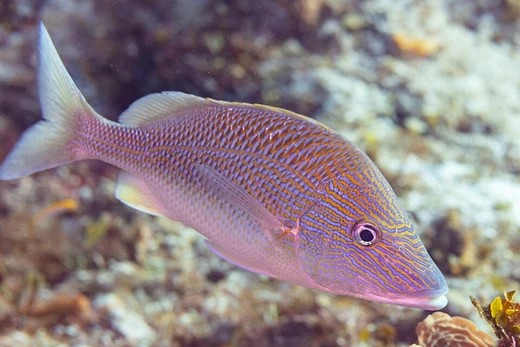
Scalemouth jobfish
The only known member of its genus, found in deep Pacific waters.

The scalemouth jobfish, or scalemouth snapper (Parapristipomoides squamimaxillaris), is a marine ray-finned fish in the snapper family Lutjanidae. It lives in the Pacific Ocean and is the sole species in its genus.
This fish has a long, slim body, with its deepest point measuring about one-third of its standard length. Its head is small and sharply pointed, with a convex area between the eyes. The lower jaw sticks out a little, and the mouth reaches back to the pupil. The upper jaw bones are covered in scales, and each jaw has a single thin band of bristle-like teeth, plus a small oval patch of teeth on the roof of the mouth. The dorsal fin has 10 spines and 10 soft rays, while the anal fin has 3 spines and 8 soft rays. The largest recorded length is 51.4 cm (20.2 in). Its main color is silvery pink, darker on the back. The fins are whitish, except the tail fin, which has a yellow upper lobe and a pinkish lower lobe.
The species has a scattered range in the southern Pacific, recorded from Easter Island, Rapa Iti, New Caledonia, and Tonga. It lives in relatively deep water, between 130 and 460 m (430 to 1,510 ft), and is associated with rocky bottoms, especially reefs.
American zoologist Harry T. Kami first described it in 1973 as *Pristipomoides squamimaxillaris*, with the type location at Easter Island. He placed it in the monotypic subgenus *Parapristipomoide*, but later researchers decided it was distinct enough to warrant its own genus, *Parapristipomoides*. The genus name means "near to *Pristipomoides*," and the species name *squamimaxillaris* means "scaly jaw," referring to its scaled jaws.
At Easter Island and Rapa Iti, this fish is caught by handline fishing and sold fresh.
Quick Facts
- Taxon
- Parapristipomoides squamimaxillaris
Facts from the source article.
Lore & Background
The scalemouth jobfish has an elongated, slender body which at its deepest point is around a third in depth as its standard length. It has a comparatively small, sharply pointed head with a convex intraorbital area. The lower jaw protrudes slightly and the mouth reaches the pupil. The maxilla are scaled, each jaw has a single, thin band of bristle-like teeth and there is a small oval-shaped patch of teeth on the vomer. The dorsal fin has 10 spines and 10 soft rays while the anal fin has 3 spines and 8 soft rays. This species attains a maximum length of 51.4 cm (20.2 in). The main colour is a silvery pink, darker on the back. The fins are whitish, except for the caudal fin which has a yellow upper lobe and a pinkish lower lobe.
The scalemouth jobfish has a scattered distribution in the southern Pacific Ocean with records from Easter Island, Rapa Iti, New Caledonia and Tonga. It is found in relatively deep water between 130 and 460 m (430 and 1,510 ft), at least. It is associated with rocky substrates, particularly reefs.
The scalemouth jobfish was first formally described in 1973 as Pristipomoides squamimaxillaris by the American zoologist Harry T. Kami with the type locality given as Easter Island. Kami placed this species in the monotypic subgenus Parapristipomoide but later workers argued that it was too different from other species in that genus and made Parapristipomoides a valid genus. The generic name means 'near to Pristipomoides' while the specific name squamimaxillaris means 'scaly jaw', a reference to the scaled jaws of this species.
Reader's Guide
The scalemouth jobfish is notable as the only known member of its genus, Parapristipomoides, a distinction that arose from taxonomic debate. Originally described in 1973 as Pristipomoides squamimaxillaris by Harry T. Kami, it was placed in the monotypic subgenus Parapristipomoide. Later workers argued that it was too different from other species in that genus and elevated Parapristipomoides to a valid genus. This species is caught by handline fishing at Easter Island and Rapa Iti, and the catch is sold fresh. Its scattered distribution across the southern Pacific Ocean, from Easter Island to Tonga, and its occurrence in relatively deep water between 130 and 460 m, associated with rocky substrates and reefs, highlight its specialized habitat. The scalemouth jobfish's scaled jaws, reflected in its scientific name, and its distinctive coloration—silvery pink with a yellow upper caudal fin lobe—further distinguish it among snappers.
Did You Know?
- The scalemouth jobfish is the only known member of its genus, Parapristipomoides.
- It was first formally described in 1973 by American zoologist Harry T. Kami.
Frequently Asked Questions
What is the scalemouth jobfish?
The scalemouth jobfish (Parapristipomoides squamimaxillaris) is a deep-water snapper belonging to the family Lutjanidae. It stands out taxonomically as the only species in its genus, making it a true one-of-a-kind within the Pacific snapper group.
Where does the scalemouth jobfish live?
This species occupies the Pacific Ocean at depths between roughly 130 and 460 meters (about 430 to 1,510 feet). Its type locality is Easter Island, the site where the original specimens were gathered.
What makes the scalemouth jobfish's mouth distinctive?
The upper jaw bones are covered in scales, a trait that gives the fish its 'scalemouth' common name. Each jaw bears a single thin row of bristle-like teeth plus a small oval tooth patch, and the lower jaw projects slightly beyond the upper.
How large does the scalemouth jobfish grow?
Adults reach a maximum length of about 51.4 centimeters (roughly 20 inches). The body is notably elongated and slender, with the deepest point of the trunk measuring only about one-third of the standard length.
Who first described the scalemouth jobfish and when?
The species was formally named in 1973 by Harry T. Kaminski. It has remained the sole representative of the genus Parapristipomoides ever since its original description.
More in Snappers and Grunts 1-24
Spotted an error? Know more?
Reader corrections go straight into our review queue. Suggest an edit · How this site is sourced