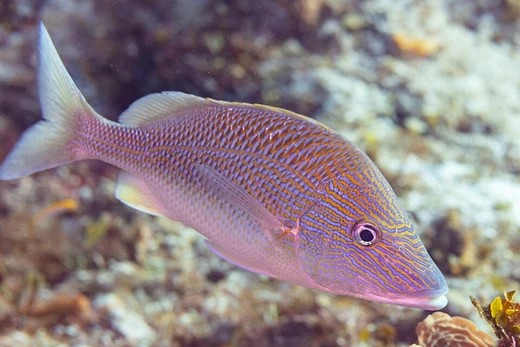
Etelis
A genus of snappers found mainly in Indian and Pacific oceans.

Etelis is a genus of marine ray-finned fish in the snapper family, Lutjanidae. Most species live in the Indian and Pacific Oceans, except for one, *E. oculatus*, which is found in the western Atlantic.
French zoologist Georges Cuvier named the genus in 1830, basing the name on a term used by Aristotle for an undescribed fish. The only species Cuvier originally placed in the genus was *Etelis carbunculus*, which is now its type species. Currently recognized species include *E. boweni*, *E. carbunculus* (deep-water red snapper), *E. coruscans* (deepwater longtail red snapper), *E. oculatus* (queen snapper), and *E. radiosus* (pale snapper). A single fossil species, *†Etelis bathypelagicus*, is known from a nearly complete skeleton from the Late Miocene Chagres Formation on Panama’s Pacific coast, suggesting it lived in deep waters of the Central American Seaway before the Isthmus of Panama formed.
These snappers are medium-sized with slender, fusiform bodies. Their jaws have small, conical teeth, with the outer row largest, and one or two pairs of enlarged canines at the front. Vomerine teeth form a V-shaped or crescent-shaped patch. The space between the eyes is flat. The continuous dorsal fin has a notch between its spiny and soft parts, with 10 spines and 10 to 11 soft rays; the anal fin has 3 spines and 8 soft rays. Both dorsal and anal fins lack scales, and the last ray of each is elongated. Pectoral fins are long, nearly as long as the head, with 15 to 17 rays. The caudal fin is forked. Coloration ranges through red or pink shades, fading to silvery or whitish on the lower sides and belly.
*Etelis* species are mainly found in the Indian Ocean and western Pacific, with the queen snapper also in the tropical western Atlantic. They live at moderate depths (90 to 450 meters) over rocky bottoms, either alone or in small groups. Their diet includes fish, squid, and crustaceans.
These snappers are important food fish, especially in the archipelagos of the Indian and western Pacific Oceans. They are caught mainly with bottom longlines and deep handlines. Considered high-quality, the catch is mostly sold fresh.
Quick Facts
- Taxon
- Etelis
- Type Species
- Etelis carbunculus
- Type Species Authority
- G. Cuvier, 1828
Facts from the source article.
Lore & Background
Etelis was named by the French zoologist Georges Cuvier in 1830 with Etelis carbunculus as its only species and, therefore, its type species. The name of the genus was taken from Aristotle by Cuvier, who said that Aristotle had used it for a fish he did not give a description for. The currently recognized species in this genus are: Etelis boweni, Etelis carbunculus, Etelis coruscans, Etelis oculatus, and Etelis radiosus. A single fossil species, †Etelis bathypelagicus, is known from a nearly complete fossil skeleton recovered from the Late Miocene-aged Chagres Formation from the Pacific coast of Panama.
Etelis snappers are medium sized Lutjanids with slender, fusiform bodies. The jaws are equipped with small, conical teeth, the outer row being the largest and they have 1 or 2 pairs of enlarged canines at their front. The vomerine teeth are placed in a v-shaped or a crescent shaped patch. The space between the eyes is flattened. They have a continuous dorsal fin but there is a notch at the junction of the spiny part of the fin, this fin has 10 spines and 10 to 11 soft rays. The anal fin has 3 spines and 8 soft rays. Both the dorsal and anal fins lack scales and the last ray in each fin is elongated compared to the neighbouring ray. The pectoral fins are long, just shorter than the head and contain 15 to 17 rays. The caudal fins are forked. These snappers are coloured in a variety of red or pink shades changing to silvery or whitish on lower flanks and abdomen.
Etelis species are found mainly in the Indian Ocean and western Pacific Ocean, with one species the queen snapper (E. oculatus) being found in the tropical western Atlantic Ocean. They are found at moderate depths, between 90 and 450 m (300 and 1,480 ft), over rock substrates. They may be solitary or found in small groups. Their diet includes fishes, squid and crustaceans.
Reader's Guide
Etelis species are important in many areas as food fish, especially among the archipelagos of the Indian and West Pacific Oceans. These fish are fished for mainly using bottom longlines and deep handlines. They are considered to be good quality food fish and the catch is mainly sold fresh. The genus includes five extant species, with one fossil species known from the Late Miocene-aged Chagres Formation from the Pacific coast of Panama, which appears to have inhabited deep waters of the Central American Seaway just prior to its closure and the formation of the Isthmus of Panama. The genus was named by Georges Cuvier in 1830, who took the name from Aristotle, who had used it for a fish he did not give a description for. The type species is Etelis carbunculus. These snappers are medium sized, slender, and fusiform, with a variety of red or pink shades. They are found at moderate depths over rock substrates, feeding on fishes, squid and crustaceans.
Frequently Asked Questions
What is Etelis?
Etelis is a genus of deep-water snappers in the family Lutjanidae, made up of five recognized ray-finned fish species. They typically occupy mid-water depths of roughly 90 to 450 meters across the Indian and Pacific Oceans.
Who named the genus Etelis and when?
French zoologist Georges Cuvier erected the genus in 1830, borrowing a term Aristotle had once applied to an undescribed fish. Cuvier originally included only Etelis carbunculus, which still serves as the type species.
How many species belong to Etelis?
Five extant species are currently accepted, including E. boweni, E. carbunculus (the deep-water red snapper), E. coruscans (the deepwater longtail red snapper), and E. oculatus. The last of these is the sole species found outside the Indo-Pacific, occurring in the western Atlantic.
Where can you find Etelis snappers in the wild?
The vast majority of species are restricted to the Indian and Pacific Oceans, living at depths between about 300 and 1,480 feet. E. oculatus is the one outlier, extending its range into the western Atlantic.
What are the key physical traits of Etelis?
Members of the genus carry ten dorsal-fin spines and are generally robust, reddish-colored fish adapted to dim mid-water environments. Common names often highlight their hue or tail shape, as seen in labels like "deep-water red snapper" and "deepwater longtail red snapper."
More in Snappers and Grunts 1-24
Spotted an error? Know more?
Reader corrections go straight into our review queue. Suggest an edit · How this site is sourced