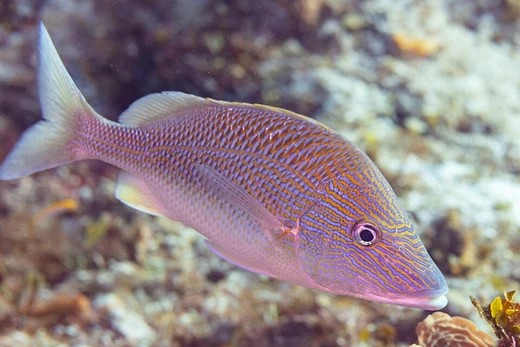
Plectorhinchus chatodonoides
A spotted Indo-Pacific sweetlips with juvenile mimicry of flatworms.

The harlequin sweetlips, also called the clown, spotted, or many-spotted sweetlips, is a marine fish in the grunt family. It lives in the Indo-Pacific. Local fisheries catch it in small numbers, and it also appears in the aquarium trade.
This fish has thick lips that swell more as it gets older. Its chin has six pores but no central pit. The dorsal fin usually has 12 spines (rarely 11) and 18 to 20 soft rays, with the soft part about as tall as its base. Young fish are brown with large, separate creamy white blotches that later develop brown spots. Adults turn grayish with big dark brown spots, each spot wider than the eye. They can reach 72 cm (28 in) long, though 60 cm (24 in) is more common, and weigh up to 7 kg (15 lb). Juveniles may mimic poisonous flatworms (Batesian mimicry). Their tail fin is deeply forked with wide, rounded lobes that are mostly white with a large brown spot; in adults, the tail is less forked.
The species ranges from the Maldives and Mauritius east to Tonga, north to the Ryukyu Islands, and south to the Great Barrier Reef. One was seen off St. Martin in the West Indies in 2007, likely released from an aquarium.
Adults live alone near ledges or caves in clear lagoons and seaward reefs, hiding during the day. Juveniles shelter in corals. They hunt at night, eating bottom-dwelling invertebrates like crustaceans and molluscs, as well as fish. Young fish often swim head-down with wiggling fins, possibly mimicking toxic flatworms or nudibranchs to avoid predators.
French naturalist Bernard Germain de Lacépède first described the species in 1801, without giving a type locality (likely somewhere in modern Indonesia). The name *chaetodonoides* means "having the form of *Chaetodon*," which at the time included both butterflyfish and marine angelfish, referring to the serrated gill cover and the then-assumed close relationship with that genus.
People catch these fish with handlines and spears. They are sold fresh or salted. Larger ones have coarse, dry meat. Colorful juveniles are collected for aquariums, and overexploitation may occur in some areas.
Quick Facts
- Taxon
- Plectorhinchus chaetodonoides
Facts from the source article.
Lore & Background
Plectorhinchus chaetodonoides has fleshy lips that become moderately swollen as the fish grows, with six pores on the chin but no central pit. The dorsal fin typically has 12 spines (rarely 11) and 18–20 soft rays, the soft-rayed part having a height roughly equal to the length of its base. Juveniles are brownish with large, discrete creamy white blotches that develop brown spotting as the fish matures; adults gradually acquire a greyish background color broken by large, dark brown spots with a diameter greater than that of the iris. The caudal fin of juveniles is deeply forked with wide rounded lobes, mostly white marked with a large brown spot, while in adults it is much less forked.
The species is distributed across the eastern Indian Ocean and western Pacific Ocean, from the Maldives and Mauritius east to Tonga, north to the Ryukyu Islands, and south to the Great Barrier Reef. One individual was seen off St. Martin in the West Indies in 2007, considered probably a deliberately released aquarium specimen. Adults are solitary, sheltering beneath ledges or caves during the day in coral-rich lagoons and seaward reefs, while juveniles shelter in corals. It is carnivorous, preying on benthic invertebrates such as crustaceans and molluscs, as well as fishes, foraging at night. Juveniles swim in a head-down posture with wildly undulating fins, a behavior thought to mimic toxic or distasteful platyhelminths or nudibranchs, providing protection from predation. It is also thought that juveniles are Batesian mimics of poisonous flatworms.
Reader's Guide
Plectorhinchus chaetodonoides holds significance as a species of minor commercial value, caught using handlines and spear, with the fish marketed fresh or preserved by salting. The meat of larger specimens has been described as coarse and dry. Its small, colorful juveniles are collected for the aquarium trade, and there may be overexploitation in some areas. The species was first formally described in 1801 by French naturalist Bernard Germain de Lacépède, with no type locality given but likely somewhere in modern Indonesia. The specific name chaetodonoides means 'having the form of Chaetodon,' referring to both butterflyfishes and marine angelfishes, alluding to the serrated operculum similar to that of marine angelfish and the then-presumed close taxonomic relationship with the genus Chaetodon. The species is notable for its juvenile mimicry of poisonous flatworms and its distinctive swimming behavior, which may deter predators. Its presence in the aquarium trade highlights its appeal, though overexploitation is a concern in some areas.
Did You Know?
- Juveniles are thought to be Batesian mimics of poisonous flatworms.
- The maximum recorded total length is 72 cm (28 in), though 60 cm (24 in) is more typical.
Frequently Asked Questions
Who is Plectorhinchus chatodonoides?
It's a marine grunt-family fish most often called the harlequin sweetlips, though you'll also see it referred to as the clown, spotted, or many-spotted sweetlips. It's a native of Indo-Pacific waters.
What does Plectorhinchus chatodonoides look like?
Juveniles are brown with large, separate creamy-white blotches, but adults shift to a grayish body covered in big dark brown spots. They're also recognizable by their notably thick lips that swell further with age, and their chin carries six pores without a central pit.
How big does Plectorhinchus chatodonoides get?
A typical adult measures around 60 cm (24 in) in total length, with the maximum recorded size reaching about 72 cm (28 in). The heaviest published weight for the species is roughly 7 kg (15 lb).
Where does Plectorhinchus chatodonoides live?
This sweetlips is found throughout the broad Indo-Pacific marine region. It's not limited to a single reef or country but spans that wide tropical zone.
Why is Plectorhinchus chatodonoides interesting to fans?
Its juveniles use flatworm mimicry as a survival trick, which is a standout defense strategy among grunts. The species also shows up in the aquarium trade and is occasionally taken in small numbers by local fisheries, so hobbyists and anglers both run into it.
More in Snappers and Grunts 1-24
Spotted an error? Know more?
Reader corrections go straight into our review queue. Suggest an edit · How this site is sourced