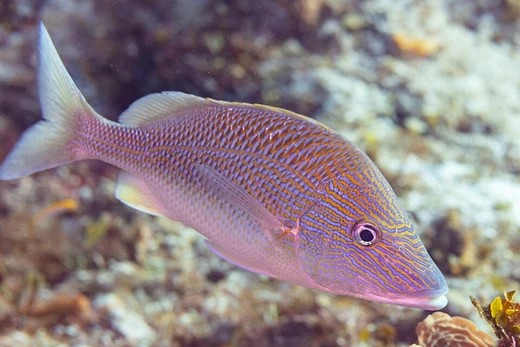
Aphareus (fish)
A genus of snappers native to the Indian and Pacific Oceans.

Aphareus is a genus of marine ray-finned fish in the snapper family Lutjanidae. These fish are found across the Indian and Pacific Oceans, ranging from the coast of Africa to the Hawaiian Islands.
The genus contains two recognized species: the small-toothed jobfish (Aphareus furca) and the rusty jobfish (Aphareus rutilans). It belongs to the subfamily Etelinae. French naturalist Georges Cuvier created the genus, taking the name from what he described as an obscure and likely corrupted passage in Aristotle, which seemed to refer to a fin specific to female tuna. The name also resembles the Arabic word *farès*, though this may be coincidental. In 1913, David Starr Jordan, John Otterbein Snyder, and Shigeho Tanaka designated *Aphareus caerulescens* (a synonym of *A. furca*) as the type species.
These snappers are medium-sized with elongated, fusiform, and fairly robust bodies. They have tiny teeth in their jaws, lack canine-like teeth, and have no vomerine teeth. Their gill openings extend relatively far forward, reaching the front of the eye. The area between the eyes is flat. The dorsal fin is continuous, without a notch between its spiny and soft-rayed sections, and has 10 spines and usually 11 soft rays (sometimes 10). The anal fin has 3 spines and 8 soft rays. The pectoral fins are long, slightly shorter than the head, and contain 15 or 16 rays. The dorsal and anal fins lack scales, and the caudal fin is forked. Their scales are comparatively small. Coloration varies from purplish-brown and blue-grey to reddish, often with a silvery sheen on the lower flanks and abdomen.
Aphareus snappers have a wide Indo-Pacific distribution, from eastern Africa to the Hawaiian Islands. They inhabit inshore waters near coral reefs and rocky bottoms, at depths from about 6 meters (20 feet) down to possibly more than 100 meters (330 feet). They may be solitary or form small schools.
These fish are important as food, particularly on islands. Fishermen catch them using handlines or bottom longlines. Their flesh is considered good quality, and the catch is usually sold fresh.
Quick Facts
- Taxon
- Aphareus
- Type Species
- Aphareus caerulescens
- Type Species Authority
- G. Cuvier, 1830
Facts from the source article.
Lore & Background
The genus Aphareus was created by the French naturalist Georges Cuvier. He took the name from an 'unintelligible and probably corrupt passage from Aristotle, where it seems to designate a fin specific to the female of the tuna'; the name is also similar to the Arabic word farès, although this could be coincidental. In 1913, David Starr Jordan, John Otterbein Snyder, and Shigeho Tanaka designated Aphareus caerulescens as the type species, which is a synonym of A. furca.
Aphareus snappers are medium-sized Lutjanids with elongated, fusiform but rather robust bodies. They have tiny teeth in their jaws with no canine-like teeth and lack any vomerine teeth. Their gill openings reach relatively far forward to the front of the eye, and the area between the eyes is flat. The dorsal fin is continuous with no notch, having 10 spines and 11 (infrequently 10) soft rays, while the anal fin contains 3 spines and 8 soft rays. They have long pectoral fins with 15 or 16 rays, and the dorsal and anal fins lack scales. The caudal fin is forked, and the scales are comparatively small. Their colour can be purplish-brown, blue-grey, or reddish, sometimes with a silvery sheen on the lower flanks and abdomen.
Aphareus snappers have a wide Indo-Pacific distribution from eastern Africa to the Hawaiian Islands. They prefer inshore waters with coral reefs and rocky bottoms at depths from around 6 m to possibly greater than 100 m. They can be solitary or occur in small schools.
Reader's Guide
Aphareus snappers are important foodfish, especially in islands. Fishermen catch them using handlines or bottom longlines. The flesh is considered to be of good quality and normally the catch is sold fresh. The genus contains two recognized species: the small-toothed jobfish (Aphareus furca) and the rusty jobfish (Aphareus rutilans). The genus was named by Georges Cuvier from a passage in Aristotle, with a possible coincidental similarity to the Arabic word farès. The type species was designated in 1913 by Jordan, Snyder, and Tanaka as Aphareus caerulescens, a synonym of A. furca. These fish are distinguished by their lack of canine-like and vomerine teeth, continuous dorsal fin, and forked caudal fin. They inhabit coral reefs and rocky bottoms in the Indian and Pacific Oceans, from the African coast to Hawaii, at depths from 6 m to over 100 m, and may be solitary or in small schools.
Did You Know?
- The genus name Aphareus comes from an 'unintelligible and probably corrupt passage from Aristotle' about a fin specific to the female tuna.
- Aphareus snappers have no canine-like teeth and lack vomerine teeth.
- The dorsal fin of Aphareus has 10 spines and 11 (infrequently 10) soft rays, with no notch.
- The type species, Aphareus caerulescens, is a synonym of Aphareus furca.
Geographic Range and Regional Recording
The Coral Sea, as delineated by the International Hydrographic Organization, stretches from the southern coast of New Guinea in the north, down through the Solomons and Vanuatu in the northeast, past New Caledonia in the southeast, and along the eastern Australian coast to 30° South. Within this vast expanse bordering Australia, Papua New Guinea, Vanuatu, and New Caledonia, species such as Aphareus have been documented. Importantly, the ranges recorded for any given species in this region represent the known distribution within Coral Sea waters specifically, not necessarily the full global or regional extent. A species might range far beyond these boundaries, but the listing captures only what has been confirmed in these particular waters. This geographic specificity matters for understanding where the fish has actually been observed versus where it might theoretically occur, and it anchors the record to a clearly defined hydrographic area rather than a vague regional label.
Taxonomic Framework and Nomenclature Conventions
The placement of Aphareus within the broader classification follows a system that aligns with Fishbase's current taxonomic usage wherever possible. This means the ordering and family assignments may differ from older cited sources, as those references were included primarily to document the existence of records or range data for the Coral Sea region rather than to establish taxonomy. Sub-taxa within any given family are arranged alphabetically as a general organizational rule. Scientific names carry author citations indicating who first described the species and when, providing a historical thread back to the original taxonomic work. Where relevant, synonyms are noted to help researchers cross-reference older literature. This framework ensures that even as our understanding of relationships between species evolves, the documentation remains traceable and consistent with the most current scientific consensus on classification.
Biodiversity Context Within the Coral Sea Fauna
Aphareus exists within an extraordinarily diverse assemblage of marine life in the Coral Sea. The documented fauna spans multiple classes and orders, from the ancient six- and seven-gill sharks of the Hexanchiformes to the familiar requiem sharks of the Carcharhiniformes. The region hosts species ranging from the massive whale shark to the small epaulette shark, from wobbegongs to bamboo sharks, from thresher sharks to mako sharks. This breadth of diversity—from the tawny nurse shark found from East Africa to the Society Islands, to the locally restricted marbled catshark found only in Northern Australia—illustrates the ecological richness of these waters. Aphareus, as part of this documented community, occupies a niche within a system that supports both widely distributed circumtropical species and those with more restricted, regionally specific ranges.
Documentation Practices and Species Recording
The recording of species like Aphareus in the Coral Sea follows a structured approach to nomenclature and documentation. Each entry pairs a locally used common name with the formal scientific name and the author citation that credits the original describer. This dual naming system serves both local fishers and the international scientific community. The list is organized by class, then order, then family, with individual species listed beneath their respective families. Citations attached to each entry primarily serve to verify that a record exists for the region or to document the range, rather than to establish the taxonomic authority. Where a species has been known by multiple names over time, synonyms are included to prevent confusion. This methodical approach ensures that the documentation of Coral Sea ichthyofauna remains a reliable reference for researchers studying distribution patterns and biodiversity across the region's waters.
Frequently Asked Questions
What is Aphareus (fish)?
Aphareus is a small genus of marine ray-finned fish placed in the snapper family Lutjanidae, specifically under the subfamily Etelinae. It groups together two species commonly called jobfish.
Which species are included in the genus Aphareus?
Only two species are currently recognized: the small-toothed jobfish (Aphareus furca) and the rusty jobfish (Aphareus rutilans). Both share the same 10 dorsal-fin spines characteristic of the genus.
Where can you find Aphareus fish in the wild?
These snappers inhabit tropical waters spanning the Indian and Pacific Oceans, with their range stretching from the coast of Africa eastward to the Hawaiian Islands.
Who named the genus Aphareus and what is the origin of the name?
French naturalist Georges Cuvier erected the genus, borrowing the name from a passage in Aristotle that he judged to be obscure and probably corrupted, apparently describing a fin he associated with female tuna. He also noted the term's resemblance to the word 'Ara.'
At what depths do Aphareus fish typically occur?
They are recorded from roughly 6 meters (about 20 feet) down and may be encountered well beyond 100 meters (330 feet), though the exact lower limit is still uncertain.
More in Snappers and Grunts 1-24
Spotted an error? Know more?
Reader corrections go straight into our review queue. Suggest an edit · How this site is sourced