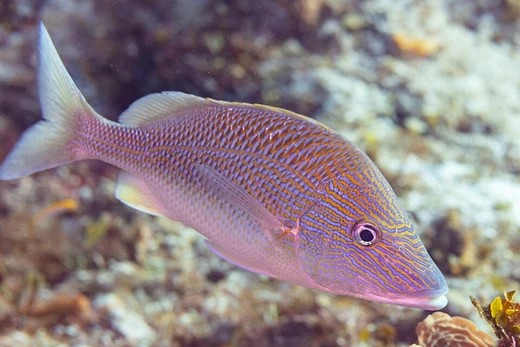
Vermilion snapper
A western Atlantic snapper, vulnerable from overfishing.

The vermilion snapper (Rhomboplites aurorubens), also called the clubhead snapper, night snapper, or beeliner, is a marine fish belonging to the snapper family Lutjanidae. It is the sole member of the genus Rhomboplites and lives in the western Atlantic Ocean.
French zoologist Georges Cuvier first described the species in 1829, naming it *Centropristis aurorubens* based on specimens from Brazil, Martinique, and Santo Domingo. Theodore Nicholas Gill later placed it in its own genus, *Rhomboplites*, in 1862, within the subfamily Lutjaninae. The genus name combines *rhombo* (rhombus-shaped) and *hoplites* (armed), referring to the rhombus-shaped patch of teeth on the vomer bone. The species name *aurorubens* comes from *aureus* (golden) and *rubens* (reddish), describing the golden-red color the fish takes on when preserved in alcohol.
The body is elongated and oblong, with a short snout, a slightly protruding lower jaw, and a small mouth. Two pairs of simple nostril holes sit on the snout. When the mouth closes, the upper jaw slides under the cheekbones. There are no enlarged canine teeth; the vomerine teeth form a triangular or rhombus-shaped patch with a wide rear extension, and the tongue has a patch of granular teeth. The dorsal fin has 12 to 13 spines and 10 to 11 soft rays, while the anal fin has 3 spines and 8 soft rays and is rounded. The pectoral fins have 17 to 19 rays and are relatively short, not reaching the anus. The caudal fin is forked but not extremely so. Maximum total length is 60 cm (24 in), though 35 cm (14 in) is more typical, and the heaviest recorded weight is 3.2 kg (7.1 lb). Overall color is bright red, fading to pink on the lower sides and whitish on the belly. Short, wavy, oblique blue lines appear on the upper sides above the lateral line, formed by spots on the scales, and yellow streaks may occur below the lateral line. The anal fin is pinkish red; the caudal fin is red with a black margin; the dorsal fin is red with a yellow margin; and the pectoral fins are red.
The species ranges from North Carolina and Bermuda south along the U.S. east coast to the Bahamas, then through the Gulf of Mexico and Caribbean Sea, and down the South American coast to Santa Catarina, Brazil. It lives at depths of 20 to 300 m (66 to 984 ft).
Quick Facts
- Taxon
- Rhomboplites aurorubens
Facts from the source article.
Lore & Background
The vermilion snapper was first formally described in 1829 by French zoologist Georges Cuvier, who placed it in the genus Centropristis. In 1862, Theodore Nicholas Gill created the monotypic genus Rhomboplites for this species, which is classified within the subfamily Lutjaninae. The generic name combines rhombo (rhombus-shaped) and hoplites (armed), referring to the rhombic patch of vomerine teeth; the specific name aurorubens combines aureus (golden) and rubens (reddish), describing the golden-red color specimens develop when preserved in alcohol.
The species has an elongated, oblong body with a short snout, slightly protruding lower jaw, and small mouth. Its dorsal fin has 12–13 spines and 10–11 soft rays, the anal fin has 3 spines and 8 soft rays, and the pectoral fins have 17–19 rays. The overall color is bright red, fading to pink on the lower flanks and whitish on the abdomen, with short wavy oblique blue lines above the lateral line and sometimes yellow streaks below. The caudal fin is red with a black margin, the dorsal fin red with a yellow margin, and the pectoral and anal fins are red or pinkish red.
Vermilion snappers frequently aggregate in large schools, often with red snapper species Lutjanus campechanus and Lutjanus purpureus, especially younger individuals. They are predatory, foraging on benthic and pelagic fishes, shrimps, crabs, polychaetes, cephalopods, and other invertebrates. Spawning seasons vary by location: in the Gulf of Mexico and off the eastern United States it runs from mid-April to mid-September; off Trinidad and Tobago it occurs year-round, peaking June to November; and over the Abrolhos Bank off Brazil it occurs in February and March. They are slow-growing, with a longevity of more than 15 years, and reach sexual maturity at 1 to 2 years old.
Reader's Guide
The vermilion snapper is subjected to severe fishing pressure across nearly its entire range, targeted by commercial, artisanal, and recreational fisheries using hook and line, trawling, and traps. Its flesh is considered good eating, though the catch may also be used for fish meal, and it is often sold as red snapper. The IUCN assesses the vermilion snapper as Vulnerable due to overfishing in many parts of its range, leading to an overall population decline of up to 30%. In United States waters, three stocks are recognized: two for this species alone in the southern Atlantic coast and the Gulf of Mexico, and a 'snapper complex' in the Caribbean. None of these stocks is regarded as subject to overfishing. The species is found from North Carolina and Bermuda south through the Gulf of Mexico and Caribbean Sea to Santa Catarina, Brazil, at depths between 20 and 300 meters, typically over rock, gravel, or sand substrates near the edge of continental and island shelves. Juveniles occur in shallower waters. Its status as a heavily fished species with a vulnerable conservation rating underscores its significance in western Atlantic fisheries.
Did You Know?
- The vermilion snapper is the only species in the monotypic genus Rhomboplites.
- Its specific name aurorubens combines Latin for 'golden' and 'reddish', describing its alcohol-preserved color.
- It can live more than 15 years and reaches sexual maturity at 1 to 2 years old.
More in Snappers and Grunts 1-24
Spotted an error? Know more?
Reader corrections go straight into our review queue. Suggest an edit · How this site is sourced