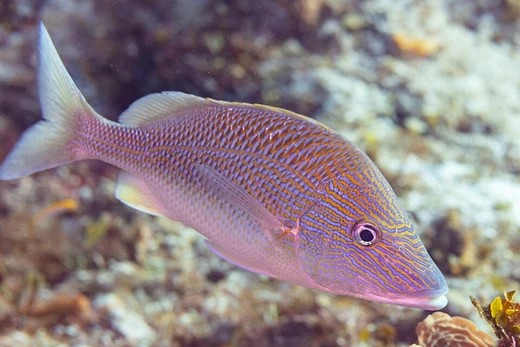
Green jobfish
A robust Indo-Pacific snapper, important for fisheries and game fishing.

The green jobfish (Aprion virescens), also called the gray jobfish, gray snapper, slender snapper, or uku in Hawaiian, is a type of snapper in the family Lutjanidae. It is the only species in its genus and lives across the Indo-Pacific region. This fish is found in various reef habitats, from the surface down to 120 meters deep. It is highly valued in local commercial fisheries and is a popular target for sport fishing, though it can carry ciguatera toxin.
This fish has a sturdy, elongated body that is round in cross-section. Its head is long with a blunt snout, and a noticeable groove runs from the snout to the eye. The tail fin is deeply forked. The jaws have bands of teeth with two distinct canines at the front, and the vomerine teeth form a crescent-shaped patch. The dorsal fin has 10 spines and 11 soft rays, while the anal fin has 3 spines and 8 soft rays. The body is dark green to bluish, fading toward the belly, and the spiny part of the dorsal fin has black spots at the base of the last five spines. It can reach a maximum length of 112 cm (44 in), though 90 cm (35 in) is more typical, and a top weight of 15.4 kg (34 lb).
The green jobfish has a wide range across the Indo-Pacific, from the Red Sea and eastern Africa down to northeastern South Africa, across the Indian Ocean, and into the Pacific as far north as southern Japan, south to Australia and Rapa Iti, and east to Hawaii. In Australia, it appears from Ningaloo Reef to Rowley Shoals, Scott Reef, and the Ashmore and Cartier Islands in the Timor Sea, as well as from the northern Great Barrier Reef south to Wooli in New South Wales. It is also found at Lord Howe Island, Middleton Reef, Christmas Island, and the Cocos (Keeling) Islands.
This species is a benthopelagic fish that lives in open waters of deep lagoons, channels, or seaward reefs from the surface down to 120 m. It is usually seen alone but may form small schools. Its diet consists mainly of fish, but it also eats crustaceans, cephalopods, and zooplankton. Off Hawaii, spawning has been observed from May to October, and the fish spawns multiple times. Females reach sexual maturity at about 4.5 years old, when they are around 40 cm (16 in) long.
The green jobfish was first formally described in 1830 by French zoologist Achille Valenciennes, with the type location given as the Seychelles.
Quick Facts
- Taxon
- Aprion virescens
Facts from the source article.
Lore & Background
The green jobfish was first formally described in 1830 by the French zoologist Achille Valenciennes with the type locality given as the Seychelles. It is the only species in the genus Aprion. The generic name Aprion is a compound of a meaning 'without' and prion meaning 'saw', a reference to the unserrated preoperculum. The specific name virescens means 'greenish' referring to the overall colour of the body.
The green jobfish is a robust fish with an elongate body which is cylindrical in cross-section. The head is also elongate with a blunt snout, with an obvious longitudinal groove running from the snout to the eye and it has a deeply forked caudal fin. The teeth in the jaws are arranged in bands with 2 distinct canines at the front. The vomerine teeth are set out in a crescent shaped patch. The overall colour of the body is dark green to bluish, fading towards the abdomen. The spiny part of the dorsal fin has black spots at the base of the five rearmost spines.
It is a benthopelagic fish of open waters of deep lagoons, channels, or seaward reefs at depths from the surface down to 120 m. It is typically encountered singly but they may aggregate into small schools. Its diet is dominated by fishes but it is also known to feed on crustaceans, cephalopods and zooplankton. This species has been observed to spawn in May to October off Hawaii and it is known that they are multiple spawners. They reach sexual maturity at 4.5 years, when the females are around 40 cm in length.
Reader's Guide
The green jobfish is considered to have good quality flesh and is an important part of some subsistence fisheries. It is commonly sold fresh in many fish markets, but also preserved by drying and salting. In Hawaii it is one of the four most important species of snapper for fisheries, one of the prime quarry fish for the handlines bottom fishery and it is managed as part of the bottom fish management unit. It is one of the most important quarry species throughout its range and in 2010 the catch was 2,350 t. Larger individuals can be dangerous to eat because they are known to be a cause of ciguatera poisoning in humans. It is also a popular quarry in sports fishing and is sometimes found in the aquarium trade. Its wide Indo-Pacific distribution extends from the Red Sea and the eastern coast of Africa as far south as northeastern South Africa and across the Indian Ocean into the Pacific Ocean where it is found north to southern Japan, south to Australia and Rapa Iti and east to Hawaii.
Did You Know?
- The green jobfish is the only known member of its genus, Aprion.
- It attains a maximum total length of 112 cm and a maximum published weight of 15.4 kg.
- It has been observed to spawn from May to October off Hawaii and is a multiple spawner.
Frequently Asked Questions
Who is Green jobfish?
The green jobfish (Aprion virescens) is a standalone snapper species found in Indo-Pacific waters, and it is the sole representative of its genus. Locals also know it as the gray jobfish, slender snapper, or by the Hawaiian name uku.
What are Green jobfish's powers or role in the reef?
This sturdy, elongated snapper patrols reef habitats from the surface down to 120 meters, giving it a remarkably wide vertical range among Lutjanidae. Its long head, blunt snout, and a visible groove along the jaw set it apart from neighboring reef predators.
Why is Green jobfish important to fans and anglers?
It is a highly sought-after game fish and a staple of local commercial fisheries throughout its range. One major caveat for anglers and consumers is that it can carry ciguatera toxin, so safe handling and preparation are essential.
Where does Green jobfish live, and what does it look like?
It inhabits reef environments across the Indo-Pacific, ranging from open surface waters to depths of 120 meters. Its body is robust and round in cross-section, with a dorsal fin of 10 spines and 11 soft rays, plus an anal fin of 3 spines and 8 soft rays.
More in Snappers and Grunts 1-24
Spotted an error? Know more?
Reader corrections go straight into our review queue. Suggest an edit · How this site is sourced