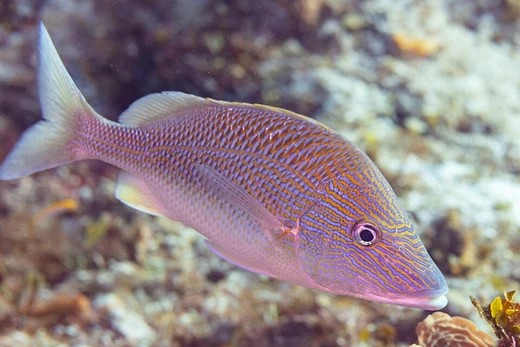
Sailfin snapper
A monotypic snapper with blue stripes and a black tail spot.

The sailfin snapper (Symphorichthys spilurus), also called the blue-lined sea bream or blue-lined sea perch, is a marine ray-finned fish in the snapper family Lutjanidae. It lives in the Indo-Pacific region and is the only species in its genus.
German-born British ichthyologist Albert Günther first described it in 1874 as *Symphorus spilurus*, based on a specimen from Palau. In 1967, Australian marine scientist Ian Stafford Ross Munro moved it to its own genus, *Symphorichthys*, which is one of two genera in the subfamily Paradicichthyinae. The genus name refers to its earlier placement in *Symphorus*, and the species name *spilurus* combines the Greek words for "spot" and "tail," referring to the large black blotch on the upper part of the adult's caudal peduncle.
This fish has a deep, laterally compressed body with a rounded head profile, angular forehead, and steep snout. Its mouth reaches to the front edge of the eye, and there is no notch or bump on the preoperculum. The upper jaw has a row of small, flattened teeth, while the lower jaw has about three rows; both jaws also have an outer row of short conical teeth that are slightly larger. There are no vomerine teeth. The dorsal fin has 10 spines and 14–18 soft rays, and the anal fin has 3 spines and 8–11 soft rays. At least one of the front soft rays in both fins extends beyond the membrane as a long filament. The pectoral fins are long, sometimes reaching past the anus, and have 16 rays. The tail fin is slightly forked. The fish can grow up to 60 cm (24 in) in total length, but 50 cm (20 in) is more common. Its body is yellowish with blue horizontal stripes along the sides. A large black spot with a pale border sits on the upper caudal peduncle, and there is an orange bar over the eye and another behind the head. Juveniles are pale grey with a wide black stripe bordered in white running from the snout to the tail's rear edge, and their dorsal and anal fin filaments are yellowish.
The sailfin snapper is found in the eastern Indian Ocean and western Pacific Ocean. In the Indian Ocean, it occurs near the Rowley Shoals and Broome, Western Australia. In the Pacific, its range extends east to Tonga and Fiji, north to the Ryukyu Islands, and south to New Caledonia and the Great Barrier Reef. It has also been recorded near the Mentawai Islands off western Sumatra and off the west coast of Thailand.
Quick Facts
- Taxon
- Symphorichthys spilurus
Facts from the source article.
Lore & Background
The sailfin snapper was first formally described in 1874 by the German-born British ichthyologist Albert Günther as Symphorus spilurus, with the type locality given as Palau. The Australian marine scientist Ian Stafford Ross Munro placed it in the monotypic genus Symphorichthys in 1967. The genus name Symphorichthys references its former classification within Symphorus, and the specific name spilurus combines spilos (spot) and urus (tail), referring to the large black blotch on the dorsal surface of the adults' caudal peduncle.
The body is deep and laterally compressed, with a rounded dorsal head profile, angular forehead, and steeply sloped snout. The mouth extends to the anterior edge of the eye. The dorsal fin has 10 spines and 14–18 soft rays; the anal fin has 3 spines and 8–11 soft rays. At least one anterior soft ray in both fins extends beyond the membrane as a long filament. The pectoral fins are long, sometimes past the anus, with 16 rays. The caudal fin is emarginate. Adults are yellowish with blue horizontal stripes and a large pale-margined black spot on the upper caudal peduncle, plus an orange bar over the eye and another behind the head. Juveniles are pale grey with a white-bordered black stripe along the flanks and yellowish filaments.
The sailfin snapper is found in the eastern Indian Ocean and western Pacific Ocean, from the Rowley Shoals and Broome, Western Australia, east to Tonga and Fiji, north to the Ryukyu Islands, and south to New Caledonia and the Great Barrier Reef, with records from the Mentawai Islands and off western Thailand. It occurs at depths between 5 and 60 m, living in sandy areas near reefs in lagoons and over outer reefs. It is typically solitary but aggregates to spawn along outer reef edges, foraging for benthic crustaceans, molluscs, and fishes.
Reader's Guide
The sailfin snapper is targeted in mixed-species fisheries throughout its range. In areas such as the Philippines it is known to be overfished, while in others, for example Palau, pressure is lighter. It is caught predominantly using handlines and bottom trawling. Juveniles appear in the aquarium trade. As the only known member of its genus, Symphorichthys, it holds taxonomic significance within the subfamily Paradicichthyinae of the snapper family Lutjanidae. Its description by Albert Günther in 1874 and later reclassification by Ian Stafford Ross Munro in 1967 mark key steps in its scientific recognition. The species' distribution across the Indo-Pacific and its role in mixed-species fisheries highlight its ecological and economic importance, though overfishing in some regions underscores conservation concerns. Its distinctive appearance, including blue stripes and elongated fin filaments, makes it notable both in the wild and in the aquarium trade.
Did You Know?
- The sailfin snapper is the only known member of the genus Symphorichthys.
- It was first formally described in 1874 by Albert Günther with the type locality given as Palau.
- The specific name spilurus means 'spot tail', referring to the black blotch on the caudal peduncle.
- Juveniles have a pale grey body with a white-bordered black stripe and yellowish fin filaments.
More in Snappers and Grunts 1-24
Spotted an error? Know more?
Reader corrections go straight into our review queue. Suggest an edit · How this site is sourced