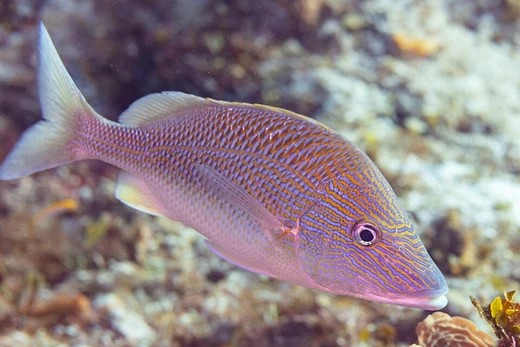
Randall's snapper
A deepwater snapper of the Indo-Pacific, named for John E. Randall.

Randall's snapper (Randallichthys filamentosus) is a ray-finned fish in the snapper family Lutjanidae, found in the Indo-Pacific. It is the sole species in the genus Randallichthys. The species was first described in 1970 by French ichthyologist Pierre Fourmanoir, who named it *Etelis filamentosus* based on a specimen from New Caledonia. In 1977, William D. Anderson Jr., Harry T. Kami, and G. David Johnson moved it into its own genus, *Randallichthys*. The specific name *filamentosus* refers to the filament-like extensions on several caudal fin rays of the original specimen, though this trait is not seen in other individuals. The genus name honors American ichthyologist John Ernest Randall, who worked at the Bishop Museum in Honolulu and contributed greatly to the study of Indo-Pacific fishes. This snapper has a fairly elongate body, a short snout, a blunt head, and a flattened area between the eyes. Its lower jaw sticks out, and the vomerine teeth form a chevron shape; there are no teeth on the tongue. The dorsal fin has 10 spines and 12 soft rays, and the anal fin has 3 spines and 9 soft rays; neither fin has scales at the base. The short pectoral fins do not reach the anus and have 16 to 17 rays. The caudal fin is crescent-shaped, and in young fish the lower lobe rays may be drawn out into filaments. The body is rosy with a yellowish tint on the back. The dorsal fin is greyish yellow, while the anal and caudal fins are rosy; all fins, including the pelvic fins, have dark to black edges. Maximum total length is 50 cm (20 in), though 40 cm (16 in) is more common. Randall's snapper lives in the eastern Indian Ocean and western Pacific, with records from New Caledonia (the type locality), the Hawaiian Islands, the Cook Islands, the Ryukyu Islands, the Izu Islands, the Ogasawara Islands, Chuuk, Majuro, the Society Islands, and Tonga. In Australia it has been found off Esperance in southern Western Australia, at Scott Reef off northwestern Western Australia, and near Lord Howe Island in the Tasman Sea. The species is uncommon and likely more widespread than currently known. It inhabits relatively deep water, between 150 and 380 m (490 to 1,250 ft), over rocky bottoms. Commercially, Randall's snapper is taken by hook and line in areas where it occurs, though it is of secondary importance. Its flesh is considered good quality and is sold fresh.
Quick Facts
- Taxon
- Randallichthys filamentosus
Facts from the source article.
Lore & Background
Randall's snapper was first formally described in 1970 as Etelis filamenosus by the French ichthyologist Pierre Fourmanoir, with the type locality given as New Caledonia. In 1977, William D. Anderson Jr, Harry T. Kami and G. David Johnson placed E. filamentosus into the monotypic genus Randallichthys. The specific name means 'filamentous', which Fourmanoir gave it because the holotype had several caudal fin rays which extended into filaments, although this is not a feature seen in other specimens. The name of the genus honours the American ichthyologist John Ernest Randall, who worked at the Bishop Museum, Honolulu, and who made a significant contribution to the study of Indo-Pacific fishes. Randall's snapper has a relatively elongate body with a short snout, blunt head and a flattened space between the eyes. The lower jaw is protruding. The vomerine teeth are arranged in a chevron and there are no teeth on the tongue. The dorsal fin has 10 spines and 12 soft rays while the anal fin has 3 spines and 9 soft rays, both these fins have no scales on their bases. The short pectoral fins do not extend as far as the anus and contain 16-17 rays. The caudal fin is lunate and in young individuals the rays of the lower lobe may be produced into filaments. The overall colour of this fish is rosy with a yellowish hue on the back. The dorsal fin is greyish yellow and the anal and caudal fins are rosy. All of these fins, as well as the pelvic fins, have dark to black margins. Randall's snapper is found in the eastern Indian Ocean and the western Pacific Ocean. It has been recorded from New Caledonia, the Hawaiian Islands, the Cook Islands, the Ryukyu Islands, Izu Islands, Ogasawara Islands, Chuuk, Majuro, the Society Islands and Tonga. It has also been found at scattered localities around Australia, off Esperance on the southern coast of Western Australia, Scott Reef off northwestern Western Australia and Lord Howe Island in the Tasman Sea. This is an uncommon species and will probably be proven to be more widespread. It occurs in comparatively deep water over rocky substrates.
Reader's Guide
Randall's snapper is a species of commercial importance in places in which it occurs, albeit of lesser importance. They are typically caught using hook and line. The flesh is considered to be of good quality and is sold fresh. The species attains a maximum total length of 50 cm (20 in), although 40 cm (16 in) is more typical. Its distribution spans the eastern Indian Ocean and western Pacific Ocean, with records from numerous island groups and scattered Australian localities. The species is uncommon and may be more widespread than currently known. Its placement in the monotypic genus Randallichthys, named after John Ernest Randall, underscores its taxonomic distinctiveness among snappers.
Did You Know?
- The holotype of Randall's snapper had several caudal fin rays extended into filaments, but this feature is not seen in other specimens.
- The genus Randallichthys is monotypic, containing only this species.
- The species was originally described in 1970 as Etelis filamenosus by Pierre Fourmanoir.
- Randall's snapper is found at depths between 150 and 380 m over rocky substrates.
More in Snappers and Grunts 1-24
Spotted an error? Know more?
Reader corrections go straight into our review queue. Suggest an edit · How this site is sourced