Pristipomoides
A genus of snappers found in warm oceans worldwide.

Pristipomoides is a genus of marine ray-finned fish in the snapper family, Lutjanidae. These fish live in the Atlantic, Indian, and Pacific Oceans. They are considered important food fish, especially in the western Pacific, and are usually caught with bottom longlines or deep handlines.
The genus was established in 1852 by Dutch scientist Pieter Bleeker, who originally placed only one species, *Pristipomoides typus*, in it. The name combines *Pristipoma* with the suffix *-oides*, meaning "like," because Bleeker thought this fish was related to the grunt genus *Pristipoma* (now considered a synonym of *Pomadasys*). Some authorities recognize two subgenera within the genus, which contains 11 recognized species.
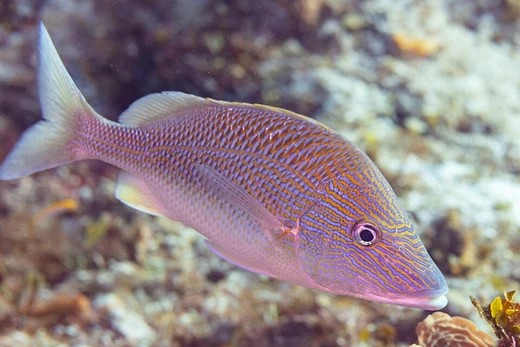
These snappers are small to medium-sized, with bodies that are typically slender and elongate, though some are more robust. They have an outer row of enlarged conical teeth and an inner band of bristle-like teeth, often with enlarged canines at the front of the jaws. The vomerine teeth form a V-shaped or triangular patch, except in *Pristipomoides sieboldii*, which has a rear extension and is the only species with teeth on its tongue. The space between the eyes is flat. The continuous dorsal fin has 10 spines and 10 to 11 soft rays, while the anal fin has 3 spines and 7 to 8 soft rays. Both fins lack scales, and their last rays are noticeably extended. The long pectoral fins have 15 to 17 rays and are about two-thirds the length of the head. The caudal fin is forked, and the body scales are medium to small. Their color is typically pink or rosy, sometimes purple, violet, or lavender on the back and upper sides, with silver or white on the lower sides and belly.
*Pristipomoides* snappers inhabit warmer waters of the Indo-Pacific and the western Atlantic. They live in relatively deep water, from 20 to 550 meters, usually over rocky bottoms. They may be solitary or gather in small schools. Like other snappers, they are predators that feed on smaller fish, squid, crustaceans, and pelagic tunicates. Their flesh is considered good quality, and they are mostly sold fresh, though some is frozen.
Quick Facts
- Taxon
- Pristipomoides
- Type Species
- Pristipomoides typus
- Type Species Authority
- Bleeker, 1852
Facts from the source article.
Lore & Background
The genus Pristipomoides was created by the Dutch ichthyologist, herpetologist and physician Pieter Bleeker in 1852 as a monotypic genus with Pristipomoides typus as its only species. The generic name is a compound of Pristipoma with the suffix oides meaning 'like', because Bleeker thought P. typus was more closely related to the genus Pristipoma, now regarded as a synonym of the grunt genus Pomadasys in the family Haemulidae. There are two subgenera recognized by some authorities and 11 currently recognized species, though one species, P. amoenus, is treated as a synonym of P. argyrogrammicus by Fishbase but regarded as valid by the Catalog of Fishes.
Pristipomoides snappers are small to medium-sized with fusiform, relatively slender and elongate bodies. They have an outer row of enlarged conical teeth and an inner band of bristle-like teeth, with enlarged canines often placed on the front of the jaws. The vomerine teeth are arranged in a V-shaped or triangular patch, except in Pristipomoides sieboldii which has a median extension and is the only species with teeth on its tongue. The dorsal fin is continuous and not notched, containing 10 spines and 10-11 soft rays, while the anal fin has 3 spines and 7-8 soft rays. The last ray of the dorsal and anal fins is extended and noticeably longer than neighboring rays. The pectoral fins are long, equivalent to two-thirds of head length, with 15-17 fin rays. The caudal fin is forked, and body scales are medium-sized to relatively small. Coloration is typically pink or rosy, occasionally purple, violet, or lavender on the back and upper flanks, with silver or whitish lower flanks and abdomen.
Reader's Guide
Pristipomoides snappers are found in relatively deep water, at depths between 20 and 550 m, typically over rocky substrates. They may live as solitary fish or aggregate in small shoals. Like other snappers, they are predatory fishes that prey on smaller fishes, squid, crustaceans, and pelagic tunicates. These fish are normally caught using bottom longlines and deep handlines, though beam trawls may also be used. They are considered to have good quality flesh and are largely sold fresh, although some of the catch may be preserved by freezing. Their significance lies in their role as important food fish in some areas, especially in the western Pacific Ocean. The genus is distributed in the warmer waters of the Indo-Pacific region and the western Atlantic Ocean.
Did You Know?
- Pristipomoides sieboldii is the only species in the genus with teeth on its tongue.
- The dorsal fin of Pristipomoides snappers has 10 spines and 10-11 soft rays, and the last ray is extended and noticeably longer than neighboring rays.
Frequently Asked Questions
Who is Pristipomoides?
Pristipomoides is a genus of marine ray-finned fish belonging to the snapper family Lutjanidae. It currently encompasses eleven species that inhabit warm waters across the Atlantic, Indian, and Pacific Oceans.
What are Pristipomoides's powers/role?
These snappers are highly valued as food fish, particularly in the western Pacific region, where they are typically harvested using bottom longlines or deep handlines. They occupy a wide depth range, from about 20 meters down to 550 meters.
How was Pristipomoides's story started?
The genus was first described in 1852 by Dutch ichthyologist Pieter Bleeker, who originally included just a single species, Pristipomoides typus, in the group. Over time, the genus expanded to its current eleven species.
Why is Pristipomoides important to fans and anglers?
Because these fish are a significant source of food in many western Pacific fishing communities, they hold a practical place in local cuisines and fishing traditions. Their deep-water habitat and robust build make them a sought-after catch for deep handline anglers.
What does the name Pristipomoides actually mean?
The name is a blend of the grunt genus Pristipoma and the Greek suffix -oides, which translates to 'resembling' or 'like.' Bleeker coined it because he believed the type species looked closely related to that grunt group, though modern taxonomy places it firmly among the snappers.
More in Snappers and Grunts 1-24
Spotted an error? Know more?
Reader corrections go straight into our review queue. Suggest an edit · How this site is sourced