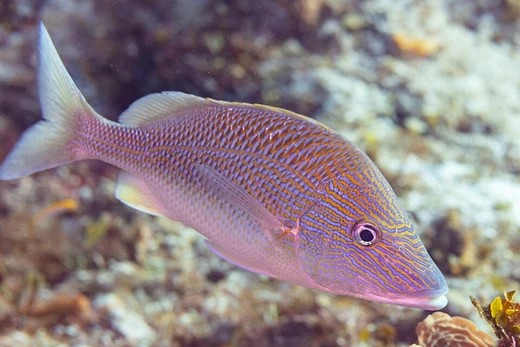
Parapristipoma octolineatum
A striped grunt found in the eastern Atlantic Ocean.

The African striped grunt, scientifically named *Parapristipoma octolineatum*, is a marine fish from the sweetlips group, which falls under the grunt family Haemulidae. It lives in the eastern Atlantic Ocean.
This fish has a long body, a large eye, and a big, slanted mouth with a noticeable chin and a short snout. Its dorsal fin is continuous, with 13 spines and 14 to 15 soft rays; the anal fin has 3 spines and 7 soft rays. Though it looks black underwater, its upper body is actually brownish, and its lower body is silvery. Four white horizontal stripes run along each side, with two passing through its black eyes. Its fins are yellow, and the tail fin is brighter than the others. The maximum standard length is 50 cm, but a more typical size is 25 cm.
The species ranges along West Africa from Angola north to Morocco, including the Gulf of Guinea islands, the Macaronesian Islands, and the southern Iberian Peninsula. It also reaches into the southern Mediterranean as far east as Tunisia. It has been recorded as a vagrant in the Bay of Biscay off France.
Found at depths between 2 and 180 meters, the African striped grunt lives over sandy and rocky bottoms, feeding on crustaceans and molluscs. Males and females form distinct pairs for spawning, and juveniles move inshore to claim territories.
First formally described in 1833 by French zoologist Achille Valenciennes, with the type location given as Gorée in Senegal, its species name *octolineatum* means "eight-lined," referring to the four stripes on each flank.
The fish is caught occasionally across its range, but it is not common, and its catch is not reported separately. It is taken with trammel nets, bottom trawls, and hook and line, and most of the catch is sold fresh.
Quick Facts
- Taxon
- Parapristipoma octolineatum
Facts from the source article.
Lore & Background
The African striped grunt has an elongated body with a large eye and a large, oblique mouth, an obvious chin, and a short snout. It has a continuous dorsal fin containing 13 spines and 14-15 soft rays, while the anal fin has 3 spines and 7 soft rays. Underwater it appears black, but the upper body is brownish and the lower body silvery, with four white horizontal stripes along each flank, two of which run through the black eyes. The fins are yellow, with the caudal fin being more vivid than the others. The maximum standard length is 50 cm, though a more typical standard length is 25 cm.
The species ranges along the western coast of Africa from Angola north to Morocco, including the islands in the Gulf of Guinea, the Macaronesian Islands, and the southern Iberian Peninsula, extending into the southern Mediterranean as far east as Tunisia. Vagrancy has occurred in the Bay of Biscay off the western coast of France. It occurs at depths between 2 and 180 m over sandy and rocky substrates, feeding on crustaceans and molluscs. Males and females form distinct pairs for spawning, and juveniles move inshore to take up territories.
Reader's Guide
The African striped grunt was first formally described in 1833 by the French zoologist Achille Valenciennes, with the type locality given as Gorée in Senegal. Its specific name octolineatum means 'eight-lined,' a reference to the four stripes on each flank. The species is occasionally caught throughout its range, but it is apparently not common and the catch is not reported separately. It is caught using trammel nets, bottom trawls, and hook and line, and the catch is largely sold fresh. Its significance lies in its distinctive striped appearance and its role as a representative of the grunt family in the eastern Atlantic, though it is not a major commercial species.
More in Snappers and Grunts 1-24
Spotted an error? Know more?
Reader corrections go straight into our review queue. Suggest an edit · How this site is sourced