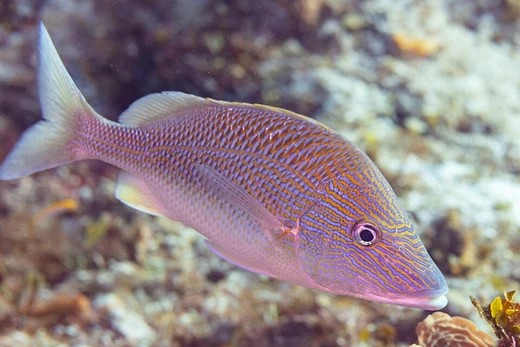
Mexican barred snapper
Monotypic snapper endemic to the eastern Pacific Ocean.

The Mexican barred snapper (Hoplopagrus guentherii), also called the barred pargo, is a marine fish in the snapper family Lutjanidae. It lives in the eastern Pacific Ocean and is the sole member of its genus.
This species was first scientifically described in 1862 by American ichthyologist Theodore Nicholas Gill, who gave the type location as Baja California. The genus name likely combines *hoplo* ("armed," referring to the serrated preoperculum) and *pagrus* ("porgy"), as Gill thought the fish was intermediate between snappers and porgies. The specific name honors German-born British ichthyologist Albert Günther. An extinct snapper called *Hypsocephalus*, known from the Late Eocene of Florida, is thought to be the closest relative of *Hoplopagrus* based on skull similarities. Its presence in the Atlantic suggests that *Hoplopagrus* relatives once ranged across both tropical Pacific and Atlantic coasts of the Americas, later shrinking to the Pacific due to cooling and falling sea levels.
The Mexican barred snapper has a deep, moderately compressed body—the deepest among snappers, with a depth 44–46% of its length. Its preoperculum is strongly notched with a distinct knob. It has a long, downward-pointing tubular front nostril and a rear nostril set in a deep groove before the eye. The jaws hold bands of robust molar-like teeth, with similar teeth on the vomer but none on the tongue. The dorsal fin has 10 spines and 14 soft rays; the anal fin has 3 spines and 9 soft rays; both fins have scales at their bases. Long pectoral fins, with 16–17 rays, extend past the anus. Overall color is reddish-brown, browner on the head, with a white chin and six alternating broad and narrow vertical white bars on the sides. Juveniles have closely paired bars and a black spot at the base of the dorsal fin rays. Maximum total length is 92 cm (36 in), though 50 cm (20 in) is more typical, and the heaviest recorded weight is 9.6 kg (21 lb).
The species is endemic to the eastern Pacific, from southern Baja California and the northern Gulf of California south to Ecuador, including the Galapagos, Malpelo, and Cocos Islands. It lives at depths of 3 to 50 m (9.8 to 164 ft). Adults inhabit rocky areas near coral reefs and caves; juveniles are found in rocky tidal pools.
Quick Facts
- Taxon
- Hoplopagrus guentherii
Facts from the source article.
Lore & Background
The Mexican barred snapper was first formally described in 1862 by the American ichthyologist Theodore Nicholas Gill, with the type locality given as Baja California. The genus Hoplopagrus is monotypic, with H. guentherii as its only species. Gill did not explain the etymology of the genus name, but it is thought to be a compound of hoplo meaning 'armed', a reference to the serrated preoperculum, and pagrus meaning 'porgy', as this taxon was assumed to be intermediate between snappers and the porgies of the family Sparidae. The specific name honours the German born British ichthyologist Albert Günther.
Hypsocephalus, an extinct snapper from the Late Eocene of Florida, US, is thought to be the sister genus to the extant Hoplopagrus, based on their very similar skull morphologies. The presence of Hypsocephalus in the Atlantic region suggests that during the Paleogene, relatives of Hoplopagrus had a much wider distribution on both the tropical Pacific and Atlantic coasts of the Americas, followed by a presumed range contraction to the Pacific due to global cooling and sea level falls.
The Mexican barred snapper has a moderately compressed deep body, the deepest body of all the snappers being 44-46% as deep as it is long. The preoperculum is strongly incised and has an obvious knob. It has a long anterior, tubular nostril which points downwards while the posterior nostril is set in a relatively long deep groove in front of the eye. The jaws are equipped with a band of robust molar-like teeth, and there are several similar vomerine teeth but no teeth on the tongue. The dorsal fin has 10 spines and 14 soft rays while the anal fin contains 3 spines and 9 soft rays, there are scales on the bases of both these fins. The long pectoral fins extend past the level of the anus and contain 16-17 rays. The overall colour is reddish-brown, browner on the head with a white chin. There are six alternating broad and slender vertical white bars on their flanks. The juveniles are marked with closely paired bars on their flanks and a black spot on the base of the dorsal fin rays.
Reader's Guide
The Mexican barred snapper is of some importance to subsistence fisheries and is caught using gill nets and hook and line. The catch is usually sold fresh. Its significance lies in its unique taxonomic position as the only species in its genus, and its evolutionary history as indicated by the extinct sister genus Hypsocephalus from the Late Eocene of Florida. This suggests that during the Paleogene, relatives of Hoplopagrus had a much wider distribution across both the tropical Pacific and Atlantic coasts of the Americas, followed by a presumed range contraction to the Pacific due to global cooling and sea level falls. The species is endemic to the eastern Pacific Ocean, ranging from southern Baja California and the northern Gulf of California south to Ecuador, and is also found around the Galapagos, Malpelo and the Cocos Islands. Adults inhabit rocky areas near coral reefs and caves at depths between 3 and 50 m, while juveniles can be found in rocky tidal pools. Very little is known about its biology, though it is a nocturnal predator on other fishes and crustaceans, emerging at night from day shelters in caves and crevices to hunt.
Did You Know?
- The Mexican barred snapper is the only species in its genus Hoplopagrus.
- It has the deepest body of all snappers, with depth 44-46% of its length.
- Its extinct sister genus Hypsocephalus is known from the Late Eocene of Florida.
- The species was first described in 1862 by Theodore Nicholas Gill.
More in Snappers and Grunts 1-24
Spotted an error? Know more?
Reader corrections go straight into our review queue. Suggest an edit · How this site is sourced