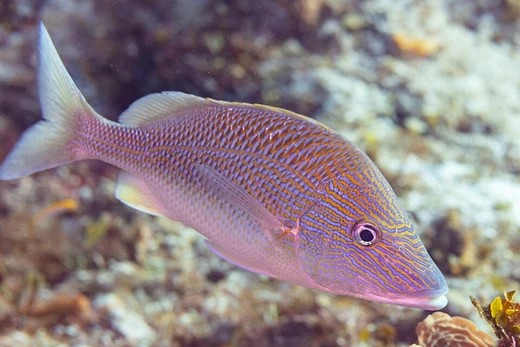
Japanese snapper
A blue-bodied snapper valued as a food fish in Japan.

The Japanese snapper (Paracaesio caerulea) is a marine fish from the snapper family Lutjanidae, found in the Western Pacific Ocean. Its body is slender and fusiform, with large eyes and a convex area between them. The jaws are equal in length and lined with bristle-like teeth, and the snout is short. The pectoral fins are long, reaching the anus, and the caudal fin may be slightly forked or lunate. The dorsal fin has 10 spines and 10 soft rays, while the anal fin has 3 spines and 8 soft rays; both fins lack scales. The upper body and sides are blue, fading to whitish or silvery on the belly. The dorsal and caudal fins are light yellow, and the other fins are whitish or translucent. This species reaches a maximum total length of 50 cm, though 30 cm is more typical.
The fish was first formally described in 1934 by Japanese zoologist Masao Katayama, who named it *Vegetichthys caeruleus*. The type specimen came from the Tokyo Fish Market, possibly caught near Hachijō-jima in the Izu Islands. The specific name *caerulea* means "blue," referring to its dominant color.
The Japanese snapper lives in the western Pacific, off southern Japan, Taiwan, and the Chesterfield Islands of New Caledonia. It inhabits rocky substrates at depths greater than 100 meters. Spawning off Japan is thought to occur from April to September.
This fish is an important food species, often sold fresh in markets. Fishermen catch it with handlines and bottom longlines. In Japan, it is called *aodai* and is used in sushi and sashimi, as well as sautéed, broiled, deep fried, or prepared in miso soup.
Quick Facts
- Genus
- Paracaesio
- Species
- caerulea
Facts from the source article.
Lore & Background
The Japanese snapper was first formally described as Vegetichthys caeruleus in 1934 by Japanese zoologist Masao Katayama, with the type locality given as the Tokyo Fish Market; the type may have been caught near Hachijō-jima in the Izu Islands. Its specific name caerulea means 'blue', referring to its dominant colour. The fish has a relatively slender, fusiform body with large eyes, a convex area between the eyes, equal jaws with bands of bristle-like teeth, and a short snout. Its pectoral fins are long, extending to the anus, and the caudal fin may be slightly forked or lunate. The dorsal fin has 10 spines and 10 soft rays, while the anal fin has 3 spines and 8 soft rays, both lacking scales. The upper body and flanks are blue, fading to whitish or silvery on the abdomen; the dorsal and caudal fins are light yellow, and the remaining fins may be whitish or translucent.
Reader's Guide
The Japanese snapper is regarded as an important food fish, frequently available in fish markets. Fishermen catch it using handlines and bottom longlines, and it is sold fresh. Known in Japanese as aodai, its flesh is used in sushi and sashimi, as well as being sautéed, broiled, deep fried, or prepared in a soup with miso. The species occurs in the western Pacific Ocean off southern Japan, Taiwan, and the Chesterfield Islands of New Caledonia, over rocky substrates at depths exceeding 100 m. Its spawning season in waters off Japan is thought to be from April to September. The fish attains a maximum total length of 50 cm, though 30 cm is more typical. Its blue coloration and slender body distinguish it among snappers, and its consistent presence in markets underscores its role as a staple seafood in the region.
Did You Know?
- The Japanese snapper was first described in 1934 by Masao Katayama from a specimen at the Tokyo Fish Market.
- It is caught using handlines and bottom longlines and sold fresh.
More in Snappers and Grunts 1-24
Spotted an error? Know more?
Reader corrections go straight into our review queue. Suggest an edit · How this site is sourced