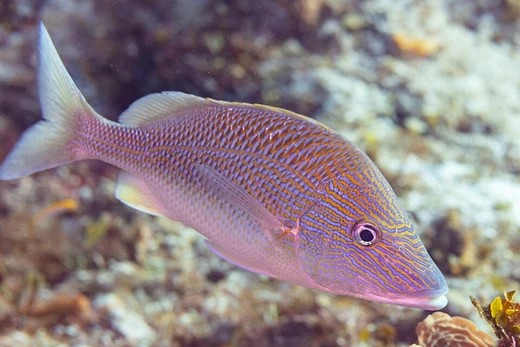
Haemulon
A genus of grunts important to Brazil's coral reefs.

Haemulon, commonly called scaled-fin grunts, is a genus within the grunt family. Its members are mostly native to the western Atlantic, though a handful of species live in the eastern Pacific. In Brazil, this genus is regarded as especially significant to coral reef ecosystems, both because of its commercial importance and its essential ecological functions.
The genus contains roughly 23 species. These fish have an oblong body shape and a large mouth. A distinctive feature is the presence of scales covering the rays of the second dorsal and anal fins, and the second spine in the anal fin is longer than the third. The interior of the mouth is typically bright red. While juvenile Haemulon look very similar across species, adults vary greatly in appearance.
Most Haemulon species feed on small prey found on the seabed, though some eat plankton in open water. Like other grunts, they are nocturnal: around sunset, they leave the shelter of the reef in schools to hunt. The schools break apart as individuals forage, then reform near dawn to return to the reef.
These fish are common in shallow reef communities. Their schools can number in the hundreds or thousands and include both adults and juveniles. Schools often contain multiple Haemulon species—for instance, H. squamipinna and H. aurolineatum may mix together. Haemulon have also been observed schooling with grunts from other genera, such as Anisotremus virginicus, and with fish from other families, including the snapper Lutjanus alexandrei, the goatfish Pseudupeneus maculatus, and the jack Carangoides bartholomaei. Other fish join large Haemulon schools for protection. Some simply benefit from the safety of a large group, but others engage in protective mimicry: unrelated fish that resemble Haemulon in color, size, and shape join the school to evade predators, copying the swimming style, movements, and postures of the grunts. Examples include the goatfish Mulloidichthys martinicus, the parrotfish Sparisoma axillare, and the herring Harengula clupeola. M. martinicus, in particular, stays with its own kind while sheltering in the reef, but when it moves into open water where it is more visible to predators, it tends to join schools of Haemulon chrysargyreum, which it closely resembles, adopting the grunt’s posture to blend in.
Quick Facts
- Taxon
- Haemulon
- Type Species
- Haemulon elegans
- Type Species Authority
- G. Cuvier, 1829
Facts from the source article.
Lore & Background
Fish of this genus are oblong in shape and have large mouths. They have scales over the rays of their second dorsal and anal fins, and the second anal spine is larger than the third. The inside of the mouth is usually bright red. Juveniles of the genus look similar to each other, but the variation in the appearance of the adults is great. Some Haemulon species eat plankton in the open water, but most seek small prey on the seabed. Fish of the grunt family are nocturnal feeders, venturing in schools from the cover of the reefs around sunset to find food. The schools disperse as individuals go hunting, and then reform as morning approaches and they prepare to return to the reef. Haemulon species are common members of shallow reef fish communities in their range. Their schools can have hundreds or thousands of fish, including adults and juveniles. Schools can be made up of several different Haemulon species; for example, H. squamipinna and H. aurolineatum may associate with each other. Haemulon spp. have also been observed in schools with grunts of other genera, such as Anisotremus virginicus, and fish of different families, such as the snapper Lutjanus alexandrei, the goatfish Pseudupeneus maculatus, and the jack Carangoides bartholomaei. Other fish tend to join large Haemulon schools for protection. Sometimes they join a school simply for the protection offered by a large mass of fish, but some species engage in protective mimicry in a school. Unrelated fish that resemble Haemulon in color, size, and shape join the school to hide from predators, even mimicking the swimming style, movements, and postures of the Haemulon. Fish that do this include the goatfish Mulloidichthys martinicus, the parrotfish Sparisoma axillare, and the herring Harengula clupeola. M. martinicus, in particular, stays with groups of its own species while sheltering in the reefs, but when it enters the open water column and becomes visible to predators, it tends to join schools of Haemulon chrysargyreum, which it closely resembles. It assumes the posture of the grunts and blends into the group. Despite their general preference for close association with other fish, some Haemulon spp. can be territorial and display aggressive behaviors. Larger individuals are more likely to act aggressively, and this behavior is more common at certain times of the day, such as early morning. Like other members of their family, these fish produce a grunting sound by grinding their pharyngeal teeth, the behavior which inspired their common name. The spawning behavior of these fish has not been observed.
Reader's Guide
Haemulon is notable for its commercial value and crucial ecological role in the coral reefs of Brazil. The genus includes about 23 species, most found in the western Atlantic Ocean, with a few in the eastern Pacific. These fish are common members of shallow reef communities, forming large schools that can include hundreds or thousands of individuals, often mixing with other Haemulon species, grunts of other genera, and even fish from different families. Their schools provide protection, and some unrelated fish engage in protective mimicry by resembling Haemulon in color, size, and shape, and mimicking their swimming style and postures. Despite their social nature, some species can be territorial, especially larger individuals and at certain times of day. They are nocturnal feeders, venturing from reefs at sunset to hunt small prey on the seabed or plankton in open water. The genus has also been subject to systematic debate, with some authorities splitting it into two genera based on molecular studies suggesting polyphyly, leading to the revival of the genus Brachygenys for certain species.
Did You Know?
- The inside of the mouth of Haemulon fish is usually bright red.
- Some unrelated fish, like the goatfish Mulloidichthys martinicus, join Haemulon schools for protective mimicry.
- The spawning behavior of Haemulon has not been observed.
- Haemulon is considered one of the most important fish groups of the coral reefs of Brazil.
More in Snappers and Grunts 1-24
Spotted an error? Know more?
Reader corrections go straight into our review queue. Suggest an edit · How this site is sourced