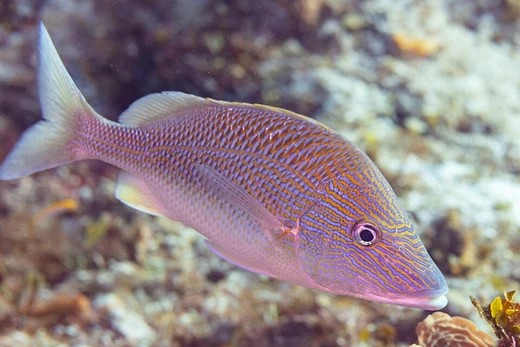
Genyatremus luteus
A silvery-yellow grunt of South American Atlantic estuaries.

Genyatremus luteus, commonly known as the Torroto grunt, is a species of marine ray-finned fish belonging to the subfamily Plectorhinchinae of the family Haemulidae. It is native to the Atlantic coast of South America, ranging from Colombia to Brazil, and also occurs north into the southern part of the Lesser Antilles. This species is notable for its distinctive coloration and its preference for brackish estuarine habitats.
Quick Facts
- Taxon
- Genyatremus luteus
Facts from the source article.
Lore & Background
Genyatremus luteus was first formally described in 1790 as Lutjanus luteus by the German naturalist and physician Marcus Elieser Bloch, with the type locality given as the Antilles, thought to be Martinique. The specific name luteus means “yellow”, a reference to the yellow or yellowish fins of this species. Some authorities have argued that Genyatremus luteus is not a valid name and that this taxon is synonymous with Cuvier's Diagramma cavifrons, while others contend that Cuvier's D. cavifrons is not a haemulid but belongs to another family, and that Bloch's L. luteus is valid and should be used as the type species of the genus Genyatremus.
The body of Genyatremus luteus is oval-shaped and compressed, with a depth just under half its standard length. The head is small with a moderately large mouth, and there are two pores on the chin but no central groove. The preoperculum has strong serrations at its corner. The dorsal fin is high, containing 13 spines (the fifth being longer than the others) and 12 soft rays; the anal fin has 3 spines and 11 soft rays. The caudal fin is emarginate. The body is silvery with a yellowish tint, the edge of the preoperculum is yellow, the dorsal fin spines are silvery with a black margin, the anal fin is yellowish, the pectoral fins have a yellowish cast, and the pelvic fins and base of the tail have a black rear margin.
Reader's Guide
Genyatremus luteus is of minor importance to local commercial fisheries along the Atlantic coast of South America. It is caught using seines and trawls, and the catch is mostly sold fresh. The species prefers brackish waters of estuaries with a mud or sand substrate down to about 40 m (130 ft), though it has also been caught in marine waters. Its diet consists of smaller fishes and crustaceans. The taxonomic history of this species involves a dispute: some authorities consider it synonymous with Cuvier's Diagramma cavifrons, while others argue that Cuvier's taxon is not a haemulid and that Bloch's original name is valid. This uncertainty does not diminish its role as a locally harvested food fish, but it does affect how the species is classified within the genus Genyatremus. The maximum recorded size is 37 cm total length, though most individuals do not exceed 25 cm, and the maximum published weight is 800 g.
Did You Know?
- Genyatremus luteus was first described in 1790 as Lutjanus luteus by Marcus Elieser Bloch.
- The specific name luteus means 'yellow', referring to the yellow or yellowish fins.
- The fifth dorsal spine is longer than the others.
More in Snappers and Grunts 1-24
Spotted an error? Know more?
Reader corrections go straight into our review queue. Suggest an edit · How this site is sourced