Etelis boweni
A deepwater snapper discovered in the Indo-West Pacific.

Etelis boweni, also called Bowen's snapper or giant ruby snapper, belongs to the ray-finned fish family Lutjanidae. A multinational team of marine biologists from the United States, Spain, and Taiwan discovered this species in the deeper waters of the Indo-West Pacific region. It was officially named on March 9, 2021, in honor of Brian Bowen, a University of Hawaii researcher.
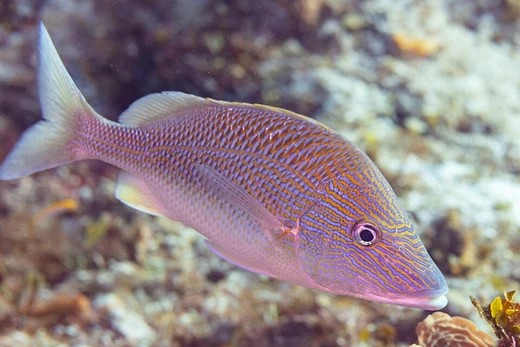
The fish has a fusiform, orange-red body that transitions to pink toward the middle and then to silvery white on its belly. It closely resembles Etelis carbunculus but differs in several ways: E. boweni grows to nearly twice the adult size, has a protruding lower jaw, a black tip on the upper part of its tail fin, and a longer snout.
Specimens of E. boweni have been collected from the Red Sea and Western Australia. Genetic samples have also come from Seychelles, Christmas Island, New Caledonia, Wallis and Futuna, Fiji, Tonga, and Samoa. Although its distribution largely overlaps with that of E. carbunculus, E. boweni is unlikely to appear in the Hawaiian Archipelago. It has been found at depths ranging from 209 to 319 meters.
Overfishing poses a threat to this species. From 2016 onward, E. boweni has ranked among the 50 most abundant species in the deepwater demersal fisheries of southern Indonesia. Catch data indicate that most individuals caught have not yet reached maturity or had a chance to reproduce. However, recent fisheries trends suggest that the risk of overfishing in the area is decreasing.
Quick Facts
- Taxon
- Etelis boweni
Facts from the source article.
Lore & Background
Etelis boweni has a fusiform, orange red body that gradually becomes pink midway down and silvery white on its underbelly. It is similar to Etelis carbunculus but differs in having a much larger adult body size—nearly twice as large—as well as a protruding lower jaw, a black tip on the top of the tail fin, and a larger snout length. The species has been collected from the Red Sea and Western Australia, with genetic samples also obtained from Seychelles, Christmas Island, New Caledonia, Wallis and Futuna, Fiji, Tonga, and Samoa. Although its distribution is largely sympatric with that of E. carbunculus, E. boweni is unlikely to be found in the Hawaiian Archipelago. It has been found at depths from 209 to 319 meters.
Reader's Guide
Etelis boweni is notable as a recently described species that highlights ongoing biodiversity discoveries in deepwater Indo-West Pacific habitats. Its naming honors Brian Bowen, a researcher at the University of Hawaii, and reflects international collaboration among scientists from the United States, Spain, and Taiwan. The species is threatened by overfishing: from 2016 to the present, it has ranked among the 50 most abundant species in the deepwater demersal fisheries of Southern Indonesia. Catch data indicate that most individuals caught have not had the opportunity to reproduce or reach maturity before capture. However, fisheries trends suggest that overfishing risks in the area are improving. Its morphological differences from the similar Etelis carbunculus—particularly its larger size and distinctive jaw and fin markings—aid in species identification and management. The species' distribution across a wide geographic range, from the Red Sea to Samoa, underscores its ecological role in deepwater reef systems, while its absence from the Hawaiian Archipelago marks a notable biogeographic boundary.
Did You Know?
- Etelis boweni was named on March 9, 2021, after Brian Bowen, a researcher at the University of Hawaii.
- It has a fusiform, orange red body that becomes pink midway and silvery white on its underbelly.
More in Snappers and Grunts 1-24
Spotted an error? Know more?
Reader corrections go straight into our review queue. Suggest an edit · How this site is sourced