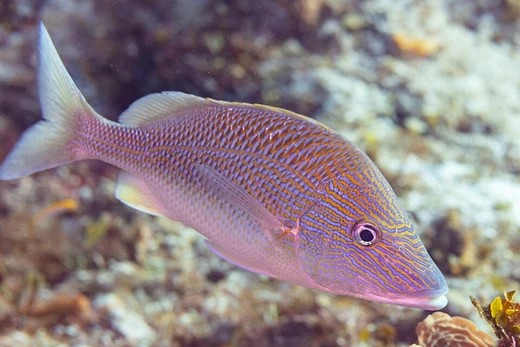
Conodon nobilis
A grunt with dark vertical bars, found in the Western Atlantic.

Conodon nobilis, commonly known as the barred grunt, is a marine fish in the Haemulidae family. It lives in the western Atlantic and is caught by some commercial fisheries.
The fish has a fairly sturdy, elongated body that is flattened from side to side, with a large eye. Its upper side is brownish, the belly is whitish, and yellowish horizontal lines run along its flanks. Typically, eight wide dark vertical bars appear on its back. The soft part of the dorsal fin, along with the anal and pelvic fins, are yellow. The dorsal fin has 12 spines and 13 soft rays, while the anal fin has 3 spines and 7 soft rays. The maximum recorded length is 33.6 cm (13.2 in), though 25 cm (9.8 in) is more common.
Its range spans the western Atlantic from northeastern Florida to the upper Florida Keys, across the Gulf of Mexico from Louisiana to the northern Yucatán Peninsula, and through the Caribbean from Hispaniola to Tobago. It also appears along the Central and South American coast from Mexico down to Argentina.
This species is found at depths up to 100 m (330 ft). It mostly inhabits sandy coastal areas but also occurs along rocky shores and in brackish or estuarine waters. It primarily uses the surf zone, rather than estuaries, as a nursery. Feeding at night, it preys mainly on small fishes and crustaceans, with mysids and amphipods being important food items. Recruitment appears to peak in spring.
The species was first formally described in 1758 as *Perca nobilis* by Carl Linnaeus in the 10th edition of *Systema Naturae*. In 1830, French anatomist Georges Cuvier described a species he named *Conodon antillanus*, creating the new genus *Conodon* for it. Cuvier’s *C. antillanus* was later recognized as a synonym of Linnaeus’s *Perca nobilis*, making this fish the type species of the genus *Conodon*. The specific name *nobilis* means “notable,” “majestic,” or “excellent,” though Linnaeus did not explain his choice.
The barred grunt is targeted by commercial fisheries, with the catch sold fresh. It is also frequently taken as bycatch, notably in shrimp fisheries off Mexico and Brazil. It is pursued in sport fishing and appears in the aquarium trade. Fishing methods include seine nets, trawls, and hook and line.
Quick Facts
- Taxon
- Conodon nobilis
Facts from the source article.
Lore & Background
Conodon nobilis has a relatively robust, elongate, laterally compressed body with a large eye. The upper body is brownish, the abdomen is whitish, and there are yellowish horizontal lines along the flanks. It normally shows 8 wide dark vertical bars on the back. The soft-rayed part of the dorsal fin, the anal fin, and the pelvic fin are yellow. It is found at depths down to 100 m, largely in sandy coastal areas, though also along rocky shores and in brackish and estuarine waters. It mainly uses the surf zone as a nursery instead of estuaries. It feeds at night, mostly on small fishes and crustaceans, with mysids being the most important crustaceans in the diet, and amphipods also important. There appears to be a peak of recruitment into the Spring.
Reader's Guide
Conodon nobilis was first formally described in 1758 as Perca nobilis by Carolus Linnaeus in the 10th edition of the Systema Naturae. The French anatomist Georges Cuvier described a species he named Conodon antillanus in 1830, creating a new genus, Conodon, for it. Cuvier's C. antillanus was later shown to be a synonym of Linnaeus's Perca nobilis, and thus this species is the type species of the genus Conodon. The specific name, nobilis, means 'notable', 'majestic', or 'excellent', but Linnaeus did not explain why he chose this adjective. The species is a target for commercial fisheries, the catch being sold fresh. It is also frequently caught as bycatch in other fisheries, for example it is commonly caught in the fishery for shrimp off Mexico and Brazil. It is also a quarry for sports fishing and appears in the aquarium trade. It is caught using seine nets, trawls, and hook and line.
More in Snappers and Grunts 1-24
Spotted an error? Know more?
Reader corrections go straight into our review queue. Suggest an edit · How this site is sourced