Chinamanfish
A Western Pacific snapper with filamentous fins and ciguatera risk.

The Chinamanfish (Symphorus nematophorus) goes by several common names, including Chinaman snapper, galloper, and thread-finned sea perch. This marine ray-finned fish belongs to the snapper family Lutjanidae and inhabits the Western Pacific Ocean. Its most distinctive feature is the long, thread-like extensions on the front spines of its dorsal fin, which are especially prominent in younger fish. In some regions, the species is also known for the risk of ciguatera poisoning.
Pieter Bleeker, a Dutch ichthyologist, first scientifically described the Chinamanfish in 1860, giving it the name *Mesoprion nematophorus* based on a specimen from Badjoa on Sulawesi. Later, in 1872, the German-born British ichthyologist Albert Günther placed it in the genus *Symphorus*. This genus is one of two within the subfamily Paradicichthyinae of the snapper family Lutjanidae. The genus name *Symphorus* may combine *sym* ("together with") and *phorus* ("bearer"), possibly referring to the fish's undivided dorsal fin. The species name *nematophorus* combines *nemato* ("thread") and *phorus*, pointing to the filamentous projections on the dorsal fin rays of younger specimens.
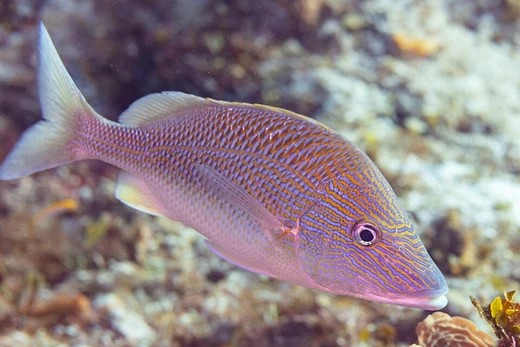
The body of the Chinamanfish is deep and compressed from side to side, with a steeply sloping forehead. A deep slit runs between the eyes and the nostrils. The mouth reaches back to the center of the eye. The preoperculum lacks any notch or bump. The jaws hold thin bands of teeth, with the outer band containing enlarged teeth that become canine-like at the front of the upper jaw. There is no patch of teeth on the vomer, but a patch of granular teeth sits on the tongue. The dorsal fin has 10 spines and 15 to 16 soft rays, while the anal fin has 3 spines and 9 soft rays. In juveniles and sub-adults, at least one of the front dorsal fin rays extends into a long filament. The pectoral fins are long, reaching the level of the anus, and contain 16 rays. The caudal fin is slightly forked. This species can reach a total length of 100 cm (39 inches), though 35 cm (14 inches) is more typical, and a maximum published weight of 13.2 kg (29 lb). Overall, the fish is greyish-brown to reddish, often broken by thick, irregular light and dark vertical bars on the sides.
Quick Facts
- Taxon
- Symphorus nematophorus
Facts from the source article.
Lore & Background
The Chinamanfish was first formally described in 1860 by the Dutch ichthyologist Pieter Bleeker as Mesoprion nematophorus, with the type locality given as Badjoa on Sulawesi. The German-born British ichthyologist Albert Günther later placed it in the genus Symphorus in 1872. The genus name Symphorus may be a compound of sym, meaning 'together with', and phorus meaning 'bearer', possibly a reference to its undivided dorsal fin. The specific name nematophorus is also a compound, with nemato meaning 'thread' and phorus, referring to the projection of at least one of the anterior rays of the dorsal fins into filaments in younger specimens.
The body is deep and laterally compressed, with a steep dorsal profile of the head and a deep slit between the eyes and nostrils. The mouth extends as far back as the center of the eye. The jaws have thin bands of teeth, with the outer band having enlarged teeth that are caniniform at the front of the upper jaw. There is no patch of vomerine teeth, but there is a patch of granular teeth on the tongue. The pectoral fins are long, extending to the level of the anus, and the caudal fin is emarginate. The overall color is greyish-brown to reddish, frequently broken by thick irregular light and dark vertical bars on the flanks. Juveniles are light orange to brownish, with irregular bluish lines and spots on the head and flanks, and more numerous long filamentous dorsal-fin rays than adults.
Reader's Guide
The Chinamanfish is a widely distributed species in the West Pacific Ocean, ranging from the Andaman Sea and western Thailand east to Fiji and Tonga, and from northern Australia and New Caledonia north to the Ryukyu Islands. It inhabits coastal reefs at depths of less than 50 meters. Typically solitary, a breeding aggregation has been recorded off Palau. The species is mainly piscivorous and can live up to 36 years.
In fisheries, the Chinamanfish is taken mostly with handlines and also by spearfishing. Its flesh is considered excellent eating, but in Queensland and Vanuatu it is considered dangerous, and Australia bans its sale due to the risk of ciguatera. This dual reputation—prized for its taste yet hazardous in certain regions—underscores its significance as a species that requires careful management and public awareness regarding seafood safety.
Did You Know?
- Juveniles and sub-adults have at least one anterior dorsal fin ray projected into a long filamentous thread.
- The species can reach a maximum total length of 100 cm (39 in) and a maximum published weight of 13.2 kg (29 lb).
- Australia bans the sale of Chinamanfish due to the risk of ciguatera poisoning.
More in Snappers and Grunts 1-24
Spotted an error? Know more?
Reader corrections go straight into our review queue. Suggest an edit · How this site is sourced