Brachygenys jessiae
A striped grunt endemic to the Galápagos Islands.

Brachygenys jessiae, called the black-striped salema, is a marine ray-finned fish and a member of the grunt family Haemulidae. It lives only in the eastern Pacific Ocean, restricted to the waters surrounding the Galápagos Islands.
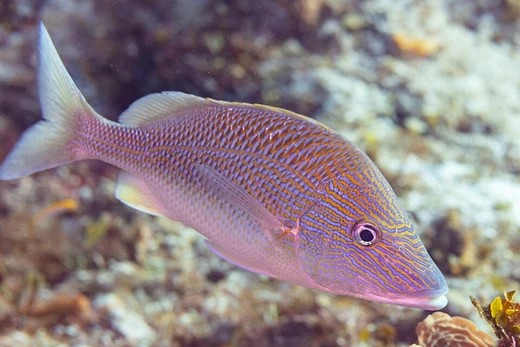
This fish has a fairly slender, elongated body, which sets it apart from most of its relatives. Its head is cone-shaped, with large eyes and a short, diagonal mouth where the lower jaw sticks out. The teeth are very small and arranged in bands on the jaws and the roof of the mouth. The dorsal fin is split into two separate parts: a front section with 10 spines and a rear section with one spine and 13 to 14 soft rays. The anal fin has three small spines and 10 to 11 soft rays. The black-striped salema can grow up to 30 cm (12 inches) in total length. Its back is a dark silvery-grey, often with hints of yellowish green, yellowish blue, or blue-green. This color fades to a paler silver on the sides and to silvery-white on the belly. Seven black horizontal stripes run along each side.
It is found at depths from the surface down to 20 meters (66 feet). In these shallow waters, it forms dense schools. During the day, these schools stay near rock walls and over rocky slopes. The fish feed on plankton and small fish. They reproduce by laying eggs (oviparous), spawning in distinct pairs.
The species was first formally described in 1890 by American ichthyologists David Starr Jordan and Charles Harvey Bollman, with the type location given as Isla Santa Maria in the Galápagos Islands, Ecuador. Some authorities place it in the monotypic genus *Xenocys*. This reclassification happened after molecular studies showed that the genus *Haemulon* was paraphyletic, and that *Haemulon chrysargyreum* (the type species of *Brachygenys*) grouped with *Xenistius californianus*. As a result, the genus *Brachygenys* was revived to include that species, the other species from *Xenistius*, and this one. This change is accepted by Catalog of Fishes but not by Fishbase. The specific name *jessiae* honors Jordan’s second wife, Jessie Knight Jordan.
Quick Facts
- Genus
- Brachygenys
- Species
- jessiae
Facts from the source article.
Lore & Background
Brachygenys jessiae was first formally described in 1890 by American ichthyologists David Starr Jordan and Charles Harvey Bollman, with the type locality given as Isla Santa Maria in the Galápagos Islands. The specific name honors Jordan's second wife, Jessie Knight Jordan. The species has a relatively slender, elongated body, differing from most related species, with a conical head, large eyes, and a short diagonal mouth featuring a protruding lower jaw. Its very small teeth are set in bands on the jaws and palate. The dorsal fin is not continuous, with the anterior spiny portion completely divided from the posterior soft-rayed part. The back is dark silvery-grey, often showing yellowish green, yellowish blue, or blue-green tints, shading to paler silver on the flanks and silvery-white on the underparts, with seven black horizontal stripes along the flanks.
Reader's Guide
Brachygenys jessiae is found at depths between 0 and 20 meters, forming dense schools in shallow waters. During the day, these schools spend time along rock walls and over rocky slopes. The species feeds on plankton and small fishes. It is oviparous, spawning in distinct pairs. In terms of systematics, the species is placed in the monotypic genus Xenocys by some authorities, a change made when Haemulon was determined to be paraphyletic in molecular studies. These studies showed that Haemulon chrysargyreum, the type species of Brachyogenys, clustered with Xenistius californianus, leading to the revival of the genus Brachyogenys to include this species and others from Xenistius. This taxonomic revision has been accepted by Catalog of Fishes but not by Fishbase, preserving a dispute in the scientific literature.
Did You Know?
- Brachygenys jessiae is endemic to the waters around the Galápagos Islands.
- It has 7 black horizontal stripes along its flanks.
- The species attains a maximum total length of 30 cm (12 in).
- It was first described in 1890 by David Starr Jordan and Charles Harvey Bollman.
More in Snappers and Grunts 1-24
Spotted an error? Know more?
Reader corrections go straight into our review queue. Suggest an edit · How this site is sourced