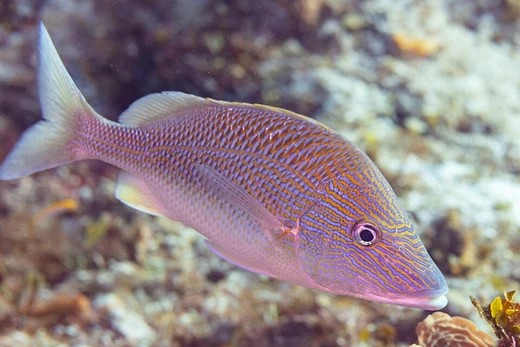
Borriqueta porgy
A grunt native to the southwestern Atlantic Ocean.

The Borriqueta porgy (Boridia grossidens) is a marine ray-finned fish and a type of grunt in the Haemulidae family. It lives along the Atlantic coast of South America and is the sole species in its genus, Boridia.
This fish has a rectangular body and a shallow, blunt head, with eyes set toward the front and a small mouth. The soft-rayed parts of its dorsal and anal fins lack scales, and the dorsal fin has a clear notch between its spiny and soft-rayed sections. The dorsal fin consists of 12 spines and 13 soft rays, while the anal fin has 3 spines and 10 to 11 soft rays. The first two dorsal spines are low, and the second anal spine is robust. Its pectoral fins are short. The body is light gray, darker on the back, with dark scale margins that create a latticed pattern. The spiny part of the dorsal fin is gray with darker membranes between the spines, and the soft-rayed parts of the dorsal and anal fins are gray with a darker blotch. The rear parts of the caudal and pelvic fins are dark. It reaches a maximum total length of 32 cm (13 in).
The Borriqueta porgy is found in the southwestern Atlantic Ocean, off southern Brazil, Uruguay, and northern Argentina. There is evidence its range is shifting southward due to warming waters, possibly from climate change.
It inhabits continental shelf waters and estuaries over soft substrates. It forms distinct pairs for mating. The trematode *Diplomonorchis leiostomi* is an endoparasite of this species.
French anatomist Georges Cuvier first formally described the Borriqueta porgy in 1830, with the type locality given as Brazil. The genus name *Boridia* comes from a word used by Xenocrates for an unidentified fish, while the species name *grossidens* combines *grossus* (large) and *dens* (teeth), referring to its large front teeth on both jaws.
Quick Facts
- Genus
- Boridia
- Species
- grossidens
Facts from the source article.
Lore & Background
The borriqueta porgy has a rectangular body with a shallow, blunt head, eyes placed towards the front, and a small mouth. The soft-rayed parts of the dorsal and anal fins are scaleless, and there is a clear notch between the spines and soft-rayed portions of the dorsal fin. The dorsal fin contains 12 spines and 13 soft rays, while the anal fin has 3 spines and 10-11 soft rays. The initial pair of dorsal spines are low, and the second spine in the anal fin is robust. It has short pectoral fins. The body color is light grey, darkening on the back, with dark scale margins creating a latticed pattern. The spiny portion of the dorsal fin is grey with darker membranes between the spines, and the soft-rayed parts of the dorsal and anal fins are grey with a darker blotch. The rear parts of the caudal and pelvic fins are dark.
The borriqueta porgy is found in the southwestern Atlantic Ocean off southern Brazil, Uruguay, and northern Argentina. There is some evidence of a southward shift in its range due to warming water temperatures which may be a result of climate change. It inhabits waters of the continental shelf and estuaries over soft substrates. They form distinct pairs for mating. The trematode Diplomonorchis leiostomi has been recorded as an endoparasite of this species.
The species was first formally described in 1830 by the French anatomist Georges Cuvier with the type locality given as Brazil. The genus Boridia is monospecific. The genus name is derived from a word used by Xenocrates for an unidentified fish, while the specific name is a compound of grossus meaning 'large' and dens meaning 'teeth', a reference to the large front teeth on both jaws.
Reader's Guide
The borriqueta porgy is significant as the sole species in the genus Boridia, making it a unique representative within the family Haemulidae. Its description by the prominent French anatomist Georges Cuvier in 1830 adds historical importance to its taxonomy. The species is ecologically notable for its habitat in continental shelf waters and estuaries over soft substrates, and for forming distinct pairs for mating. The presence of the endoparasite Diplomonorchis leiostomi indicates its role in local food webs. The observed southward shift in its range, possibly due to climate change, highlights its sensitivity to environmental changes and provides a marker for studying the effects of warming waters on marine species along the Atlantic Coast of South America. Its physical characteristics, such as the rectangular body, latticed scale pattern, and fin coloration, aid in identification. The etymology of its scientific name, referencing large front teeth, reflects a distinctive morphological trait. As a grunt, it contributes to the biodiversity of the region's marine fish communities.
Did You Know?
- The borriqueta porgy is the only species in the genus Boridia.
- It was first formally described in 1830 by French anatomist Georges Cuvier.
More in Snappers and Grunts 1-24
Spotted an error? Know more?
Reader corrections go straight into our review queue. Suggest an edit · How this site is sourced