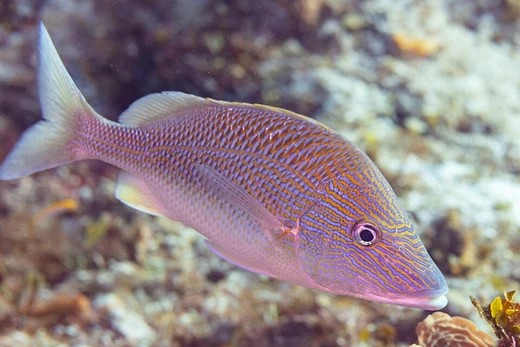
Bigeye grunt
A commercially important grunt of West African coastal waters.

The bigeye grunt (Brachydeuterus auritus) is a marine fish from the grunt family Haemulidae, found along Africa's Atlantic coast. Its body is oblong and somewhat compressed, with a noticeably large eye, a snout shorter than the eye's diameter, and a large, protrusible mouth. The dorsal fin is deeply notched and has 10 to 13 spines, with the third (and sometimes fourth) being the longest. The anal fin has three spines and nine or ten soft rays, occasionally eight. The caudal fin is deeply forked. The back is olive, while the sides and belly are silvery to white. A dark blotch sits on the upper edge of the gill cover, and small dark spots sometimes appear at the base of the dorsal fin. This species reaches a maximum total length of 30 cm (12 in), though 23 cm (9.1 in) is more typical.
In the eastern Atlantic, the bigeye grunt ranges from Morocco to Angola, but it is most common from Senegal southward. It lives at depths between 10 and 150 m (33 to 492 ft) over sandy and muddy bottoms, moving higher in the water column at night to feed near the surface on small fish and invertebrates. Spawning may occur year-round, with males reaching sexual maturity at about 8 months and females at 12 months; there are often two spawning peaks that coincide with upwelling events.
First formally described in 1832 by French zoologist Achille Valenciennes as *Larimus auritus*, with the type locality given as Gorée, Senegal, it is the only species in the genus *Brachydeuterus*. The genus name combines *brachy* ("short") and *deuterus* ("second"), referring to the deep notch that nearly separates the lower, soft-rayed part of the dorsal fin from the spiny front section. The species name *auritus* means "eared," a reference to the blotch on the gill cover.
The bigeye grunt is commercially important in many parts of West Africa, especially Ghana and Côte d'Ivoire. It is caught with bottom trawls, gill nets, set nets, and push seines, and is sold fresh, smoked, or processed into fish meal. Its flesh is also mixed with cassava to make dish crackers.
Quick Facts
- Genus
- Brachydeuterus
- Species
- auritus
Facts from the source article.
Lore & Background
The bigeye grunt has an oblong, somewhat compressed body with a large eye, a snout shorter than the diameter of its eye, and a large, protrusible mouth chin. Its dorsal fin is deeply notched and contains 10-13 spines, with the third spine (occasionally the fourth) being the longest. The anal fin has 3 spines and 9-10 soft rays, and the caudal fin is deeply emarginate. The back is olive, the flanks and abdomen are silvery to white, and there is a dark blotch on the upper edge of the gill cover, with small dark spots sometimes present on the base of the dorsal fin.
The species was first formally described in 1832 as Larimus auritus by French zoologist Achille Valenciennes, with the type locality given as Gorée in Senegal. It is the only species in the monotypic genus Brachydeuterus, a name that combines brachy meaning 'short' and deuterus meaning 'second', referring to the lower soft-rayed part of the dorsal fin nearly separated from the spiny part by a deep notch. The specific name auritus means 'eared', referencing the blotch on the gill cover.
The bigeye grunt is found in the eastern Atlantic Ocean along the western coast of Africa from Morocco to Angola, though it is most common from Senegal south. It inhabits sandy and muddy substrates at depths between 10 and 150 m, moving up the water column to feed near the surface at night on small fish and invertebrates. It may spawn throughout the year, with two possible peaks coinciding with upwellings, and becomes sexually mature at around 8 months for males and 12 months for females.
Reader's Guide
The bigeye grunt holds notable commercial significance in West Africa, particularly in Ghana and Côte d'Ivoire, where it is caught using bottom trawls, gill nets, set nets, and push seines. The fish is sold fresh, smoked, or processed into fish meal, and has also been used to make dish crackers when its flesh is mixed with cassava. This species attains a maximum total length of 30 cm, though 23 cm is more typical, and it is found at depths from 10 to 150 m over sandy and muddy substrates. Its biology includes nocturnal feeding near the surface on small fish and invertebrates, and it may spawn throughout the year with peaks tied to upwellings. The bigeye grunt is the sole member of the genus Brachydeuterus, first described in 1832 by Achille Valenciennes from a specimen collected at Gorée, Senegal. Its distinctive features include a large eye, a deeply notched dorsal fin, and a dark blotch on the gill cover. The species is most common from Senegal south along the African coast, ranging from Morocco to Angola.
More in Snappers and Grunts 1-24
Spotted an error? Know more?
Reader corrections go straight into our review queue. Suggest an edit · How this site is sourced