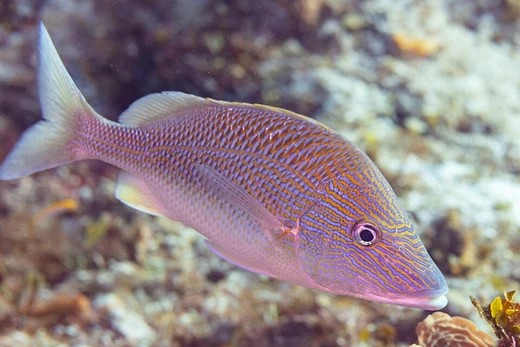
Apsilus fuscus
A dark-bodied snapper of the eastern Atlantic, found on rocky reefs.

The African forktail snapper (Apsilus fuscus) is a marine ray-finned fish in the snapper family Lutjanidae, found in the eastern Atlantic Ocean. Its body is moderately elongated and fusiform, with a mouth that extends to the front of the eye. All teeth are bristle-like, and the vomerine teeth form a V-shaped patch. The space between the eyes is wide and convex, and the caudal fin is forked. The dorsal fin has 10 spines and 10 soft rays, while the anal fin has 3 spines and 8 soft rays. The upper body and flanks are dark brown, with a lighter abdomen, chin, and throat. This species typically reaches 60 cm (24 in) in total length, though a maximum of 75 cm (30 in) is possible.
This snapper ranges along the western coast of Africa from Mauritania to Namibia, including the Cape Verde Islands. It is rare in the northern part of its range and is very uncommonly caught off Senegal. Reports from the Indian Ocean are considered misidentifications. It inhabits depths of 15 to 300 m (49 to 984 ft), usually deeper than 50 m (160 ft), over rocky or coral substrates, often on reefs. It is solitary or found in small aggregations, feeding on small fishes, crustaceans, and cephalopods. In Nigeria, it has been reported in estuaries, and off Ghana, gatherings in waters shallower than 40 m (130 ft) may relate to seasonal upwellings.
The species was first formally described in 1830 by French zoologist Achille Valenciennes, with the type locality given as Porto Praya in the Cape Verde Islands. At that time, it was the only species in the genus *Apsilus*, making it the type species by monotypy. The specific name *fuscus* means "dark," "dusky," or "swarthy," referring to its brown coloration. The African forktail snapper is considered of potential interest to fisheries due to its good-quality flesh. It is caught with handlines, set nets, and bottom trawls, sold fresh, and also taken as bycatch in commercial octopus fisheries.
Quick Facts
- Taxon
- Apsilus fuscus
Facts from the source article.
Lore & Background
The African forktail snapper has a moderately elongated fusiform body with a mouth reaching the level of the anterior part of the eye. All teeth are bristle-like, and the vomerine teeth form a V-shaped patch. The space between the eyes is wide and convex in profile, and the caudal fin is forked. The upper body and flanks are dark brown, lighter on the abdomen, chin, and throat. It attains a maximum total length of 75 cm, though 60 cm is more typical.
This species is found over substrates of rock or coral, frequently on reefs, at depths between 15 and 300 m, though typically deeper than 50 m. It occurs singly or in small aggregations. Its diet consists of small fishes, crustaceans, and cephalopods. It has been reported from estuaries in Nigeria, and gatherings in relatively shallow waters off Ghana may be associated with seasonal upwellings.
The species was first formally described in 1830 by French zoologist Achille Valenciennes, with the type locality given as Porto Praya in the Cape Verde Islands. The specific name fuscus means 'dark', 'dusky', or 'swarthy', referring to its brown colouration. Claims of this species from the Indian Ocean are considered misidentifications.
Reader's Guide
The African forktail snapper is regarded as of potential interest to fisheries due to its good quality flesh. It is caught using handlines, set nets, and bottom trawls, and the catch is sold fresh. It is also taken as bycatch by commercial octopus fisheries. The species is rare in the northern part of its range and is very uncommonly caught off Senegal. Its distribution is limited to the eastern Atlantic, with Indian Ocean records dismissed as misidentifications. As the type species of the genus Apsilus by monotypy, it holds taxonomic significance. Its biology—occurring singly or in small groups over rocky or coral reefs, and feeding on small fishes, crustaceans, and cephalopods—places it within the typical ecological role of snappers. The species' presence in estuaries and association with seasonal upwellings off Ghana suggests some adaptability, though it remains primarily a reef-associated fish. Its dark brown colouration and forked tail are distinctive field marks. Despite its potential for fisheries, it is not a major target species, appearing mostly as bycatch. The lack of Indian Ocean records reinforces its status as an eastern Atlantic endemic.
More in Snappers and Grunts 1-24
Spotted an error? Know more?
Reader corrections go straight into our review queue. Suggest an edit · How this site is sourced