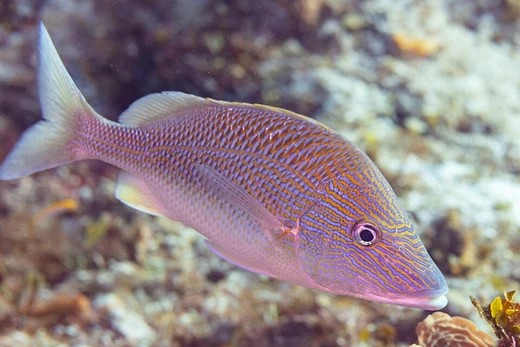
Apsilus dentatus
A snapper with distinct canine teeth and violet-brown coloration.

The black snapper (*Apsilus dentatus*) is a marine ray-finned fish in the snapper family Lutjanidae, found across the western Atlantic Ocean. Its range includes the Caribbean Sea, the Gulf of Mexico, the Florida Keys, the Bahamas, the West Indies, and islands off Venezuela and Belize; in the Gulf, it has been recorded at the Flower Garden Banks. Scientists believe the species is even more widely distributed than these records show.
This fish has an elongated, oval body. The area between its eyes is convex, and its upper jaw can protrude moderately, slipping under the cheek bone for much of its length when the mouth is closed. Its jaws feature distinct canine-like teeth, with an inner band of simple teeth and an outer band of conical teeth. Small conical teeth line the front and sides of the palate, and there is a triangular or V-shaped patch of teeth at the center. The preoperculum is serrated. The dorsal fin is continuous, with no notch between the spiny and soft-rayed sections; the bases of both the dorsal and anal fins are scaleless. The dorsal fin has 10 spines and 9–10 soft rays, while the anal fin has 3 spines and 8 soft rays. Adults have violet or dark brown backs and upper flanks, darker on the head, with paler lower flanks and abdomen. Juveniles are bright blue, with a black-margined bronze iris, dark fins (the caudal fin has a pale rear margin), and sometimes blue on the fins. The species reaches a maximum total length of 65 cm (26 in), though 40 cm (16 in) is more typical; the heaviest recorded weight is 3.2 kg (7.1 lb).
The black snapper inhabits depths from 12 to 300 m (39–984 ft), usually deeper than 40 m (130 ft), though young fish are occasionally found near the surface. It prefers rocky substrates. A predator, it feeds on fishes and benthic invertebrates such as cephalopods and tunicates. Spawning occurs nearly year-round, with peaks from February to April, in September and October, and off Jamaica in November.
French zoologist Alphonse Guichenot first formally described the species in 1853, giving Havana as the type locality. The specific name *dentatus* means “toothed,” referring to the prominent canine teeth on the upper front jaw.
The black snapper is of limited interest to fisheries, though its flesh is considered good quality.
Quick Facts
- Taxon
- Apsilus dentatus
Facts from the source article.
Lore & Background
Apsilus dentatus has an elongated, oval-shaped body with a convex intraorbital area and a moderately protrusible upper jaw. Its jaws feature distinct canine-like teeth, with an inner band of simple teeth and an outer band of conical teeth. The preoperculum is serrated, and the dorsal fin is continuous with no incision between the spined and soft-rayed portions. The back and upper flanks are violet or dark brown, deeper on the head, while the lower flanks and abdomen are paler. Juveniles have a bright blue body, a black-margined bronze iris, and dark fins with a pale rear margin on the caudal fin.
The species was first formally described in 1853 by French zoologist Alphonse Guichenot, with the type locality given as Havana. The specific name dentatus means 'toothed,' referring to the obvious upper front jaw canine teeth. It is found at depths between 12 and 300 m, typically deeper than 40 m, though young fish have been found near the surface. It prefers rocky substrates and is a predatory species that eats fishes and benthic invertebrates, including cephalopods and tunicates.
Reader's Guide
Apsilus dentatus is of limited interest to fisheries, although its flesh has been described as being of good quality. The only part of its range where it is regular in markets is on Cuba, usually sold fresh, though freezing is not unknown. It is caught using handlines. The species has been a source of ciguatera poisoning in humans following consumption. Spawning takes place nearly year round, peaking from February to April, in September and October, and off Jamaica in November. The species is thought to be more widely distributed than currently recorded, with known occurrences from the Florida Keys and the Bahamas south through the West Indies to the islands off Venezuela and Belize, as well as the Flower Garden Banks in the Gulf of Mexico.
Did You Know?
- The specific name dentatus means 'toothed,' referring to its obvious upper front jaw canine teeth.
- Juveniles have a bright blue body and a black-margined bronze iris.
- Spawning peaks in February to April, September and October, and off Jamaica in November.
More in Snappers and Grunts 1-24
Spotted an error? Know more?
Reader corrections go straight into our review queue. Suggest an edit · How this site is sourced