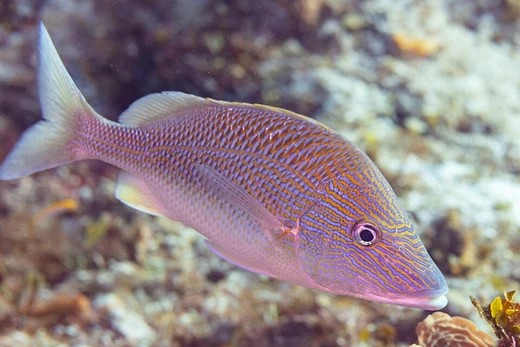
Aphareus furca
A tropical snapper with a forked tail and yellow fins.

Aphareus furca, also called the small toothed jobfish, blue smalltooth jobfish, fork-tailed snapper, or snapper jobbyfish, is a marine ray-finned fish in the snapper family Lutjanidae. Its scientific name, *furca*, means "fork," referring to its deeply forked tail fin. The species was first described in 1801 as *Labrus furca*, with the type location given as Mauritius. In 1913, David Starr Jordan, John Otterbein Snyder, and Shigeho Tanaka designated *Aphareus caerulescens* as the type species for the genus *Aphareus*, which Georges Cuvier had created in 1830 with only that species. *A. caerulescens* is a synonym of *A. furca*.
Adults have a bronze to blue-gray body, yellow fins, and long filaments at the tips of the tail fin. Males may show yellow on the head. The dorsal fin has 10 spines and usually 11 soft rays (sometimes 10), the anal fin has 3 spines and 8 soft rays, and the pectoral fins have 15 to 16 rays. The fish reaches a maximum length of 70 cm, but is more commonly around 25 cm.
This species is found across the Indo-Pacific region, from south of Hawaii to the Pitcairn Islands, and from West to East Africa. Its range also extends from the Gulf of Mannar to southern Japan and southward to Australia. It has been collected at depths from 1 to 122 meters, with reports as deep as 302 meters. In the late 1990s, it appeared at 38.6% of sampling sites and made up 2.5% of the recorded biomass. Between 2008 and 2014, density estimates in Pacific coral reef areas ranged from 2.5 to 41.2 individuals per hectare. Population size is affected by fishing; where fishing pressure was reduced, populations increased. The highest densities were recorded in the Line Islands (19.4 per hectare) and Phoenix Islands (63 per hectare). Lower densities, from 0.3 to 17.2 per hectare, were found in the Federated States of Micronesia, the Solomon Islands, remote islands near the Solomon Islands, Fiji, and Raja Ampat.
*Aphareus furca* is a benthopelagic and pelagic species, typically inhabiting inshore coral and rocky reef areas, rocky bottoms, and clear water lagoons. It is piscivorous and is usually found alone or in small groups. Though most common at depths of 1 to 120 meters, it has been reported at depths of 300 meters.
The species is vulnerable to population declines from fishing.
Quick Facts
- Taxon
- Aphareus furca
Facts from the source article.
Lore & Background
Aphareus furca was first formally described in 1801 as Labrus furca, with the type locality given as Mauritius. In 1913, David Starr Jordan, John Otterbein Snyder, and Shigeho Tanaka designated the synonym Aphareus caerulescens as the type species of the genus Aphareus, a genus created by Georges Cuvier in 1830 with A. caerulescens as its only member. The specific name furca means 'fork,' a reference to the deeply forked caudal fin.
Adults are identified by their bronze/blue-gray body coloration and yellow fins, with long filaments at the tips of the tail fin. Males may have yellow on the head. The species is benthopelagic and pelagic, typically inhabiting inshore coral and rocky reef areas, rocky bottoms, and clear water lagoons. It is piscivorous and found singly or in small groups at depths of 1–120 m, though reported as deep as 300 m.
In the late 1990s, this species was found at 38.6% of sampling sites and accounted for 2.5% of recorded biomass. From 2008 to 2014, density estimates ranged from 2.5 to 41.2 individuals per hectare in Pacific coral reef areas. The highest population sizes were recorded in the Line Islands and Phoenix Islands, at 19.4 and 63 per hectare, respectively.
Reader's Guide
Aphareus furca is a commonly sought-after gamefish, captured by spearfishing, handlines, or vertical longlines. Fishing has been identified as a main factor reducing its population size, particularly in Fiji and the Philippines, where it is found close to the coast. In South Africa, bag limits have been implemented to control the number caught. The species' population size is affected by fishing pressure; in areas where fishing pressure was relieved, population size increased. Small population measurements, ranging from 0.3 to 17.2 individuals per hectare, were found in the Federated States of Micronesia, Solomon Islands, remote islands around the Solomon Islands, Fiji, and Raja Ampat. The species is vulnerable to detrimental effects that can decrease its population, and its distribution spans from the south of Hawaii to the Pitcairn Islands, West and East Africa, the Gulf of Mannar to southern Japan, and southward to Australia.
Did You Know?
- Males may be identified by yellow present on the head.
- The highest recorded population density was 63 individuals per hectare in the Phoenix Islands.
More in Snappers and Grunts 1-24
Spotted an error? Know more?
Reader corrections go straight into our review queue. Suggest an edit · How this site is sourced