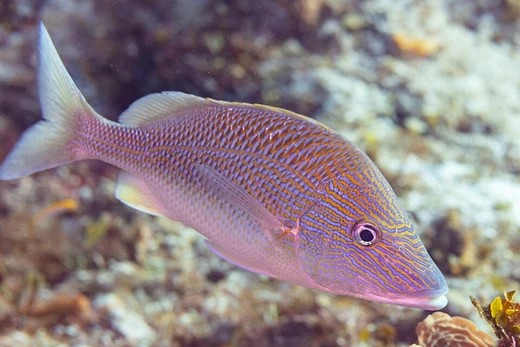
African forktail snapper
A dark-bodied snapper of the eastern Atlantic, found on reefs.

The African forktail snapper, known scientifically as *Apsilus fuscus*, is a marine fish from the snapper family Lutjanidae. Its range is the eastern Atlantic Ocean, running along Africa’s western coast from Mauritania down to Namibia, and includes the Cape Verde Islands. When first described, it was the sole member of its genus, making it the type species of *Apsilus* by monotypy.
This fish has a moderately long, spindle-shaped body. Its mouth extends back to the front of the eye, and all its teeth are bristle-like, with a V-shaped patch on the vomer. The space between its eyes is wide and rounded. Its tail fin is forked. The dorsal fin has 10 spines and 10 soft rays, while the anal fin has 3 spines and 8 soft rays. The upper body and sides are dark brown, fading to lighter shades on the belly, chin, and throat. It can reach a total length of 75 cm (30 in), though 60 cm (24 in) is more common.
The snapper lives at depths between 15 and 300 m (49 to 984 ft), but is usually found deeper than 50 m (160 ft). It prefers rocky or coral substrates, often on reefs, and is seen alone or in small groups. A predator, it feeds on small fish, crustaceans, and cephalopods. In Nigeria, it has been reported in estuaries, and off Ghana, gatherings in waters shallower than 40 m (130 ft) may be linked to seasonal upwellings. It is rare in the northern part of its range and is very uncommonly caught off Senegal. Reports from the Indian Ocean are considered misidentifications.
The fish is considered potentially valuable to fisheries because its flesh is of good quality. It is caught with handlines, set nets, and bottom trawls, and sold fresh. It also turns up as bycatch in commercial octopus fisheries. The species was first formally described in 1830 by French zoologist Achille Valenciennes, who gave the type locality as Porto Praya in the Cape Verde Islands. Its specific name, *fuscus*, means "dark" or "dusky," referencing its brown color.
Quick Facts
- Taxon
- Apsilus fuscus
Facts from the source article.
Lore & Background
The African forktail snapper was first formally described in 1830 by the French zoologist Achille Valenciennes, with the type locality given as Porto Praya in the Cape Verde Islands. When Valenciennes described this species, it was the only one in the genus Apsilus, meaning that it was the type species of that genus by monotypy. The specific name fuscus means 'dark', 'dusky' or 'swarthy' and refers to the brown colouration of this fish.
This species has a moderately elongated fusiform body with a mouth that reaches level with the anterior part of the eye. All teeth are bristle-like, and the vomerine teeth form a V-shaped patch. The space between the eyes is wide and convex in profile, and the caudal fin is forked. The upper body and flanks are dark brown, lighter on the abdomen, chin, and throat. It attains a maximum total length of 75 cm, though 60 cm is more typical.
The African forktail snapper is found at depths between 15 and 300 m, though typically encountered at depths in excess of 50 m. It occurs over substrates consisting of rock or coral, frequently on reefs, and is found either singly or in small aggregations. It is a predator with a diet made up of small fishes, crustaceans, and cephalopods. It has been reported from estuaries in Nigeria, and gatherings in relatively shallow waters off Ghana may be associated with seasonal upwellings.
Reader's Guide
The African forktail snapper is regarded as being of potential interest to fisheries because it has good quality flesh. It is caught using handlines, set nets, and bottom trawls, and the catch is sold fresh. It is also caught as a bycatch by commercial octopus fisheries. The species is rare in the northern part of its range and is very uncommonly caught off Senegal. There are claims of this species from the Indian Ocean, but these are considered to be misidentifications. Its distribution along the western coast of Africa from Mauritania to Namibia, including the Cape Verde Islands, places it within reach of several regional fisheries, though its typical occurrence at depths exceeding 50 m may limit its accessibility to some artisanal fishers. The species' preference for rocky or coral reef substrates and its solitary or small-group behavior further influence its catch patterns. Despite its potential, the African forktail snapper does not appear to be a primary target of any major fishery, instead being taken incidentally alongside other species. Its good-quality flesh, however, suggests that it could become more important if targeted more deliberately.
Did You Know?
- The African forktail snapper was the only species in the genus Apsilus when first described, making it the type species by monotypy.
- Its specific name fuscus means 'dark', 'dusky', or 'swarthy', referring to its brown colouration.
More in Snappers and Grunts 1-24
Spotted an error? Know more?
Reader corrections go straight into our review queue. Suggest an edit · How this site is sourced