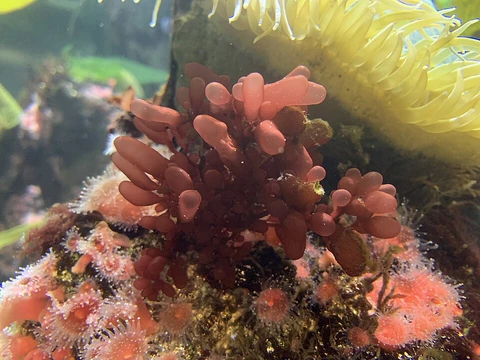
Spongites yendoi
A crustose coralline alga with a mutualistic limpet partner.

Spongites yendoi is a crustose red seaweed belonging to the Corallinaceae family. It has a hard, chalky skeleton made of calcium carbonate. This alga lives on the lower shore in the southeastern Atlantic and Indo-Pacific Oceans. The thallus is thin and built from filaments of small, squarish cells. The lowermost layer can be up to eight filaments thick, and these cells are often elongated and fused. The alga gets its colour from chlorophyll, using photosynthesis to make carbohydrates. Its colour ranges from grey to chalky white. The reproductive structures, called tetrasporangial conceptacles, are elliptical with a single pore, and old conceptacles do not get buried as the thallus grows. This species is found from South Africa and the western Indian Ocean islands (Réunion, Comoroes, Mayotte, Mauritius) across to China, Indonesia, and Australia, as well as around New Zealand’s North, South, and Chatham Islands. It grows on rocks and benthic organisms in the lower intertidal zone. On South African rocky coasts, Spongites yendoi is the main algal component of a low-intertidal community. A thin layer of it often covers rock surfaces, with other seaweeds growing as epiphytes on top. Both the coralline alga and these epiphytes are grazed by the pear limpet (Scutellastra cochlear) and other herbivores. Twice a year, Spongites yendoi sheds its upper layers. This sloughing likely removes old reproductive structures and damaged cells, and reduces the risk of burrowing organisms penetrating the surface. After sloughing, seaweeds quickly regrow on the exposed surface, which is usually kept clean by herbivore feeding. The relationship with the pear limpet may be mutualistic. The limpet gets about 85% of its nutrition by grazing on the alga, leaving it in thin, damaged sheets. Where the limpet is absent (in the north of the alga’s range), the algal sheets are thicker, flabbier, and develop protuberances. The thin form grows laterally five times faster than the thick form and is less vulnerable to burrowing organisms, so the association benefits both. Spongites yendoi also grows on the marine lichen Pyrenocollema spp., which often covers the pear limpet. It grows on the shells of Scutellastra argenvillei, Patella granatina, Oxystele sinensis, and Turbo spp., and around the colonial mollusc Dendropoma corallinaceum.
Quick Facts
- Genus
- Spongites
- Species
- yendoi
Facts from the source article.
Lore & Background
Spongites yendoi is a hard, encrusting species whose cell walls contain deposits of calcium carbonate, giving it a firm consistency. Its thallus is relatively thin, composed mainly of filaments of small, squarish cells; the lowermost layer is up to eight thick filaments of mostly elongate cells, often fused. The tetrasporangial conceptacles are elliptical with a single pore, and old conceptacles do not become buried as the thallus grows. Its colour varies but may be grey or chalky white. In South Africa, its range extends further north than that of the pear limpet Scutellastra cochlear, and when ungrazed by this limpet it is thicker and more knobbly.
Reader's Guide
Spongites yendoi is the main algal component of a low intertidal community on South African rocky coasts, where a thin layer tends to cover rock surfaces and seaweeds grow as epiphytes on top. Twice a year it sloughs off its upper layers, likely to eliminate old reproductive structures and damaged surface cells and reduce the risk of burrowing organisms. The pear limpet grazes on it, obtaining 85% of its nutritional needs, and leaves it in thin sheets with a damaged surface. Where the limpet is absent in the north of its range, the algal sheets are much thicker and flabbier, developing protuberances. The thin form grows laterally five times as fast as the thick form and is less attacked by burrowing organisms, suggesting a mutually beneficial association. Spongites yendoi also grows on marine lichen Pyrenocollema spp. and on the shells of several molluscs, and may line tidal pools higher up the shore.
Did You Know?
- Spongites yendoi sloughs off its upper layers twice a year.
- The pear limpet gets 85% of its nutritional needs by grazing on Spongites yendoi.
- When ungrazed by the pear limpet, Spongites yendoi is thicker and more knobbly.
- The thin form of Spongites yendoi grows laterally five times as fast as the thick form.
More in Red Macroalgae and Coralline Algae 1-24
Spotted an error? Know more?
Reader corrections go straight into our review queue. Suggest an edit · How this site is sourced