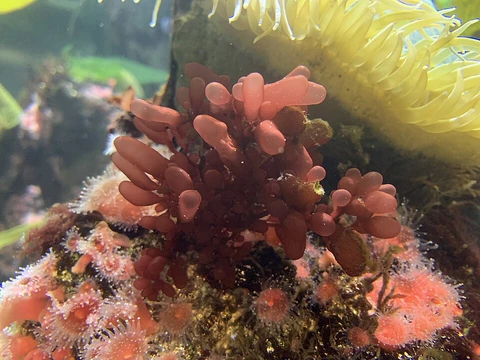
Crustaphytum
A crustose coralline alga with a triphasic life cycle.

Crustaphytum is a genus of red algae, first identified by Taiwanese researchers on the algal reefs of Taoyuan. Its name combines “crusta,” for its crust-like thallus, and “phytum,” meaning plant. It belongs to the family Hapalidiaceae, within the order Hapalidiales, and is classified as a crustose coralline alga—also referred to as non-geniculate coralline algae.
Like all members of the phylum Rhodophyta, Crustaphytum undergoes a triphasic life cycle, with all reproductive structures enclosed in specialized, sac-like conceptacles located in the receptacle. This cycle alternates between haploid gametophytes, diploid carposporophytes, and diploid tetrasporophytes. Male and female gametes develop in conceptacles on the thallus surface. Male gametes mature, exit through a cystic pore, and fertilize female gametes within the carpogonia. The resulting carposporophytes grow on the female gametophytes, releasing carpospores that develop into tetrasporophytes. Each conceptacle on the tetrasporophyte then releases four tetraspores, which, under suitable conditions, germinate into new gametophytes, completing the cycle.
The algal body is monomerous and non-geniculate, forming thin, shell-like calcified leaflets 4 to 10 cm long and 3 to 5 cm wide. These leaflets may be irregularly fragmented or oval. The dorsal surface, containing 5 to 10 or more layers of pigmented cortical cells, appears dark purple or dark red. The ventral surface grows tightly against the reef matrix or other calcified organisms, though the leaflet edges remain wavy and unattached. Thallus thickness ranges from 100 to 300 μm, with 35 to 45 cell layers. Gametophytes and tetrasporophytes look alike to the naked eye. In the gametophyte, a longitudinal section shows medullary cells making up about 70% of the thickness, growing radially from a coaxial core. The dorsal perithallial filaments consist of 7 to 10 cell layers, including one or two epithelial layers and one subepithallial layer. Calcified crystal filaments in the meristem are radially arranged, and cell fusion between adjacent cells is common.
Quick Facts
- Taxon
- Crustaphytum
Facts from the source article.
Lore & Background
The epithet 'crusta' refers to crustose thallus and 'phytum' refers to plant. Crustaphytum goes through the triphasic life cycle characteristic of Rhodophyta, alternating between haploid gametophytes, diploid carposporophytes, and diploid tetrasporophytes. All reproductive structures are protected by specialized conceptacles. The algal body is monomerous and non-geniculate, consisting of thin, shell-like calcified leaflets with wavy edges. The dorsal surfaces are dark purple or dark red due to cortical cells containing photosynthetic pigments, while ventral surfaces grow closely to the reef matrix.
Reader's Guide
Crustaphytum plays ecologically significant roles. When alive, it is an important producer of coastal regions and uses carbon dioxide released during calcification to produce glucose. It also prevents the hard matrix from wave erosion, achieving coastal protection. After death, it forms algal reefs that create habitat and provide shelter for many marine creatures. The genus prefers environments with higher nutrient salinity, higher sedimentation, and higher wave strength compared to corals. It mostly inhabits lower intertidal zones attached to old algal reefs or pebbles, and sometimes subtidal zones at 2–3 m depth. As of 2020, Crustaphytum pacificum has been recorded in northern Taiwan and New Caledonia, while Crustaphytum atlanticum was discovered in southeastern Brazil.
Did You Know?
- Crustaphytum was first discovered in Taoyuan algal reefs by Taiwanese scientists.
- The genus name combines 'crusta' (crustose thallus) and 'phytum' (plant).
- Its tetrasporangiate conceptacle chambers are 130 to 155 μm high by 115 to 200 μm wide.
Frequently Asked Questions
What is Crustaphytum?
Crustaphytum is a genus of red algae that grows as a hard, encrusting coralline form. It sits within the family Hapalidiaceae and the order Hapalidiales, and is classified as a non-geniculate (crustose) coralline alga in the phylum Rhodophyta.
Where was Crustaphytum first identified?
Taiwanese researchers first described the genus while studying the algal reefs of Taoyuan. That region's reef communities are where the species was originally collected and formally recognized.
What does the name "Crustaphytum" mean?
The name fuses the Latin word "crusta," referring to the crust-like texture of its thallus, with the Greek-derived "phytum," meaning plant. In essence, it translates to something like "crust-plant."
How large is a typical Crustaphytum thallus?
Individual thalli generally span 4 to 10 cm in length and 3 to 5 cm in width. Despite that footprint, the crust itself is very thin, measuring only 100 to 300 micrometers thick.
How does Crustaphytum reproduce?
It follows the triphasic life cycle common to rhodophytes, cycling through haploid and diploid generations. All reproductive structures are enclosed within specialized sac-like conceptacles embedded in the receptacle tissue.
More in Red Macroalgae and Coralline Algae 1-24
Spotted an error? Know more?
Reader corrections go straight into our review queue. Suggest an edit · How this site is sourced