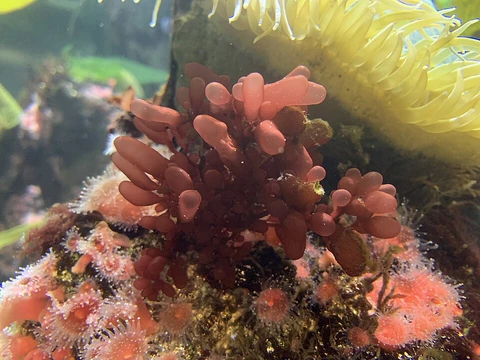
Maerl
Maerl is a slow-growing coralline alga forming ancient, biodiverse seabed beds.

Maerl (also called rhodolith) is a term for non-geniculate coralline red algae that grow in a particular way. It grows roughly one millimeter each year, building up as loose, unattached particles that create extensive beds in suitable shallow underwater areas. Originally, "maerl" described the branched growth form, while "rhodolith" was a sedimentological or genetic term covering both nodular and branched types. A 2023 study clarified that maerl now refers only to living, branched coralline thalli, whereas rhodolith includes unattached coralline red algae, whether dead or alive.
In Europe, maerl beds are found throughout the Mediterranean, along most of the Atlantic coast from Portugal to Norway, and in the English Channel, Irish Sea, and North Sea. Their distribution depends on water movement, light, and salinity. Maerl beds exist in the photic zone, reaching depths of about 30 meters around the British Isles and up to 120 meters in the Mediterranean. Deposits can be up to 10 meters thick, though usually much thinner; carbon dating shows some beds are over 5,500 years old. In the British Isles, maerl consists of three species of coralline algae that grow loose in beds of fragmented nodules: *Lithothamnion corallioides*, *Lithothamnion glaciale*, and *Phymatolithon calcareum*.
Maerl is dredged from the seafloor and crushed into a powder. It is still harvested off the coasts of Brittany in France and Bantry Bay in Ireland, where it is popular as an organic garden fertilizer. Dredging off Falmouth, Cornwall, stopped in 2004. Scientists studying Falmouth maerl found that *L. corallioides* dominated down to 6 meters, and *P. calcareum* from 6 to 10 meters. A 2024 survey by University of Exeter researchers, commissioned by Cornwall Council's Blue Natural Capital Project, found that the Fal and Helford Estuary Special Area of Conservation supports an 880-hectare maerl bed. Chemical analysis showed maerl contains 32.1% calcium carbonate and 3.1% magnesium carbonate (dry weight).
The ecology of maerl habitats has received little attention compared to kelp forests or seagrass beds. Maerl beds offer a complex habitat with many niches, supporting high biodiversity of invertebrates and algae.
- Growth rate
- c. 1 mm per year
- Depth range british isles
- to around 30 m
- Depth range mediterranean
- up to 120 m
- Maximum thickness
- up to 10 m
- Maximum age
- more than 5500 years
- Chemical composition caco3
- 32.1%
- Chemical composition mgco3
- 3.1%
- Extraction rate ireland 2000
- c. 5,000 tonnes per year
- Extraction rate france 2000
- c. 500,000 tonnes per year
Lore & Background
Maerl has been extracted for centuries, mainly as agricultural fertilizer. An early reference was made by John Ray in 1690 from Falmouth. Extraction increased in the late 20th century, with about 5,000 tonnes per year taken in Ireland and 500,000 tonnes per year in France by 2000. In Cornwall, extraction began in the 1970s but was banned in 2005 by Falmouth Harbour Commissioners. In Ireland, maerl is still extracted from subfossil beds in Bantry Bay by Celtic Sea Minerals. The species Lithothamnion corallioides and Phymatolithon calcareum are listed in Annex V of the EC Habitats Directive.
Maerl beds occur throughout the Mediterranean, along most of the Atlantic coast from Portugal to Norway, and in the English Channel, Irish Sea and North Sea. Distribution depends on water movement, light, and salinity. Beds lie in the photic zone, to about 30 m depth in the British Isles and up to 120 m in the Mediterranean. Deposits can reach 10 m thick but are usually thinner; carbon dating shows they can be over 5500 years old. In the British Isles, maerl is composed of Lithothamnion corallioides, Lithothamnion glaciale, and Phymatolithon calcareum. A 2024 survey found an 880-hectare bed in the Fal and Helford Estuary Special Area of Conservation.
Reader's Guide
Maerl beds provide a complex habitat supporting high invertebrate and algal biodiversity, yet their ecology has received little attention compared to kelp forests or seagrass beds. They act as nursery areas for juvenile commercial species such as cod, saithe, pollack, and scallops, offering physical refuge and productive feeding grounds. However, maerl is easily damaged by dredging and towed fishing gear, and has no tolerance for desiccation. The slow growth of individual nodules (about 1 mm per year) and their accumulation over millennia mean that maerl cannot keep up with dredging; it should be considered a non-renewable resource. Readily available alternatives like garden lime make modern exploitation controversial. Maerl is still harvested around Brittany and Bantry Bay for use as a soil conditioner, crushed to a powder for organic gardening.
Did You Know?
- Maerl grows at a rate of about 1 mm per year.
- Maerl deposits can be more than 5500 years old.
- Maerl beds in the Fal and Helford Estuary cover 880 hectares.
- Maerl has no tolerance for desiccation.
Biology and the Slow Architecture of Maerl
Maerl is a collective term for non-geniculate coralline red algae that grow in a distinctive branched form, accumulating over time as loose, unattached particles on the sea floor. A 2023 clarification in the literature distinguishes maerl strictly as living, branched coralline thalli, while the broader term rhodolith encompasses both living and dead unattached coralline red algae. In the British Isles, beds are typically composed of three species: Lithothamnion corallioides, Lithothamnion glaciale, and Phymatolithon calcareum. The growth pace is remarkably slow, roughly one millimetre per year, which means the deposits that can reach ten metres in thickness and exceed 5,500 years in age, as confirmed by carbon dating, represent millennia of patient accumulation. Chemically, dry maerl contains 32.1 percent calcium carbonate and 3.1 percent magnesium carbonate. The organisms have no tolerance whatsoever for desiccation, anchoring them firmly to submerged environments where water movement, light, and salinity conditions are suitable.
Where Maerl Thrives: Geography and Depth
Across Europe, maerl beds stretch throughout the Mediterranean, line much of the Atlantic coastline from Portugal up to Norway, and populate the English Channel, Irish Sea, and North Sea. Their distribution is governed by three environmental factors: water movement, available light, and salinity concentration. Because they must remain in the photic zone, depth limits vary by region. In the British Isles, beds are typically found to around 30 metres, whereas in the Mediterranean they can extend to depths of 120 metres. Species composition shifts with depth as well; research around Falmouth showed Lithothamnion corallioides dominating down to six metres, with Phymatolithon calcareum taking over between six and ten metres. A 2024 survey carried out by University of Exeter researchers under commission from Cornwall Council's Blue Natural Capital Project identified an 880-hectare maerl bed within the Fal and Helford Estuary Special Area of Conservation, underscoring just how extensive these habitats can be even in sheltered estuarine settings.
A Hidden Nursery: Ecology and Vulnerability
Despite their ecological importance, maerl habitats have received remarkably little scientific attention compared to better-studied marine ecosystems like kelp forests or seagrass meadows. The three-dimensional matrix of fragmented nodules creates a complex mosaic of microhabitats and niches, supporting high levels of associated invertebrate and algal biodiversity. Perhaps most significantly, maerl beds serve as nursery grounds for the juvenile stages of commercially important species, including cod, saithe, pollack, and scallops. The tangled structure offers young fish and shellfish physical refuge and protection from predators while also providing productive feeding grounds. However, this very complexity makes the beds highly vulnerable. Dredging operations and towed fishing gear can easily crush and disperse the fragile particles, destroying habitat that took centuries to build. The organisms' complete intolerance of desiccation further limits their resilience, as any exposure to air is fatal. Once a bed is broken up, the slow one-millimetre-per-year growth rate means recovery, if it occurs at all, will span many generations.
Harvest, History, and the Non-Renewable Debate
For centuries, communities along the European coast have dredged maerl from the sea floor and crushed it into a fine powder for use as an agricultural soil conditioner. The practice intensified dramatically in the late twentieth century: by the year 2000, roughly 5,000 tonnes were being extracted annually in Ireland and an estimated 500,000 tonnes in France. In Cornwall, extraction began in the 1970s and continued until Falmouth Harbour Commissioners imposed a ban in 2005; the last dredging off Falmouth ceased in 2004. An early written reference dates to John Ray in 1690, who recorded maerl at Falmouth. In Ireland, the company Celtic Sea Minerals still harvests from subfossil beds in Bantry Bay, and similar operations persist around Brittany. Yet the slow accumulation rate makes maerl effectively a non-renewable resource on any human timescale, and readily available alternatives such as garden lime render continued exploitation increasingly controversial. Two of the constituent species, Lithothamnion corallioides and Phymatolithon calcareum, are now listed under Annex V of the EU Habitats Directive, reflecting their recognised conservation value.
Frequently Asked Questions
What is Maerl?
Maerl is a non-geniculate coralline red alga that grows as loose, unattached particles rather than a single fixed structure. Over time these particles pile up into thick, biodiverse seabed beds in shallow coastal waters.
How fast does Maerl grow?
Maerl adds roughly one millimeter of new material per year, making it one of the slowest-growing organisms on the seafloor. That glacial pace is precisely what lets beds accumulate to extraordinary thicknesses over thousands of years.
How old and thick can Maerl beds get?
Individual Maerl deposits can exceed 5,500 years of continuous growth and reach up to 10 meters in thickness. They are among the oldest living seabed structures found in European coastal waters.
At what depths does Maerl grow?
In British waters, Maerl beds are typically found down to around 30 meters. In the Mediterranean, favorable conditions allow them to extend much deeper, to roughly 120 meters.
What's the difference between Maerl and rhodolith?
A 2023 clarification narrowed the term 'maerl' to refer only to living, branched coralline thalli. 'Rhodolith' is the broader category covering all unattached coralline red algae, whether alive or dead and whether branched or nodular.
More in Red Macroalgae and Coralline Algae 1-24
Spotted an error? Know more?
Reader corrections go straight into our review queue. Suggest an edit · How this site is sourced