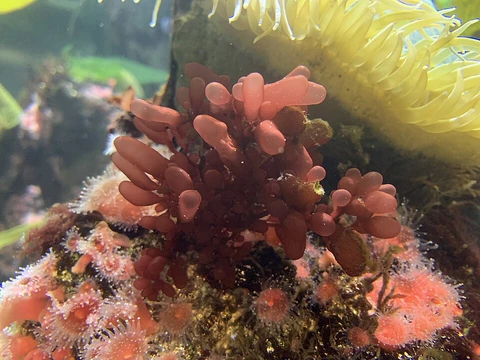
Acanthophora pacifica
Red algae with iridescent greenish-blue fronds and spinelike apical branches.

Acanthophora pacifica is a red alga belonging to the family Rhodomelaceae, native to the tropical Indo-Pacific. It grows attached to rock in the low intertidal and subtidal zones, from the shoreline down to about five meters deep, on coral or basalt reefs. The plant has upright, flattened fronds that can reach up to ten centimeters in length, with distinctive spinelike branches concentrated at the tips. Its upper surface shows a bright, iridescent greenish-blue sheen, making it easy to spot. Internally, the axes contain five pericentral cells, a feature shared with the related genus *Chondria*. A stoloniferous base allows it to form clusters. This species is epilithic and has been recorded across the Pacific, including the Philippines, French Polynesia, Fiji, Tahiti (its type locality in Arue), and Hawaii.
Quick Facts
- Genus
- Acanthophora
- Species
- pacifica
Facts from the source article.
Lore & Background
Acanthophora pacifica is characterized by upright, flattened fronds with distinctive spinelike branches concentrated at the apices. In cross-section, its axes contain five pericentral cells, a trait it shares with the closely related genus Chondria. The species has a stoloniferous basal system, often forming clusters of plants, and can reach up to 10 cm in length. Its upper surface exhibits a bright greenish-blue iridescence, making it easily recognizable in marine environments.
This species is epilithic, attaching to rocky substrates in the low intertidal to subtidal zones, and thrives in warm tropical waters. It is commonly found in the Indo-Pacific region, from low intertidal to 5 meters depth, on reef coral or basalt. Documented locations include the Philippines, French Polynesia, Fiji, and Tahiti, with its type locality recorded in Arue, Tahiti. It is also present in Hawaiian waters, where it occupies similar habitats.
Reader's Guide
Acanthophora pacifica holds significance as a distinctive red alga within the family Rhodomelaceae, noted for its iridescent greenish-blue upper surface and spinelike apical branches. Its presence across the tropical Indo-Pacific, including the Philippines, French Polynesia, Fiji, Tahiti, and Hawaii, underscores its wide distribution in warm, shallow marine environments. The species' anatomical feature of five pericentral cells in cross-section links it to the closely related genus Chondria, providing taxonomic context. Its stoloniferous basal system and tendency to form clusters contribute to its ecological role on rocky substrates in low intertidal to subtidal zones. The type locality in Arue, Tahiti, anchors its taxonomic history. As an epilithic alga, it contributes to the biodiversity of reef and basalt habitats, and its iridescence aids in field identification. The species' legacy lies in its representation of tropical Indo-Pacific red algal diversity and its morphological distinctiveness within the Rhodomelaceae.
Did You Know?
- Acanthophora pacifica has five pericentral cells in cross-section, a trait shared with the genus Chondria.
- The type locality of Acanthophora pacifica is Arue, Tahiti.
- It is epilithic, attaching to rocky substrates from low intertidal to 5 meters depth.
Frequently Asked Questions
Who is Acanthophora pacifica?
Acanthophora pacifica is a species of red alga classified within the family Rhodomelaceae. It was originally described from a specimen collected in Arue, Tahiti, and is native to tropical waters across the Indo-Pacific region.
What makes Acanthophora pacifica visually distinctive?
The upper surface of its fronds carries a bright, iridescent greenish-blue sheen that makes the plant stand out against the surrounding reef. The frond tips also bear conspicuous spine-like branches, giving the whole plant a thorny, almost sculptural silhouette.
Where does Acanthophora pacifica grow?
It anchors itself to rocky substrates—either coral or basalt reef rock—in the low intertidal zone and extends down to roughly five meters deep. Documented occurrences include the Philippines, Fiji, Hawaii, and French Polynesia.
How is Acanthophora pacifica related to other genera?
Its internal axes contain five pericentral cells, a structural trait it shares with the closely related genus Chondria. Both sit within the family Rhodomelaceae, which links them through common cellular and reproductive architecture.
Why is Acanthophora pacifica notable to reef ecologists?
As an epilithic alga it colonizes bare rock in shallow reef habitats, adding structural complexity to the benthic community. Its iridescent coloration and spiny apical branches also make it a readily identifiable landmark species for divers and researchers surveying Indo-Pacific shorelines.
More in Red Macroalgae and Coralline Algae 1-24
Spotted an error? Know more?
Reader corrections go straight into our review queue. Suggest an edit · How this site is sourced