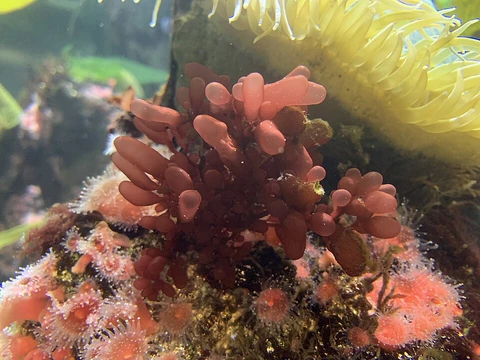
Coralline algae
Calcified red algae that build and stabilize marine reefs.

Coralline algae are a type of red algae belonging to the order Corallinales. Their cell walls are hardened by calcareous deposits, which gives them a stony texture. While most are pink or red, some species can appear purple, yellow, blue, white, or gray-green. These algae are ecologically important, especially in coral reefs, where they are grazed by sea urchins, parrotfish, limpets, and chitons. In the temperate Mediterranean Sea, they are the primary builders of a unique reef structure called the Coralligène.
These algae come in two main growth forms, though this division isn't based on taxonomy. Geniculate (or articulated) corallines are branching and tree-like, with flexible, non-calcified joints (genicula) separating the calcified segments (intergenicula). They attach to surfaces via a crust or calcified holdfasts. Nongeniculate (non-articulated) corallines form crusts that range from a few micrometers to several centimeters thick. These crusts can be thin and leafy or thick and firmly attached, and they grow on rock, coral, shells, other algae, or seagrasses. Some are parasitic or grow partly inside other corallines. Many produce knobby protrusions, and some become free-living, rounded forms called rhodoliths, whose complexity boosts species diversity.
Growth is slow, especially for encrusting types, which expand by 0.1 to 80 millimeters per year. All corallines start as a crust; some later develop fronds. The thallus has three layers: hypothallus, perithallus, and epithallus, with the epithallus shedding periodically.
Because they contain calcium carbonate, coralline algae fossilize well and are important as stratigraphic markers in petroleum geology. Their calcite crystals are elongated perpendicular to the cell wall and often contain magnesium. Higher magnesium content makes the deposits more soluble in cold ocean water, making some species vulnerable to ocean acidification.
Their fossil record is complete and matches molecular data. Stem-group corallines appear in the Ediacaran Doushantuo formation, with later forms like *Arenigiphyllum*, *Petrophyton*, *Graticula*, and *Archaeolithophyllum*. True (crown group) corallines appear from the Jurassic onward, with an excellent record from the Early Cretaceous, consistent with molecular clocks.
Quick Facts
- Taxon
- Corallinales
Facts from the source article.
Lore & Background
Coralline algae have been divided into two groups based on growth forms: geniculate (articulated) and nongeniculate (nonarticulated). Geniculate corallines are branching, tree-like organisms with non-calcified sections (genicula) separating longer calcified sections (intergenicula). Nongeniculate corallines range from a few micrometres to several centimetres thick crusts, often very slow growing, and may occur on rock, coral skeletons, shells, other algae or seagrasses. Some are parasitic or partly endophytic on other corallines. Many coralline crusts produce knobby protuberances, and some are free-living as rhodoliths.
All corallines begin with a crustose stage; some later become frondose. The thalli can be divided into three layers: the hypothallus, perithallus and epithallus. The epithallus is periodically shed, either in sheets or piecemeal. Since coralline algae contain calcium carbonate, they fossilize fairly well. The calcite crystals composing the cell wall are elongated perpendicular to the cell wall and normally contain magnesium, with the magnesium content varying as a function of species and water temperature.
The fossil record of corallines matches their molecular history and is complete and continuous. Stem group corallines are reported from the Ediacaran Doushantuo formation. True (or crown group) corallines are found in rocks of Jurassic age onwards. The crown group corallines have an excellent fossil record from the Early Cretaceous onwards. The fossil record of nonarticulated forms is better than that of articulated forms. The Sporolithaceae tend to be more diverse in periods of high ocean temperatures; the opposite is true for the Corallinaceae.
Reader's Guide
Coralline algae play an important role in the ecology of coral reefs. Sea urchins, parrot fish, along with limpets and chitons feed on coralline algae. In the temperate Mediterranean Sea, coralline algae are the main builders of a typical algal reef, the Coralligène. Many corallines produce chemicals which promote the settlement of the larvae of certain herbivorous invertebrates, particularly abalone. Larval settlement is adaptive for the corallines because the herbivores remove epiphytes which might otherwise smother the crusts and preempt available light. This settlement is also important for abalone aquaculture, as corallines appear to enhance larval metamorphosis and the survival of larvae through the critical settlement period. It also has significance at the community level; the presence of herbivores associated with corallines can generate patchiness in the survival of young stages of dominant seaweeds. Coralline rock was used as building stone since ancient Greece. The group's internal taxonomy is in a state of flux; for many years, they were included in the order Cryptonemiales as the family Corallinaceae until, in 1986, they were raised to the order Corallinales. Molecular studies are proving more reliable than morphological methods in approximating relationships within the group. Recent advances in morphological classification based on skeletal ultrastructure are promising, with crystal morphology within the calcified cell wall found to have a high correspondence with molecular studies.
Did You Know?
- Coralline algae can be purple, yellow, blue, white, or gray-green, not just pink or red.
- Only one strictly freshwater coralline species exists: Pneophyllum cetinaensis.
- Coralline algae have been found as deep as 268 metres, making them some of the deepest photosynthetic multicellular organisms in the ocean.
- The group's diversity has closely tracked the efficiency of grazing herbivores; the appearance of parrotfish in the Eocene marked a spike in coralline diversity.
Position Within the Red Algae Lineage
Coralline algae occupy a place within Rhodophyta, one of the most ancient and species-rich phyla among eukaryotic algae. This lineage encompasses more than seven thousand formally recognized species distributed across over nine hundred genera, though ongoing taxonomic revisions continue to reshape these boundaries. The vast majority of red algal diversity falls within the class Florideophyceae, and the group is overwhelmingly marine, with multicellular seaweeds forming the bulk of its members. Only about five percent of species inhabit freshwater, tending toward warmer regions. Researchers have proposed that this limited freshwater representation traces back to an evolutionary bottleneck: the last common ancestor of the phylum shed roughly a quarter of its core genes, curtailing its capacity for adaptive diversification. Despite their name, red algae span a wide chromatic range—from bright green and soft pink to deep purple and near-black at depth—because the phycobiliprotein pigments that define the group do not always dominate the visible spectrum. Coralline algae, as calcium-carbonate-secreting members of this phylum, inherit this deep evolutionary heritage.
Cellular Architecture and Biochemical Identity
At the cellular level, red algae—and by extension their coralline relatives—display a suite of features found nowhere else in the algal world. Their cells lack both flagella and centrioles throughout the entire life cycle, and their chloroplasts are enclosed in a double membrane with unstacked, evenly spaced thylakoids and no surrounding endoplasmic reticulum. Photosynthetic pigments include chlorophyll a, carotenes, and lutein, but the signature accessory pigments are water-soluble phycobilins—phycocyanobilin, phycoerythrobilin, phycourobilin, and phycobiliviolin—organized into phycobilisomes on the thylakoid surface. Cell walls are bilayered: the outer layers carry the polysaccharides agarose and agaropectin, while the inner wall is predominantly cellulose. Energy reserves are stored as floridean starch, a highly branched amylopectin lacking amylose, scattered freely in the cytoplasm rather than confined within the chloroplast. Perhaps most distinctive are the pit connections and pit plugs that form during incomplete cytokinesis, leaving a small pore between daughter cells that is later sealed by a granular protein core. Red algae also harbor the most gene-rich plastid genomes known to science.
Reproductive Strategies and Life-Cycle Complexity
Red algae, including coralline species, typically reproduce sexually and follow an alternation of generations that may involve three distinct phases rather than the two seen in most other algae. Because they produce no motile sperm, fertilization depends on water currents carrying non-motile spermatia to a growing trichogyne, a filament that extends from the female organ until it meets the male gamete. In at least one documented case, the isopod Idotea balthica assists in dispersing gametes and facilitating fertilization. Asexual reproduction supplements the cycle through spore production, fragmentation, simple cell division, or the release of propagules, and the entire reproductive timing can be cued by changes in day length. Cytokinesis in red algae is characteristically incomplete: a small pore persists in the new cell partition, creating a pit connection. A pit plug—composed of tubular membranes surrounded by a granular protein core, sometimes flanked by cap membranes—then seals the gap. Primary pit connections link cells sharing a common parent, while secondary connections arise when a nucleated daughter cell fuses with a neighbor, a pattern visible in the order Ceramiales.
Ecological Significance and Human Connections
Coralline algae stand out within the red algal lineage for their ability to secrete calcium carbonate, a trait that makes them major architects of coral reef ecosystems. Their calcium-rich structures contribute to reef framework and habitat complexity in ways that parallel the work of animal corals. Beyond their ecological role, red algae have long been woven into human food systems: Palmaria palmata, known as dulse, and Porphyra species, consumed as laver, nori, or gim, are staple ingredients across European and Asian cuisines. The outer cell walls of red algae yield agarose and agaropectin, which can be extracted by boiling to produce agar, while carrageenans and other polysaccharides serve as food additives in countless processed products. Environmental conditions such as pH shifts, salinity changes, light intensity, and nutrient availability all modulate the concentration of photosynthetic products; for instance, rising salinity stimulates increased floridoside production to help cells retain water. These biochemical responses underscore how tightly coralline and other red algae are coupled to their surrounding chemistry.
Frequently Asked Questions
Who is Coralline algae?
Coralline algae are a group of calcified red algae in the order Corallinales, instantly recognizable by the mineral-hardened, stony texture of their cell walls. Over 1,600 non-geniculate species have been formally described, and the AlgaeBase database recognizes 12 distinct families within the group.
What are Coralline algae's powers/role?
Their signature ability is building and stabilizing marine reef frameworks using calcium carbonate deposits, effectively acting as living cement for coastal ecosystems. In the temperate Mediterranean they are the sole architects of the Coralligène, a reef structure unique to that region.
Why is Coralline algae important?
They provide structural habitat, bind reef frameworks together, and support biodiversity from the surface all the way down to a recorded depth of 268 meters. Their growth rates span an extraordinary range of 0.1 to 80 mm per year, letting them thrive under very different environmental pressures.
What does Coralline algae look like?
Most species show shades of pink or red, but others can appear purple, yellow, blue, white, or gray-green depending on the species and local conditions. They grow in two broad morphological forms, though this visual split does not map neatly onto a single taxonomic category.
More in Red Macroalgae and Coralline Algae 1-24
Spotted an error? Know more?
Reader corrections go straight into our review queue. Suggest an edit · How this site is sourced