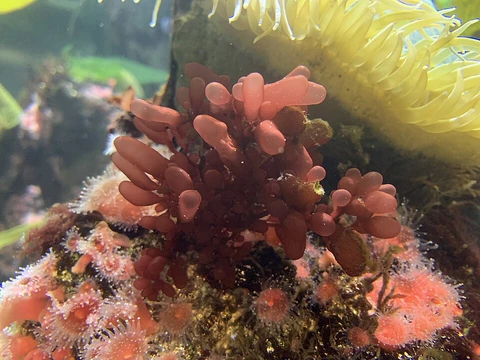
Ceramium
A genus of small red algae with pincer-like branch tips.

Ceramium is a genus of red algae (Rhodophyta) comprising a large number of species, with at least 15 species recorded in the British Isles. The genus is notable for its small size, distinctive pincer-like branch tips, and the taxonomic revision that reassigned the formerly used name Ceramium rubrum (an illegitimate name) to several distinct species.
Quick Facts
- Taxon
- Ceramium
Facts from the source article.
Lore & Background
All species of Ceramium are small algae growing to no more than 30 cm in length. They consist of a terete monosiphonous axis of cells surrounded by smaller cells forming a cortex. In most species this is a continuous cortex enclosing the axis, while in others the cortical cells are arranged only in nodes at the junctions of cells of the axes. The tips of the branches grow in a pincer-like manner. Species in the genus show irregular branching and are attached by unicellular or branched rhizoids.
The fully corticated group previously referred to as Ceramium rubrum, an illegitimate name, is represented in the British Isles by Ceramium pallidum, Ceramium botryocarpum, Ceramium nodulosum and Ceramium secundatum. The genus is dioecious, forming spermatangia and carpogonia on separate male and female plants. The fertilised carpogonium develops growing parasitically attached to the female plant. Tetraspores are born in the cortical bands.
Distribution in the British Isles includes Scotland (Orkney and Faroes, Shetland, Ross and Cromarty, Fife), England and Wales (Pembroke, Hampshire, Dorset, Devon and Cornwall, Sussex, Lincoln to Kent, Norfolk, and the Channel Isles), and Ireland (Cork, Kerry, Clare, Mayo, Waterford, Dublin, Donegal, Antrim and Down). Worldwide, some species are probably cosmopolitan, with records from the north-west Atlantic, Iceland, Norway to Spain, Denmark, Netherlands, France, Portugal, Mediterranean, Azores, Canary Islands, Cape Verde Islands, USA (Newfoundland to New York), and Australia.
Reader's Guide
The genus Ceramium holds significance as a large and widely distributed group of red algae, with at least 15 species in the British Isles alone. Its taxonomic history includes the recognition that the name Ceramium rubrum is illegitimate, and the fully corticated forms previously grouped under that name are now assigned to distinct species: Ceramium pallidum, Ceramium botryocarpum, Ceramium nodulosum, and Ceramium secundatum. This revision underscores the importance of careful morphological and taxonomic study in red algae. The genus is characterized by small size (up to 30 cm), a terete monosiphonous axis with a cortex that may be continuous or nodal, and distinctive pincer-like branch tips. Its reproductive strategy is dioecious, with tetraspores borne in cortical bands. The distribution of Ceramium is extensive, ranging from the British Isles and the north-west Atlantic to the Mediterranean, the Azores, the Canary and Cape Verde Islands, the eastern coast of the United States, and Australia, with some species considered probably cosmopolitan. This wide geographic range and the taxonomic clarification of its species contribute to its legacy as a well-studied but still evolving group within red algal research.
Did You Know?
- The name Ceramium rubrum is illegitimate and has been replaced by several distinct species in the British Isles.
- All Ceramium species grow to no more than 30 cm in length.
- The tips of Ceramium branches grow in a pincer-like manner.
- Tetraspores are born in the cortical bands of the algae.
Frequently Asked Questions
What is Ceramium?
Ceramium is a genus of small red algae (Rhodophyta) that encompasses a large number of species. It is especially well represented in the British Isles, where at least 15 species have been recorded.
What does Ceramium look like?
The genus is immediately recognizable by its distinctive pincer-like branch tips. Individuals are generally small, reaching a maximum length of about 30 cm (12 inches).
Where can I find Ceramium in the wild?
Ceramium occurs across the north-west Atlantic and European waters, from Newfoundland to New York in the USA and from Iceland and Norway down to Spain, the Mediterranean, and the Azores. It is also recorded in the Canary Islands, Cape Verde Islands, and Australia.
What happened to the old name Ceramium rubrum?
Ceramium rubrum was an illegitimate name that had been lumped over what are actually several distinct species. A taxonomic revision split it apart, and those organisms are now properly recognized as separate species such as C. pallidum, C. botryocarpum, C. nodulosum, and C. secundatum.
Why does Ceramium matter to algae researchers?
The genus is a textbook case of how a single outdated name can mask real biodiversity, and its revision reshaped how the group is classified. With at least 15 valid species in the British Isles alone, it remains a rich subject for ongoing ecological and taxonomic study.
More in Red Macroalgae and Coralline Algae 1-24
Spotted an error? Know more?
Reader corrections go straight into our review queue. Suggest an edit · How this site is sourced