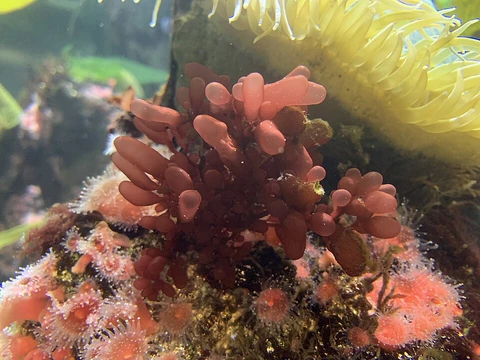
Corallinales
Calcified red algae that build and stabilize marine reefs.

Corallinales is an order of red algae (division Rhodophyta) characterized by a thallus containing calcareous deposits within its cell walls, giving it hardness. These algae are typically some hue of pink or another shade of red, but some species can be purple, yellow, blue, white, or gray-green. They are notable for their role in building and stabilizing coral reefs, and for their extensive fossil record, which makes them significant in petroleum geology.
Quick Facts
- Taxon
- Corallinales
Facts from the source article.
Lore & Background
Corallines have been divided into two groups based on growth forms: geniculate (articulated) and nongeniculate (nonarticulated). Geniculate corallines are branching, tree-like organisms with non-calcified sections (genicula) separating calcified sections (intergenicula). Nongeniculate corallines range from thin crusts to several centimeters thick, and may be free-living as rhodoliths. All corallines begin with a crustose stage; some later become frondose. Their thalli consist of three layers: hypothallus, perithallus, and epithallus, with the epithallus periodically shed.
The fossil record of corallines is complete and continuous. Stem-group corallines are reported from the Ediacaran Doushantuo formation, while true (crown group) corallines appear in rocks of Jurassic age onwards. The crown group has an excellent fossil record from the Early Cretaceous, consistent with molecular clocks. Nonarticulated forms have a better fossil record because the unmineralized geniculae of articulated forms break down quickly. The earliest known coralline deposits date from the Ordovician, though modern forms radiated in the Cretaceous.
Coralline algae are widespread in all of the world's oceans, often covering close to 100% of rocky substrata. They live from intertidal zones to depths of 270 meters. Some species tolerate brackish or hypersaline waters; only one strictly freshwater species exists: Pneophyllum cetinaensis. They are more common in higher latitudes and the Mediterranean, and their ability to calcify in low light makes them some of the deepest photosynthetic multicellular organisms in the ocean.
Reader's Guide
Coralline algae play an important ecological role in coral reefs. Sea urchins, parrot fish, limpets, and chitons feed on them. In the temperate Mediterranean Sea, coralline algae are the main builders of a typical algal reef called the Coralligène. Many corallines produce chemicals that promote the settlement of larvae of certain herbivorous invertebrates, particularly abalone, which is adaptive because the herbivores remove epiphytes that might otherwise smother the crusts. This settlement is also important for abalone aquaculture, as corallines enhance larval metamorphosis and survival through the critical settlement period. At the community level, the presence of herbivores associated with corallines can generate patchiness in the survival of young stages of dominant seaweeds.
Because coralline algae contain calcium carbonate, they fossilize well and are significant as stratigraphic markers in petroleum geology. Coralline rock was used as building stone since ancient Greece. The calcite crystals in their cell walls normally contain magnesium, and higher magnesium content makes deposits more soluble in ocean water, particularly in colder waters, making some deposits more vulnerable to ocean acidification. The group's internal taxonomy is in flux; molecular studies are proving more reliable than morphological methods, though recent advances in skeletal ultrastructure show promise. The diversity of corallines has closely tracked the efficiency of grazing herbivores; for instance, the appearance of parrotfish in the Eocene marked a spike in coralline diversity and the extinction of many delicately branched forms.
Did You Know?
- Coralline algae can grow as deep as 268 meters, making them some of the deepest photosynthetic multicellular organisms in the ocean.
- Only one strictly freshwater coralline species exists: Pneophyllum cetinaensis.
- The fossil record of corallines is complete and continuous, with stem-group forms reported from the Ediacaran Doushantuo formation.
Frequently Asked Questions
What is Corallinales?
Corallinales is an order of red algae (division Rhodophyta) whose defining trait is calcium carbonate deposited inside its cell walls, giving the thallus a hard, stony rigidity. The order spans 12 recognized families and includes more than 1,600 described non-geniculate species.
What colors can Corallinales display?
Most species show up in various pinks or reds, but the order is far from monochromatic—some taxa appear purple, yellow, blue, white, or gray-green. Color variation depends on the particular species and the light and chemistry of its local environment.
Where and how deep do Corallinales grow?
They are found from the intertidal zone all the way down to roughly 270 meters, with a maximum recorded depth of 268 m. Remarkably, the order also includes at least one freshwater species, Pneophyllum cetinaensis, which pushes the group beyond strictly marine habitats.
How fast do Corallinales grow?
Annual growth rates across the order range from a mere 0.1 mm to as much as 80 mm per year, depending on species and environmental conditions. That slow, steady accretion of calcified material is what lets colonies build the durable reef frameworks they are known for.
Why are Corallinales important to geology and reef ecology?
Their long, well-preserved fossil record makes them valuable index fossils in petroleum geology for correlating and dating sedimentary strata. In living marine ecosystems, their calcified thalli cement reef substrates, adding structural stability that helps coral communities persist.
More in Red Macroalgae and Coralline Algae 1-24
Spotted an error? Know more?
Reader corrections go straight into our review queue. Suggest an edit · How this site is sourced