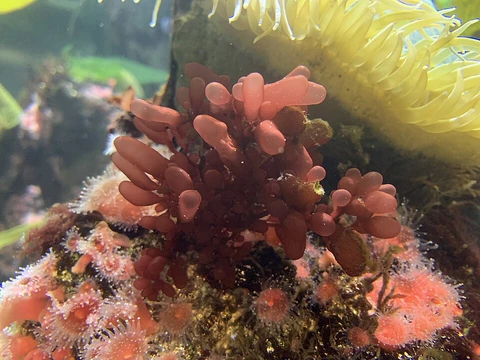
Clymene coleana
A monotypic red alga endemic to New Zealand.

Clymene coleana is a species of red algae belonging to the family Bangiaceae. It was previously classified as *Porphyra cinnamomea*. This alga is the sole member of the genus *Clymene*, which takes its name from the Greek mythological nymph Clymene, mother of Phaethon. The species is endemic to New Zealand.
The alga’s appearance changes with the seasons: it is grey in winter and fades to a golden color in summer. It has fine, finger-like lobes, and its cells are arranged in a single layer. The species is monoecious. *C. coleana* can be distinguished from three similar species—*P. cinnamomea*, *P. rakiura*, and *P. virididentata*—by several features. These include the microscopic arrangement of cells along the thallus margin, thallus shape, size, and color, as well as geographic, ecological, and seasonal distribution patterns. A key distinguishing trait is its chromosome number, which is n = 4. Additionally, these four species differ in a specific nucleotide sequence at the 18S rDNA locus.
*Clymene coleana* grows on rocky substrates in the upper intertidal zone of open coasts. Its range covers the coastlines of New Zealand’s North, South, and Chatham Islands.
Quick Facts
- Genus
- Clymene
- Species
- coleana
Facts from the source article.
Lore & Background
Clymene coleana was originally described as Porphyra cinnamomea before being placed in its own monotypic genus, Clymene. The genus name references the Greek mythological nymph Clymene, mother of Phaethon. This species is distinguished from related species—Porphyra cinnamomea (its former name), P. rakiura, and P. virididentata—by morphological traits such as the microscopic arrangement of cells along the thallus margin, thallus shape, size, and color, as well as geographical, ecological, and seasonal distribution patterns. A key distinguishing feature is its chromosome number, n = 4, and a particular nucleotide sequence at the 18S rDNA locus.
In winter, C. coleana appears grey, but in summer it bleaches to a golden color. It has fine, finger-like lobes and consists of cells in a single layer; it is monoecious. The species inhabits the upper intertidal zone on rock substrata on open coasts along the coastlines of New Zealand's North, South, and Chatham Islands.
Reader's Guide
Clymene coleana holds significance as the sole member of the genus Clymene within the family Bangiaceae. Its distinction from morphologically similar species—such as Porphyra cinnamomea, P. rakiura, and P. virididentata—relies on a combination of microscopic thallus margin cell arrangement, thallus shape, size, color, geographic and seasonal patterns, and notably its chromosome number (n = 4) and a specific 18S rDNA sequence. This species is endemic to New Zealand, occurring on the North, South, and Chatham Islands, and occupies the upper intertidal zone on rocky open coasts. Its seasonal color change from grey in winter to golden in summer, along with its fine finger-like lobes and monoecious single-layered cellular structure, further characterize it. The genus name's mythological origin adds a cultural dimension to its taxonomic history.
Did You Know?
- Clymene coleana is the only species in the monotypic genus Clymene.
- It was formerly known as Porphyra cinnamomea.
- Its chromosome number is n = 4.
Frequently Asked Questions
What is Clymene coleana?
Clymene coleana is a red alga in the family Bangiaceae that stands alone as the only species in its genus. It was long catalogued under the name Porphyra cinnamomea before being elevated into its own monotypic genus.
What does Clymene coleana look like?
It grows in fine, finger-like lobes with cells stacked in a single layer. Its color is strikingly seasonal: a muted grey in winter that shifts to a warm golden tone by summer.
Where can I find Clymene coleana in the wild?
This species is endemic to New Zealand, occurring on the North Island, South Island, and the Chatham Islands. It clings to rock substrata in the upper intertidal zone along open coasts.
What is the basic taxonomy and biology of Clymene coleana?
It sits in the family Bangiaceae, is monoecious, and carries a haploid chromosome number of n = 4. Its genus name honors the Greek nymph Clymene, mother of Phaethon, and the genus contains no other species.
How do I tell Clymene coleana apart from look-alike species?
Three similar species, including the former name Porphyra cinnamomea, can cause confusion in the field. The combination of its single-layered cell structure, finger-like lobe shape, and distinctive winter-grey-to-summer-gold color shift are the most reliable field marks.
More in Red Macroalgae and Coralline Algae 1-24
Spotted an error? Know more?
Reader corrections go straight into our review queue. Suggest an edit · How this site is sourced