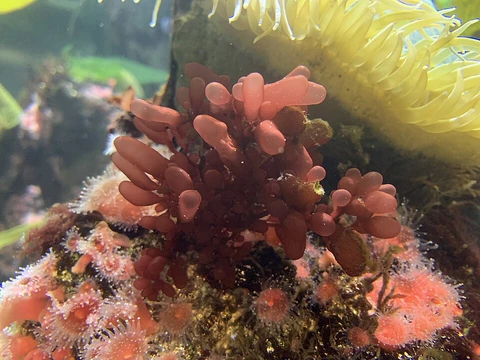
Pneophyllum cetinaensis
The only freshwater coralline alga, endemic to Croatia's Cetina River.

Pneophyllum cetinaensis is a species of coralline red algae endemic to the Cetina River in Croatia. It is notable as the only known coralline alga adapted to a strictly freshwater environment, marking a rare ecological and evolutionary transition from marine to freshwater ecosystems.
Quick Facts
- Genus
- Pneophyllum
- Species
- cetinaensis
Facts from the source article.
Lore & Background
Pneophyllum cetinaensis was first identified in 2016 in the Cetina River of southern Croatia. Its ancestor lived in brackish water and was already adapted to osmotic stress and rapid changes in water salinity and temperature. The species forms extensive and conspicuous crusts thickened with multi-layered flattened or curved branches, and its pore canals of simple conceptacles are not surrounded by specialised cells. It colonizes submerged limestone in fast-flowing, well-oxygenated, calcium-rich freshwater, and the river's karstic hydrology and chemical stability are thought to have facilitated this marine-to-freshwater transition. Unlike marine relatives that use high-magnesium calcite, P. cetinaensis calcifies using low-magnesium calcite, though its mechanical properties such as stiffness and elasticity remain comparable.
Reader's Guide
The significance of Pneophyllum cetinaensis lies in its challenge to the traditional assumption that coralline algae are strictly marine organisms. Its adaptation to freshwater provides a rare living example of biome transition, offering insights into the evolutionary plasticity of Rhodophyta under extreme environmental pressures. The case suggests that physiological traits such as calcification, once thought to be marine-restricted, can persist in freshwater given the right geochemical conditions. This discovery also raises questions about the evolutionary history and genetic mechanisms enabling such a transition. As a unique model for studying biomineralization and ecological adaptation in non-marine settings, its calcified structure in freshwater suggests novel strategies of ion regulation and metabolic flexibility. Being endemic to a single karstic river system in Croatia, the species may be vulnerable to pollution, hydrological changes, and climate-related impacts, underscoring the need for conservation efforts and further research to understand its ecological role and ensure its survival.
Did You Know?
- Pneophyllum cetinaensis is the only known species of freshwater coralline algae endemic to Croatia.
- It calcifies using low-magnesium calcite, unlike marine coralline algae that use high-magnesium calcite.
More in Red Macroalgae and Coralline Algae 1-24
Spotted an error? Know more?
Reader corrections go straight into our review queue. Suggest an edit · How this site is sourced