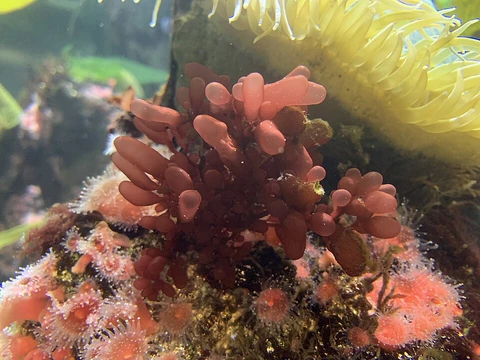
Phycodrys rubens
A perennial red alga with oak-like fronds and ruffled margins.

Phycodrys rubens is a perennial red seaweed, reaching lengths of up to 30 centimeters. Its flat, leaf-like blades, which can be 3 centimeters wide, are made of a single layer of cells—a structure called monostromatic. Each blade has a clear central mid-rib, paired lateral veins branching from it, and a ruffled, wavy edge. The plant anchors itself with a small disk-shaped holdfast, from which a stem-like axis supports the blades. This species resembles *Delesseria sanguinea*, another strongly red alga, but differs in having a toothed margin rather than a smooth one; its frond shape is also reminiscent of an oak leaf.
Reproduction involves separate male and female plants (dioecious gametophytes). Reproductive structures appear along the blade margins: cystocarps grow as branches attached to the veins, while tetrasporangial sori form near the tips of the larger bladelets.
Commonly found in the littoral and sublittoral zones, *Phycodrys rubens* inhabits low rock pools and attaches to the stipes of larger algae like *Laminaria*. It can be found at depths down to 30 meters. Its distribution spans the North Atlantic, from Spitzbergen to Portugal and Canada, and it is common along the shores of Ireland, Wales, the Isle of Man, Scotland (including the Shetland Islands), and parts of England—though it is absent from the south-east of England. The fronds adhere well to paper and can be dried to make fine herbarium specimens.
Quick Facts
- Genus
- Phycodrys
- Species
- rubens
Facts from the source article.
Lore & Background
Phycodrys rubens is a perennial seaweed that grows from a small disk holdfast with an axis to the blades. Its flat blades are monostromatic, up to 3 cm wide, and have a ruffled margin with veins growing out from a central mid-rib in paired lateral veins. The shape of the frond is similar to the leaf of an oak tree. It is somewhat similar to Delesseria sanguinea, which is also strongly red but has a smooth, not dentate, margin. The reproductive structures are found at the margins of the blades: cystocarps as branches attached to the veins, and tetrasporangial sori near the apices of larger bladelets. The gametophytes are dioecious, with male and female phases on separate plants. The fronds adhere well to paper and can be dried to make fine specimens.
Reader's Guide
Phycodrys rubens is a red alga commonly found in the littoral and sub-littoral zones, in low rock pools and attached to the stipes of large algae such as Laminaria, to a depth of 30 m. Its distribution spans the North Atlantic from Spitzbergen to Portugal and Canada, and it is common on the shores of Ireland, Wales, Isle of Man, Scotland including the Shetland Islands, and the north-east and south-east of England (though notably absent from the south-east of England). The species is distinguished by its oak-leaf-shaped fronds with ruffled margins and a clear mid-rib, setting it apart from similar species like Delesseria sanguinea. Its perennial nature and ability to be dried for specimens contribute to its recognition among red macroalgae.
Did You Know?
- Phycodrys rubens can grow up to 30 cm long and 3 cm wide.
- Its blades are monostromatic, meaning they consist of a single flat layer of cells.
- The species is dioecious, with male and female reproductive phases on separate plants.
Frequently Asked Questions
Who is Phycodrys rubens?
Phycodrys rubens is a perennial red seaweed of the North Atlantic, easily spotted by its flat, oak-leaf-shaped blades with ruffled, toothed edges. It grows up to 30 centimeters long and clings to rock via a small disk-shaped holdfast that supports a short stem-like axis.
What are Phycodrys rubens's distinguishing features?
Every blade is monostromatic, meaning it is only a single cell layer thick, yet still displays a bold central mid-rib with paired lateral veins branching outward. Its strongly red coloration and wavy, toothed margin give it a look quite unlike smoother-edged relatives.
Where can you find Phycodrys rubens in the wild?
It stretches from Spitzbergen down to Portugal and across to Canada, being especially common on the rocky shores of Ireland, Wales, the Isle of Man, and Scottish coasts including the Shetland Islands. It inhabits the intertidal zone and can be found at depths down to about 30 meters.
How does Phycodrys rubens reproduce?
The species is dioecious, so each individual plant functions as either a male or a female gametophyte rather than combining both roles in one thallus. This means successful fertilization requires the proximity of two separate, opposite-sex individuals.
How is Phycodrys rubens different from Delesseria sanguinea?
Although both are strongly red, perennial algae, Phycodrys rubens has a clearly toothed, ruffled blade margin while Delesseria sanguinea shows a smooth edge. The overall frond shape of Phycodrys also leans more toward an oak-leaf silhouette, making the two easier to tell apart in the field.
More in Red Macroalgae and Coralline Algae 1-24
Spotted an error? Know more?
Reader corrections go straight into our review queue. Suggest an edit · How this site is sourced