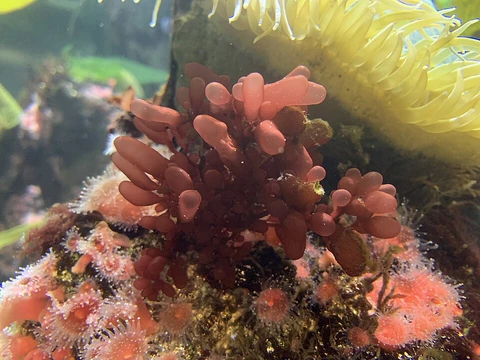
Lithophyllum
A genus of crustose red algae with a long fossil record.

Lithophyllum is a genus of crust-forming red algae in the family Corallinaceae. Its thalli are monomerous and crustose, built from a single system of filaments that grow tightly against the underlying surface. The alga reproduces through conceptacles, and its outer layer, the epithallus, is periodically shed to prevent other organisms from settling on it.
The genus has a rich fossil record, spanning from the Silurian period to the Quaternary (roughly 418.7 million years ago to the present). Fossils assigned to Lithophyllum have been recovered across Europe, the United States, South America, Egypt, Iran, Iraq, India, Japan, and Australia.
Quick Facts
- Taxon
- Lithophyllum
Facts from the source article.
Lore & Background
The monomerous, crustose thalli of Lithophyllum are composed of a single system of filaments that grow close to the underlying surface. The alga reproduces by means of conceptacles. A notable characteristic is that the epithallus is periodically shed to avoid organisms growing on top of the alga.
The genus is known in the fossil record from the Silurian to the Quaternary, spanning from about 418.7 to 0.0 million years ago. Fossils of species within this genus have been found in Europe, United States, South America, Egypt, Iran, Iraq, India, Japan, and Australia.
The valid species currently considered to belong to this genus are listed in the source article, though the article does not enumerate them. The genus was first described by Philippi in 1837, with subsequent systematic work by Foslie in 1900 and Woelkerling in 1998.
Reader's Guide
Lithophyllum holds significance as a well-documented genus of coralline red algae with a fossil record extending from the Silurian to the Quaternary. Its crustose, monomerous thalli and reproductive structures (conceptacles) are key characteristics. The periodic shedding of the epithallus is an adaptation to prevent overgrowth by other organisms. The genus has been studied by multiple researchers, including Philippi (1837), who first demonstrated that nullipores are plants, and Foslie (1900), who revised the Melobesieae. Woelkerling (1998) further contributed to the systematic understanding of non-geniculate coralline red algae. Fossils have been recovered across a wide geographic range, including Europe, the Americas, Asia, and Australia, indicating a global distribution in the past. The genus remains a subject of taxonomic study, as reflected in modern databases such as AlgaeBase.
Did You Know?
- Lithophyllum belongs to the family Corallinaceae.
- Its fossil record spans from the Silurian to the Quaternary, about 418.7 to 0.0 million years ago.
More in Red Macroalgae and Coralline Algae 1-24
Spotted an error? Know more?
Reader corrections go straight into our review queue. Suggest an edit · How this site is sourced